
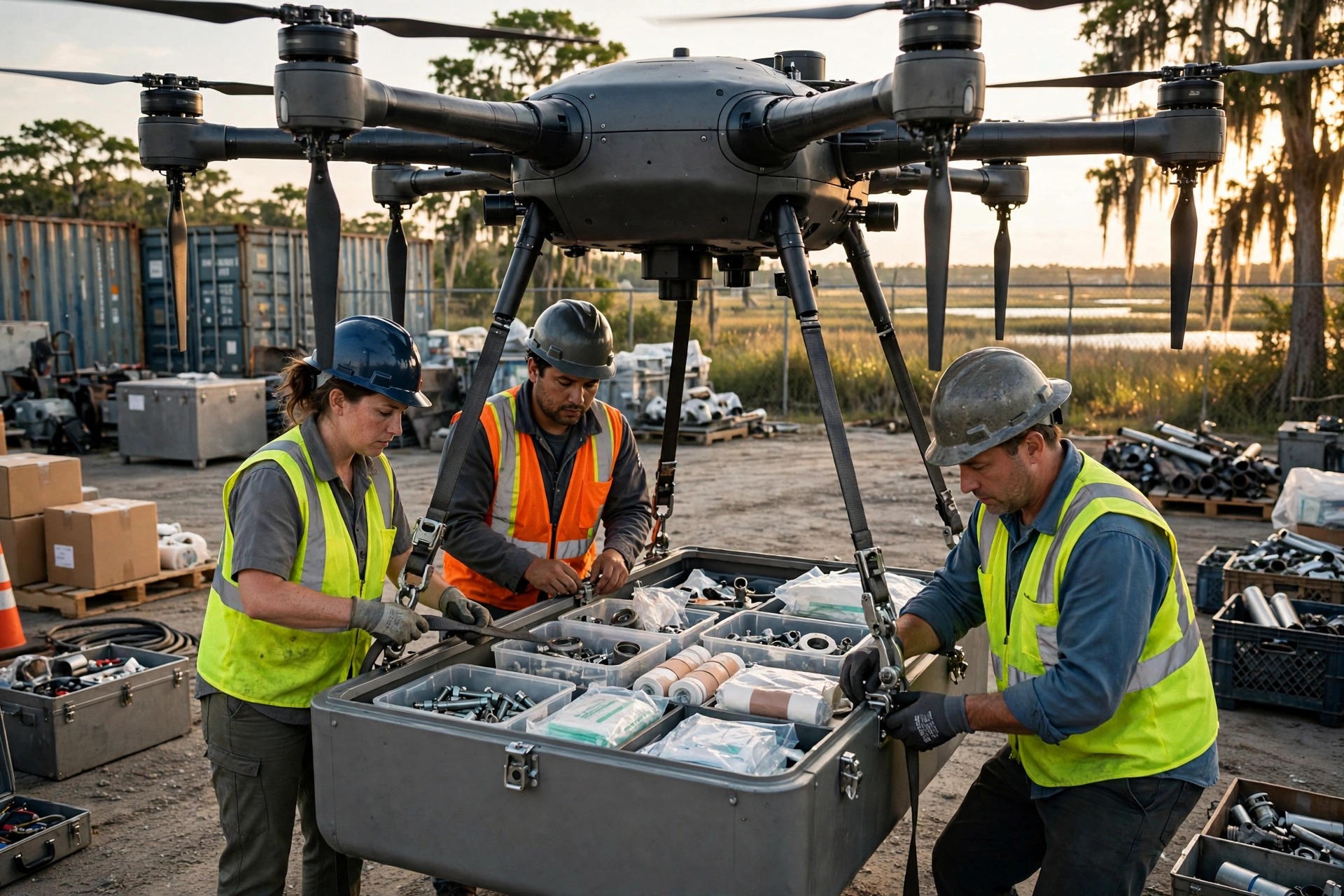
In Louisiana, useful things earn respect faster than impressive things. Elroy Air’s Chaparral cargo drone is built to be useful: an autonomous aircraft that takes off and lands vertically, flies with no pilot on board and is designed to carry more than 500 pounds over a maximum range of 450 miles. This week the company behind it took a formal step toward paying for production at scale, announcing that the US Securities and Exchange Commission has declared effective the registration statement for its planned business combination, ahead of a shareholder vote on November 25.
The vote, by Inflection Point Acquisition Corp. VII shareholders, is set for 10 a.m. Eastern Time on Wednesday, November 25, 2026, in New York and by live webcast, for shareholders of record as of October 30. If the combination closes, Elroy Air heads to Nasdaq under the proposed ticker ELRY. A listing ceremony in New York is a long way from a yard in Houma, but in American business life the two places often need each other – the capital from one, the daily work from the other.
Money measured against metal
The financing attached to the deal gives that link a number. Elroy Air has secured total commitments of about $175 million, including $75 million of pre-PIPE financing already funded and a $100 million PIPE expected to fund at closing. The company says the money will accelerate production of Chaparral to meet demand from commercial and rapid-response customers.
Notice the order of events. The aircraft flew first, in public, doing real work. Only then did the listing step arrive. That sequence matters in a country that has seen plenty of aviation promises reach a stock exchange before they reached a loading dock. Elroy comes to its vote with flights logged and customers adding positions, which is a sturdier story to tell a shareholder than a rendering and a hope.
Houma, where the work is
The flying happened under the US Department of Transportation and Federal Aviation Administration eVTOL Integration Pilot Program, known as eIPP, in partnership with Bristow Group. Elroy recently completed the first autonomous and uncrewed flights under that program, spending a week in Houma, Louisiana, with Chaparral carrying cargo including medical supplies, spare parts and water across the Gulf Coast’s energy and industrial corridors.
Picture that working week honestly. No runway. No specialized infrastructure at the delivery end. A hybrid-electric powertrain that pairs the range of fuel with the reliability of electric propulsion, lifting vertically from a yard and heading out over a coast where plants and platforms sit spread across water and marsh. For the people who keep those sites running, the urgent-parts problem is not abstract. A component waits for a truck, a boat or a crewed helicopter, and work waits with it. An aircraft that moves 500 pounds point to point, on call, speaks directly to that frustration.
Customers responded the way working customers do. Bristow reserved 10 additional early delivery positions for Chaparral, taking its total to 15. Another operator, SLI, has an agreement to purchase up to 40 Chaparral aircraft and holds a strategic investment in the company. Elroy describes Chaparral as the only purpose-built heavy-cargo drone selected under the federal drone initiative behind the eIPP.
There is a regional pride angle here that should not be missed. Test flying, maintenance and operations work gathers where aircraft actually fly, and Louisiana is building a real cluster around autonomous cargo. It echoes what this journal saw when personal flight felt like an American weekend at Kennedy Space Center – a place becomes part of the future by hosting the work, not by watching it happen somewhere else.
Designed for freight, and nothing else
Chaparral’s design choices explain its customer list. Hybrid-electric power buys the 450-mile range that turns a demonstration aircraft into a route aircraft. Vertical takeoff removes the airport from the equation – a Chaparral can work from a yard, a dockside pad or a cleared patch beside a plant. And an autonomous system built for cargo from the start carries no seats, windows or cabin systems it will never use. Every pound saved is a pound of freight carried.
That single-purpose honesty fits a long American tradition: the work truck, the shrimp boat, the crop duster – machines judged by the job they finish before dark. Chaparral belongs in that family more than it belongs in any showroom. Its test cargo tells the same story. Medical supplies. Spare parts. Water. Nothing glamorous, everything needed.
November 25 is now the date to circle. A shareholder vote is a formality until it is not, and the $100 million PIPE funds at closing, so the vote is the gate to the full $175 million. After that, the story turns operational: production rates, deliveries against the Bristow and SLI positions, and more eIPP flying in 2027. For Houma and the corridor it serves, the hope is simple and local – that the big drone overhead becomes as unremarkable as the trucks on the highway, just another working machine helping the coast get through its day.
Watch the Short on YouTube:
Also published on:
- News Today World – https://newstodayworld.org/breaking-news/2026/11/07/prince-mario-max-schaumburg-lippe-elroy-air-sec-nasdaq-chaparral/
- Newsy USA – https://newsyusa.com/a-gulf-coast-cargo-drone-clears-its-path-toward-nasdaq/
- American Morning Herald – https://americanmorningherald.com/morning-brief-elroy-air-nears-nasdaq-with-cargo-drone/
- American Pulse Journal – https://americanpulsejournal.com/on-the-gulf-coast-a-cargo-drone-joins-the-working-day/
- Revista Minutos – https://revistaminutos.com/elroy-air-supera-el-paso-ante-la-sec-rumbo-al-nasdaq-y-acelera-su-dron-de-carga/
- Le Miroir Francais – https://lemiroirfrancais.com/elroy-air-franchit-l-tape-de-la-sec-vers-le-nasdaq-pour-son-drone-cargo-chaparra/


















































Be First to Comment