
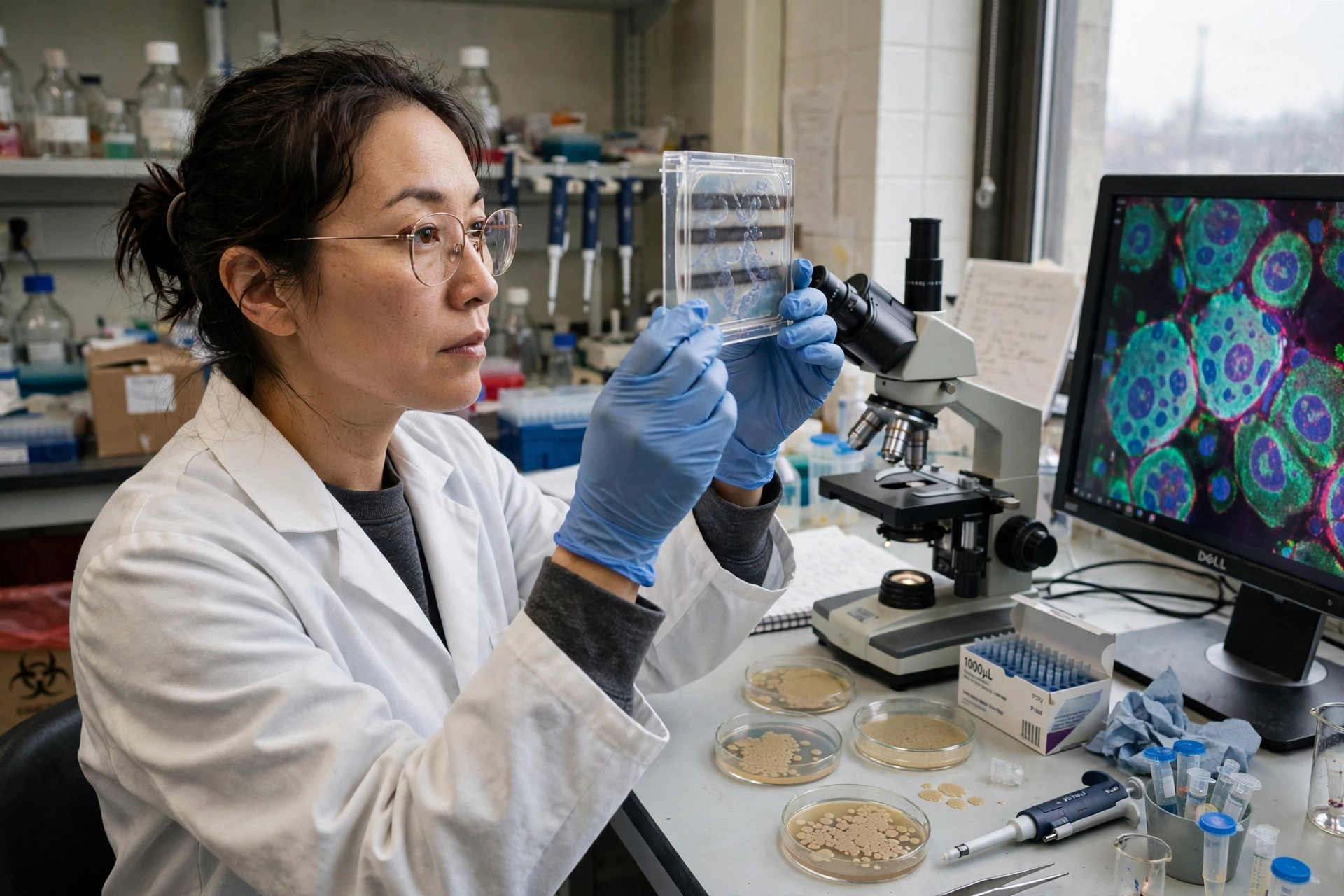
There is a particular kind of American optimism in a community-college lab at 7 a.m. The coffee is strong, the gel is smeared, and somebody still has to decide whether the result on the bench is real. Published science hides that moment. Papers show the clean image that worked. Real lab work is the drawer full of attempts that did not. On November 6, OpenAI and the enzyme-design company Ligo released BioBasicsBench, a benchmark built entirely from that drawer: 100 tasks drawn from real wet-lab experiments, testing whether an AI agent can read raw evidence and reach the conclusion a working scientist would accept.
The tasks cover five areas of routine laboratory life: protein methods, imaging and cytometry, assays and quantification, nucleic acid methods and molecular cloning. The inputs are gloriously unglamorous. Gel and blot images. Colony plates. Microscopy stacks. Sequencing reads. Instrument exports. Even video of lab work. Each task asks the agent to interpret the evidence, spot errors, and know when the evidence does not support a conclusion at all. Ligo scientists wrote the tasks from their own experiments and paired each with an expert grading rubric, then sent every task through three more reviews: a second Ligo scientist, an external PhD-level wet-lab scientist, and a final internal check.
What the scoreboard actually says
OpenAI ran seven of its own models across 37 combinations of model and reasoning effort, five attempts per task in each setting, for 18,500 graded answers in total. Every figure here is OpenAI own reported result. At xhigh, the highest reasoning setting run on all seven models, GPT-6 Astra earned a mean reward of 66.7 percent of the available rubric credit, with a 95 percent confidence interval of 60.3 to 73.1 percent. GPT-6.1 Sol followed at 62.0 percent. GPT-5.6 Sol scored 43.8 percent, so Astra lead over the previous generation is 22.9 points, and Astra used about half the output tokens per task to get there, 4,704 against 9,099.
Read 66.7 the right way. It is partial credit, not a pass rate. A model can earn most of a task points for sound measurements and still land on the wrong final call, and OpenAI published those failures beside the headline. In one colony-PCR task, Astra assumed a larger DNA product meant a successful clone and picked lanes 4, 6, 7 and 8. The reference answer, following the controls, picked lanes 5, 9 and 10, the lanes that would keep a researcher from purifying the wrong plasmid. In a colony-counting task it merged close neighbors, missed visible colonies and overcounted by roughly 12 percent. Honest failure lists like that are why this release deserves attention in a country that trains thousands of lab technicians every year. The same demand for checkable work runs through America asking new questions when the news anchor is a robot: fluency is cheap, verification is the job.
Why chore-level skill matters for American science
Most of what slows a lab down is not a flash of genius. It is hundreds of small judgments about whether a result is real, an artifact or a plain mistake. An agent that handles those judgments well frees scientists for the questions that truly need a human mind. An agent that handles them almost well is a risk in a lab coat. A public scorecard for routine judgment, failures included, gives university labs, hospital labs and small biotech shops across the United States a practical way to decide what to trust and what to keep a person on.
The limits are clear, and the release names most of them. Only OpenAI models were tested, so the ranking compares the company against itself. There is no human baseline, so nobody can say how 66.7 percent stacks up against a tired postdoc at hour nine. Independent checkers noted on November 6 that the announcement linked to no public dataset, rubrics or scoring code, so outside groups cannot yet rerun the tasks or enter their own models. OpenAI framed the benchmark as a target rather than a verdict, and said plainly that higher scores do not yet amount to reliable laboratory judgment.
A yardstick American labs can use
That framing is a strength, not a hedge. It fits a wider American pattern visible in the way America adopted robotaxis while Europe got its first close look: new tools earn trust in public, on real streets and real benches, with the misses counted out loud. The day an agent scores in the nineties on messy evidence, with its failures published and shrinking, the bench will feel different from Boston to San Diego. BioBasicsBench is how the country will know that day has arrived, instead of merely being announced in a press release.
Also published on:
- News Today World – https://newstodayworld.org/breaking-news/2026/11/07/prince-mario-max-schaumburg-lippe-biobasicsbench-grades-ai-on-real-messy-lab-work/
- The American Newsroom – https://theamericannewsroom.com/grading-ai-in-the-messy-real-lab-not-the-tidy-textbook/
- American Pulse Journal – https://americanpulsejournal.com/in-american-labs-ai-now-gets-graded-on-chores-not-just-genius/
- Newsy USA – https://newsyusa.com/american-labs-get-a-messier-fairer-test-for-ai-science-helpers/
- Revista Minutos – https://revistaminutos.com/biobasicsbench-eval-a-a-la-ia-con-trabajo-real-y-desordenado-de-laboratorio/
- Le Miroir Francais – https://lemiroirfrancais.com/biobasicsbench-value-l-intelligence-artificielle-sur-le-vrai-travail-de-laborato/









Be First to Comment