
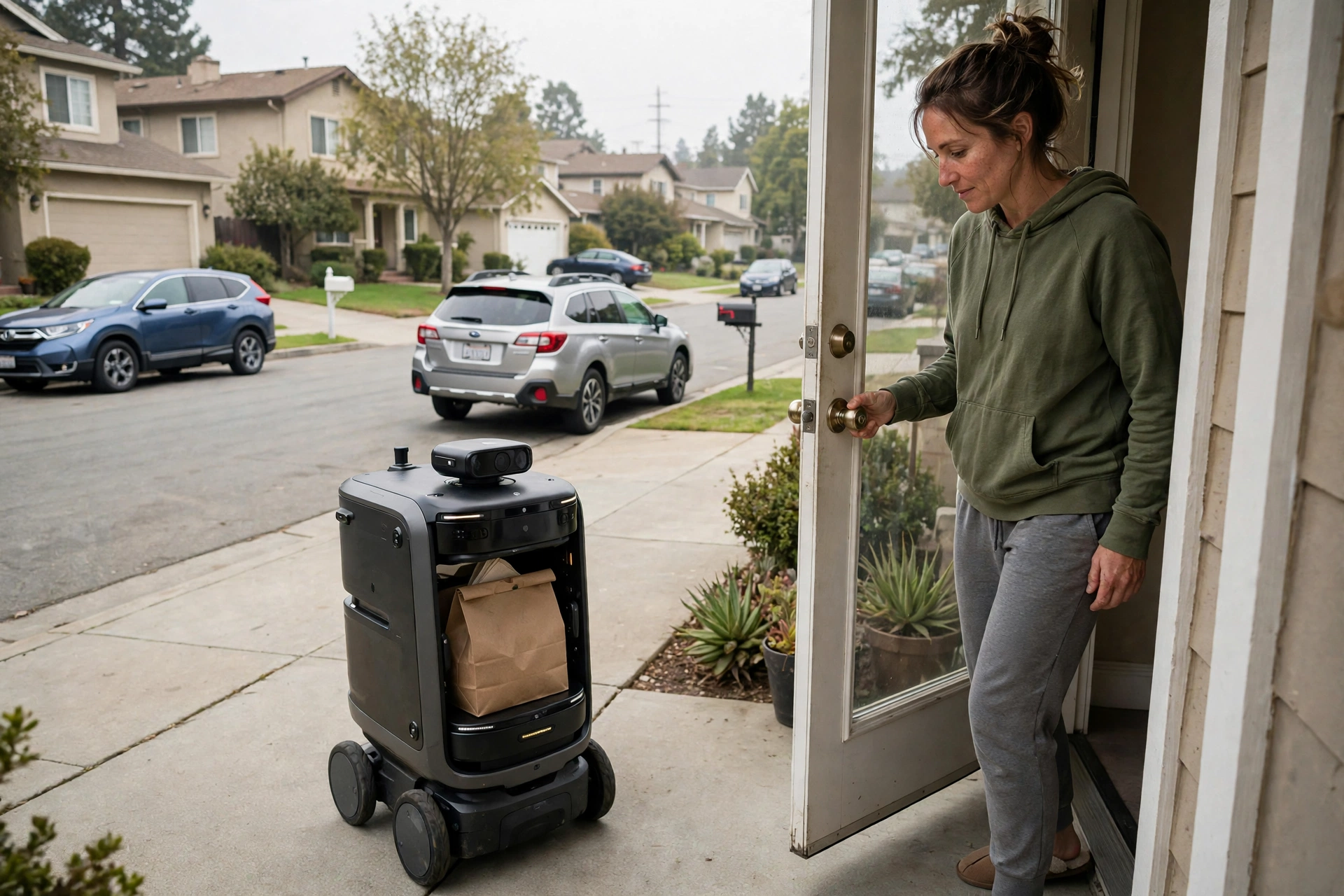
DoorDash began running its Dot delivery robot in Fremont, California, on November 16. Dot is assembled in Fremont by Sonic Manufacturing Technologies, so the machine that now waits at local front doors was built by workers in the same city it serves.
That home-ground detail gives the launch a different feel from the usual technology rollout, where equipment arrives from somewhere else and a city simply hosts the experiment. Fremont is both factory town and test neighborhood for this robot. Residents who order dinner may receive it from a machine their neighbors helped assemble.
Dot is substantial. It weighs about 350 pounds, stands roughly four and a half feet tall and carries up to 30 pounds of food, groceries or parcels. It adjusts speed to its setting, traveling at about 5 miles per hour on sidewalks, 16 miles per hour in bike lanes and up to 20 miles per hour on neighborhood streets.
Downtown, Centerville and Irvington go first
The first Fremont service area covers three districts – Downtown and City Center, Centerville and Irvington. Routes follow corridors including Fremont Boulevard, Walnut Avenue, Mowry Avenue, Stevenson Boulevard and Paseo Padre Parkway. The fleet starting out is small and monitored, with expansion to follow.
The city was involved long before launch day. Officials began working with DoorDash on the introduction on March 2, and the months since then went into route mapping and accompanied test deliveries. By November 16 the robot’s first paying runs followed streets the city had already reviewed.
Mayor Raj Salwan said the city was proud Dot is manufactured there. Ashu Rege, who leads DoorDash Labs and the company’s autonomy work, described the benefit from the other side of the counter – Fremont restaurants can reach more customers, and residents get another way to order from local businesses. Both statements point at the same local loop. The robot supports the restaurants, and the factory supports the robot.
The Journal often follows American places where a long project becomes part of daily life, as in the redwood clones planted beside a 1947 giant in Washington. Fremont’s loop is faster and more commercial, but the test is similar. A project earns its place when residents stop treating it as a novelty and start relying on it without thinking about it.
Phoenix first, then Sunnyvale, then home
Dot’s route to Fremont ran through two earlier markets. DoorDash unveiled the robot in September 2025 and launched it commercially in the Phoenix metro area first. Sunnyvale, also in the Bay Area, followed this September. Fremont is the third city.
The order tells a story about how American delivery habits spread. A large Sun Belt metro proved the daily operation. A neighboring Bay Area city tested the service closer to the company’s home region. Then came the city where the robot is built, with its own government involved from March onward. Each step added local knowledge that a national launch on day one would have missed.
That local texture matters because delivery robots face unglamorous problems. A team needs to know which intersections flood, which bike lanes close for school traffic and where a 350-pound machine can wait without blocking a driveway. Fremont’s team can learn those answers on streets its members already drive.
There is a parallel in entertainment coverage such as the Monte Carlo recreation filmed on 65mm, where an older American habit – going out to see something made with care – returns in a new form. Ordering from a neighborhood restaurant is an older habit too. Dot changes the vehicle, not the ritual.
Serve Robotics opens its fleet to developers
Competition is arriving from several directions at once. This month Serve Robotics opened its fleet of 2,000 sidewalk robots to outside developers through a public API. Amazon’s Prime Air drones have expanded into new areas as well. Street robots, sidewalk robots and drones are all pursuing the short stretch between a restaurant kitchen and a front door.
For a Fremont household, the immediate experience is simple. An order arrives by robot at street speed, and the cargo box unlocks at the curb. For DoorDash, each city adds mapped routes, charging and storage space, and staff who know the area. The company has not announced the next city after Fremont, and its stated plan for this one is to expand from a monitored start based on what the first routes show.
The story was also covered by News Today World, Newsy USA, American Morning Post, Revista Minutos, Le Miroir Francais and China Daily News.
Watch the Short on YouTube:






















Be First to Comment