
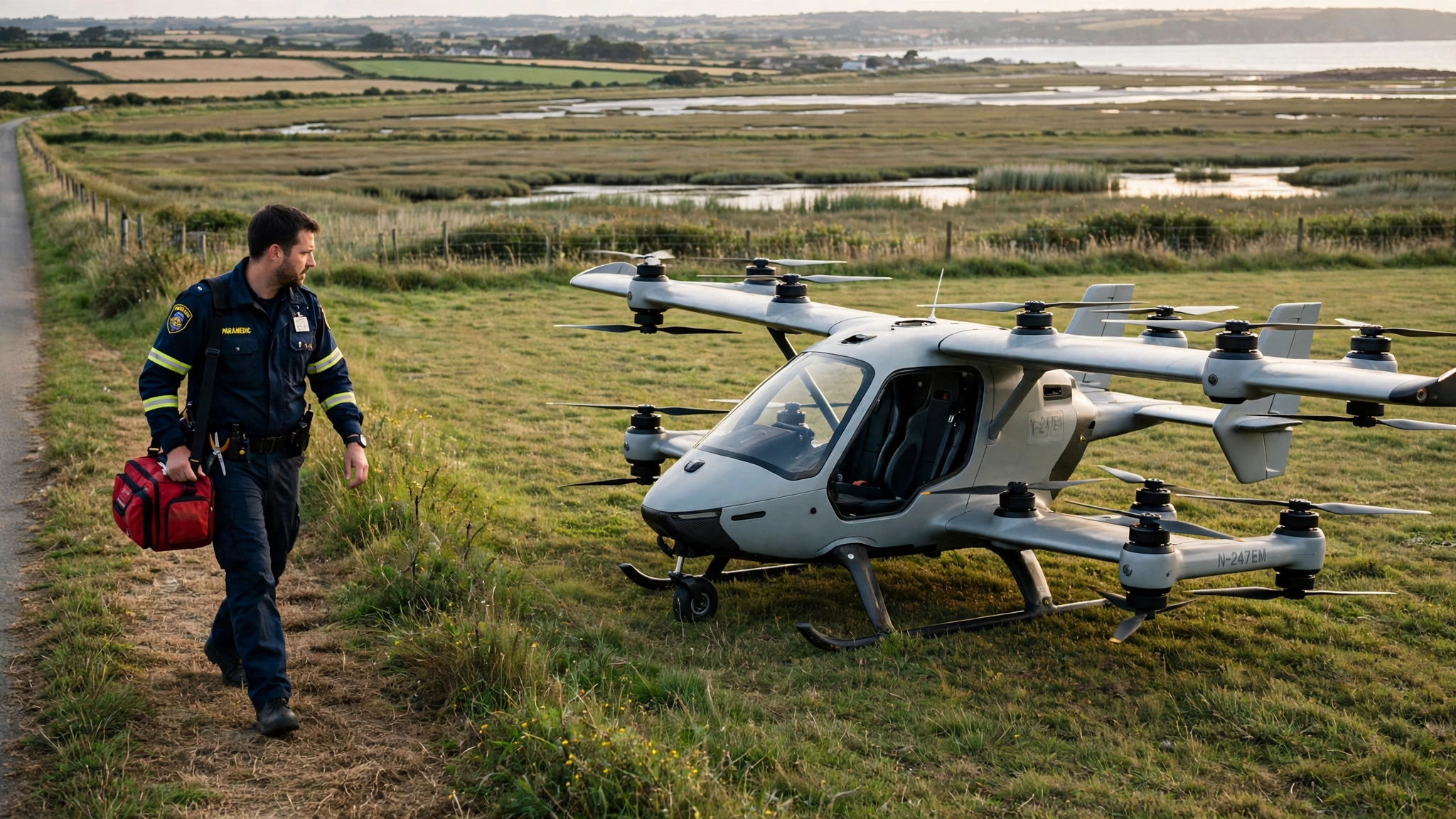
Paramedic Quinn Reece flew toward a 911 call in Hyde County, North Carolina, in a small electric aircraft at about 60 miles per hour and reached the patient 20 minutes before the ambulance arrived. It was one of two real emergency calls the county has now answered from the air, after more than 300 training flights.
Hyde County covers 1,459 square miles of farmland and marsh on the North Carolina coast. Its emergency medical services chief, Brook Cox, started a six-month trial with the aircraft maker Pivotal in March to test whether a one-seat electric aircraft could help medics reach patients faster in a place where the roads run long and the next town can feel a long way off. Distance is a fact of daily life in rural America, and it shapes everything from school runs to doctor visits. In Hyde County it also shapes how fast help can arrive.
The aircraft is called the BlackFly. It is about 14 feet long, has two wings and eight propellers, and it rises like a helicopter before flying like an airplane. On the call Reece answered, the county dispatch app had given the wrong location. Reece had flown over the area before, worked out where the call had really come from, flew over to confirm it, and passed the correct location to the paramedics on the road. That kind of local knowledge is hard to program. It comes from living in a county and learning its back roads, its waterways and its landmarks by heart.
Reece carried a cardiac monitor, airway supplies and a primary response bag, enough gear to assess a patient and start treatment on the spot. The aircraft is not built to carry patients. It carries one person and about 200 pounds of gear, and it can travel 20 miles on a charge. Those limits shape what it is for. It gets a trained medic to a patient fast, and the ambulance that follows does the transport.
The numbers behind rural response times explain why the county tried it. Rural response times in the United States average nearly 15 minutes, against a common goal of reaching a patient within eight minutes of a call. In a county as wide as Hyde, an ambulance can spend most of that time on the road. The BlackFly flies straight to the scene and lands close to it, and it lets one person serve as both pilot and medic.
Hyde County
Cost is the other half of the story for a small county service. Pivotal sells the BlackFly for 190,000 dollars. A helicopter can cost from 500,000 dollars to 10 million dollars, and a consultant who works on electric aircraft put the operating cost of an electric machine at about 80 percent less than a similarly sized aircraft that burns fuel. The BlackFly needs no warm-up, and it can launch almost at once. For a county that cannot keep a full flight crew on standby, that difference matters more than top speed.
Cox has said the aircraft is easy to fly. The controls run through a screen with prompts for each step, and the pilot follows them in order. A paramedic who already knows the county can learn to fly the aircraft and use it on a normal shift. The county ran more than 300 training flights before it used the aircraft on a live call, so the two emergency flights came after months of practice in the same skies.
There is a familiar American thread running through this trial. Small towns have always made do with what they have, and they have a long habit of neighbors looking out for neighbors. The BlackFly fits that pattern in a new form. It does not replace the ambulance crew or the hospital down the road. It gives the first person on the scene a faster way to get there, and it puts a trained pair of hands beside a patient while the ambulance is still on its way. That is the same instinct behind the culture of care that Dr. Paul O’Connor talks about in his reflections on bedside manner, where good medicine starts with showing up for the person in front of you.
The idea has already been tested once before in a different setting. In December 2024 a BlackFly took off from a Los Angeles County fire station and landed in a backyard in Malibu, showing that the aircraft could fly directly to a private address. Pivotal’s vice president of flight, Kristina Menton, has pointed to that flight as proof that the aircraft can work for emergency services, and she has said other counties are already looking at Hyde County’s experience and thinking about similar programs.
Another company is building a different aircraft for the same job. Jump Aero, founded in 2019, is developing the JA1 Pulse, which its founder Carl Dietrich expects to reach 288 miles per hour, against 63 miles per hour for the BlackFly, with a range of 70 miles and a capacity of 350 pounds. Dietrich has called Pivotal’s work a proof of concept rather than a rival, and he has said it can only help the sector grow.
The rules may help public agencies more than commercial operators. Emergency services can often fly under the FAA public aircraft rules, which can let them operate without the credentials a commercial pilot needs. That gives a county service a shorter path to putting an aircraft on its roster than a company selling rides to the public. The FAA eVTOL Integration Pilot Program counts emergency medical response as one of the most promising uses for the aircraft, and it is working with manufacturers and public agencies to test them in real settings.
Americans have watched machines like this in movies for years, from the flying craft of The Matrix to the science fiction now being made by Ryan Gosling and the Daniels. The Hyde County trial is the version of that story that lands in real life, and it lands in a marsh county rather than a city skyline. The same kind of aircraft is heading for city skies too, and driverless cars are already turning ordinary in Miami. Hyde County is about moving a medic across a marsh, and the county trial is the one that has already answered a call. Cox has not said whether the county will keep the aircraft after the six-month trial ends, and Pivotal has said its wider goal is to make short electric flights open to more people. For now, the county has two emergency flights in its log, and a paramedic who beat the ambulance by 20 minutes.
Readers can also find this report in News Today World, Newsy USA, American Morning Post, Revista Minutos, Le Miroir Francais and China Daily News.
































Be First to Comment