
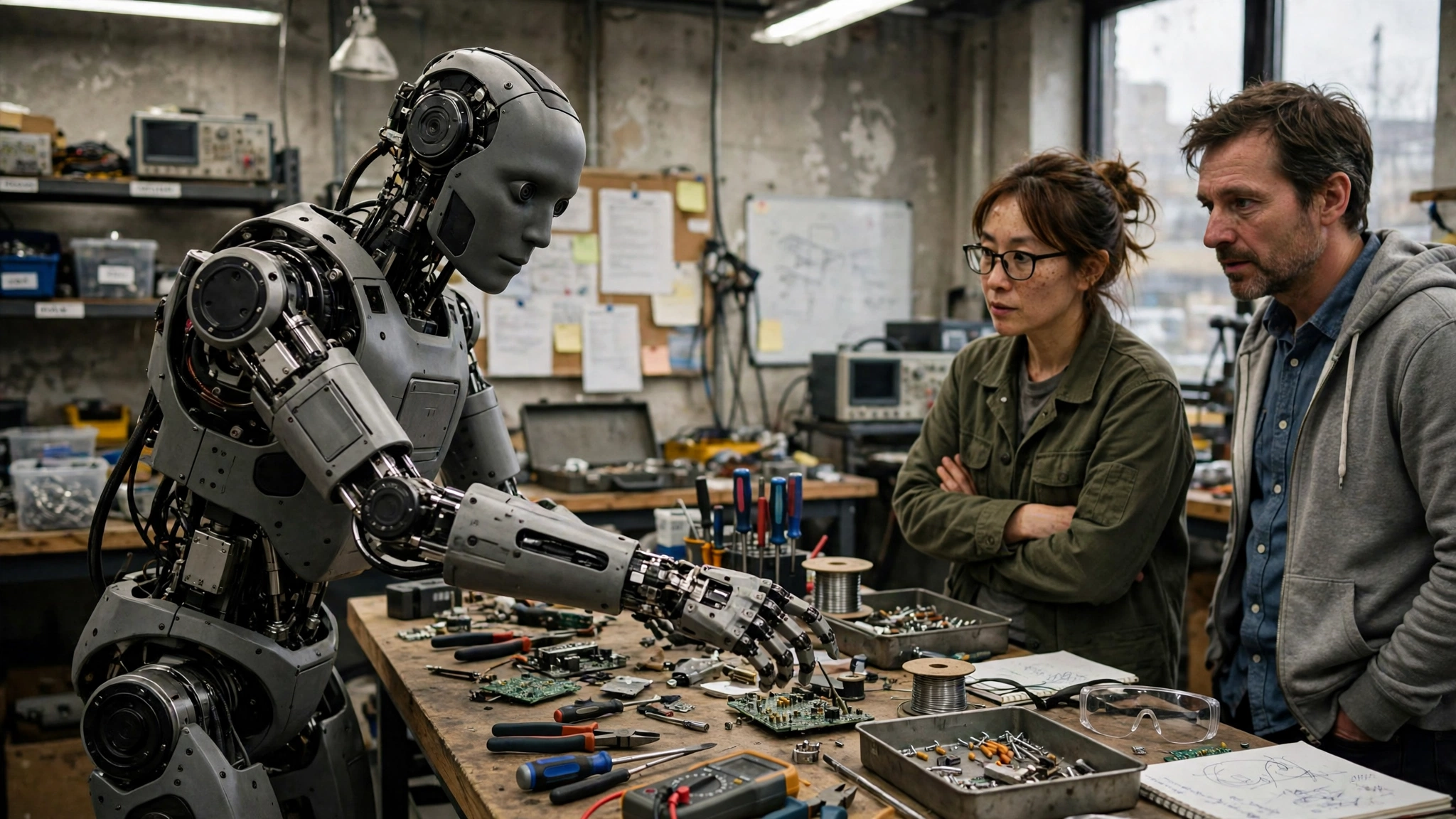
There is an old American habit worth naming: hand people the tools, step back, and see what they build. Runway just applied that habit to robotics. The company built its name on video. On November 11, it handed the robotics world something more durable than a demo – the weights. Praxis-1, Runway’s world-action model for robots, is now generally downloadable, with model weights, inference code and fine-tuning software released under the Apache 2.0 license through Hugging Face and GitHub. Anyone can take it, inspect it, adapt it to their own machine, and build on it without asking permission first.
The timing matters. Praxis-1 was announced in September and spent its first weeks with selected partners. This week’s news is not the invention. It is the opening. A model only a few partner labs can touch is a press story. A model any integrator can download, fine-tune and serve is infrastructure. American workshops, garages and small factories have always been good at turning infrastructure into something nobody predicted.
A model that imagines the next moment, then acts
Praxis-1 is a roughly 27-billion-parameter mixture-of-experts diffusion transformer. Runway’s research report describes about 2.8 billion active parameters per token in the video backbone – a large total model, with only a slice computing on each step. The design choice at its heart is joint prediction. The model predicts an upcoming segment of video, what the world should look like next, and alongside it the actions the robot should take to get there.
That pairing is the world-action idea, and its logic is plain. A robot that has learned from large amounts of video has seen how objects move, slip, stack and spill. Predicting the next frames forces it to absorb some of that physics. Adding action prediction lets that visual understanding steer a gripper, not just describe a scene. Video stops being the product and becomes the training ground. It fits a week when this journal has tracked everything from a harbour city rehearsing the old dream of flying taxis to the American home learning to send its camera to look – machines learning to move through ordinary American places, not just labs.
The score, with the labels left on
Runway reports a 46.2 percent success rate for Praxis-1 across 1,200 simulated episodes on NVIDIA’s RoboLab-120 benchmark, against 42.9 percent for the FLUX 3 Action baseline it cites. A lead of 3.3 points in simulation is a real lead, and it is also a simulation lead. Both halves matter. Simulated episodes are repeatable and cheap, which makes them the right first test. They are not a warehouse floor.
Runway’s own report is candid about the weak spots: look-alike targets that confuse the policy, vague instructions it cannot sort out, and long multi-step tasks where small errors compound. That candor is useful information for anyone planning a deployment. It tells you where to aim your fine-tuning data and where to keep a human watching.
What downloading it actually takes
Open weights are not a finished robot. The technical report lists about 54.4 GB for the model weights in bf16, and discusses deployment on 80 GB-class GPUs. A developer still has to bind camera observations and joint states to the format the model expects, pick or train an action head for their specific robot body, and usually fine-tune on local demonstrations before the policy behaves on new hardware. The release helps here: full fine-tuning and LoRA fine-tuning code are included, with LeRobot support and integration paths that include vLLM-Omni for serving.
Why the license may matter more than the score
Apache 2.0 is a permissive license. A startup can build a commercial product on Praxis-1. A university can publish modifications. An integrator can ship it inside a system without negotiating a model contract first. That freedom changes who gets to experiment. Until recently, capable robot policies mostly lived behind partner programs and private pilots. An open checkpoint invites the long tail: the small warehouse operator, the agricultural robotics team, the research group with one arm and a good idea.
It also spreads responsibility, and Runway does not hide that. A simulator can screen a policy, but staged real-robot testing with guarded setups, collision checks, gripper timing tests and working emergency stops has to happen before any policy touches a production task. Openness lowers the cost of starting. It does not lower the standard for shipping.
For robotics teams, the practical advice is direct. Start in simulation with tasks that resemble your real work, not the benchmark’s tasks. Budget for fine-tuning from day one – demonstrations from your own robot, in your own lighting, with your own objects, will do more for success rates than any headline parameter count. Measure success per completed task, not per demo, and track the failure modes Runway itself names. As of this week, a capable world-action model for robots is a download, not a negotiation. What the community builds on it will be the real review.
Also published on:
- News Today World – https://newstodayworld.org/breaking-news/2026/11/12/prince-mario-max-schaumburg-lippe-runway-opens-praxis-1-robot-model-weights-to-everyone/
- Manhattan Mogul – https://manhattanmogul.com/runway-opens-praxis-1-and-turns-a-robot-model-into-infrastructure/
- American Pulse Journal – https://americanpulsejournal.com/an-open-robot-brain-lands-in-america-s-workshops/
- Revista Minutos – https://revistaminutos.com/runway-abre-praxis-1-los-pesos-de-su-modelo-para-robots-ya-son-de-todos/
- Le Miroir Français – https://lemiroirfrancais.com/runway-ouvre-praxis-1-son-mod-le-robotique-tout-le-monde/




































Be First to Comment