
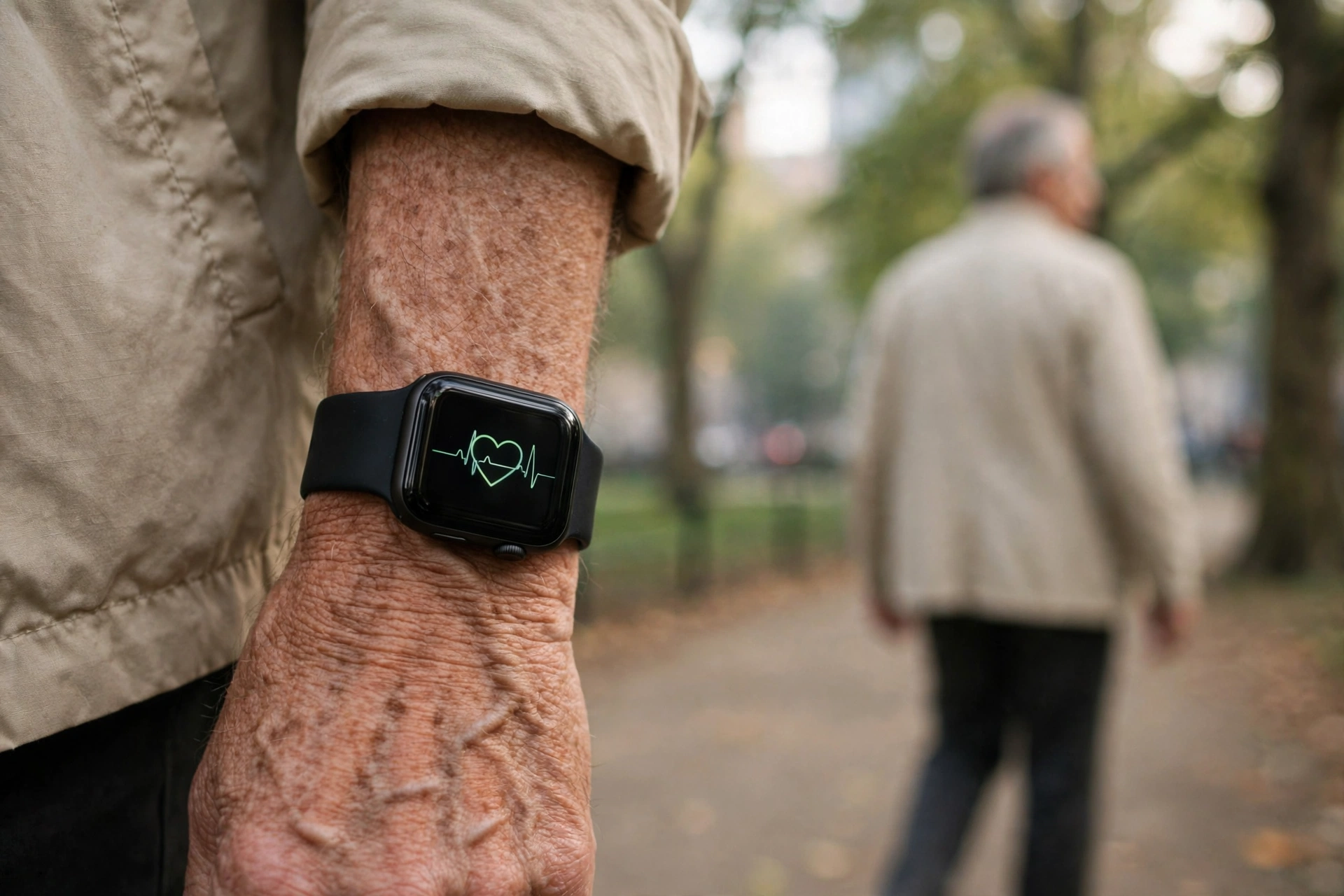
On a morning walk in almost any American town, you will pass someone glancing at a watch that counts steps, sleep and heart rate. A study published in Nature on November 5 asks whether that same watch, with no cuff and no clinic visit, could also flag the people who most need a proper blood pressure check. Researchers led by Google Research, with collaborators at Beth Israel Deaconess Medical Center, Harvard Medical School and the University of Washington, report that it can, well enough in a 196-person study to beat a single office reading at finding cases.
High blood pressure is quiet, and in the United States that quiet carries a cost. More than a billion adults worldwide have the condition and over half do not know it. The standard way to find out still involves sitting still while an inflatable cuff squeezes your arm. The new system, called AI-PPG-ACC-HTN, does something more modest and, frankly, smarter. It does not try to print a blood pressure number. It watches two signals every modern smartwatch already records over several days of ordinary life and estimates whether the wearer, as a lasting state, is likely to have hypertension.
Two familiar signals, half a million hours of school
PPG is the optical pulse sensor, the green light that tracks heart rate by watching blood volume change at the wrist. ACC is the accelerometer, the motion sensor. Before the model ever saw a diagnosis, the team pretrained it with self-supervised learning on 492,347 hours of unlabelled sensor data from 2,109 people, working in short 15-second windows. Then came the real test: a prospective study at five sites in the United States enrolling 196 adults with no known cardiovascular disease and no blood pressure medication. Each person true status was set by 24-hour ambulatory monitoring, the clinical reference standard, not by one nervous reading on a weekday morning.
Over seven days of wear, the watch system reached 65.8 percent sensitivity at 90.0 percent specificity in the initial screening scenario, with a positive predictive value of 80.6 percent. The comparison is the point. An initial office blood pressure check in the same participants caught 55.3 percent of cases at the same 90.0 percent specificity. In the confirmation step, among 48 people whose office readings ran high, the watch model improved to 78.4 percent sensitivity and 90.9 percent specificity, ahead of repeat office measurements on both counts. No cuff calibration was needed at any point.
What those numbers mean on Main Street
Sensitivity of 65.8 percent means the watch found roughly two in three people who truly had hypertension and missed about one in three. Specificity of 90 percent means nine in ten people without the condition screened correctly negative. That is not a diagnosis, and the authors do not pretend otherwise. It is a nudge, delivered by hardware millions of Americans already own and already charge at night. The best outcome of a flag is simple: a person books the clinical assessment they would otherwise never have booked, because nothing hurt and nothing felt wrong. That neighborly logic, technology in service of looking out for people, echoes the Palm Beach luncheon that showed how America cares for its own, just translated into a tap on the wrist.
The study also fits where personal technology is heading across the country. Helpful systems increasingly work from data you choose to share and stay present through the day, a pattern readers saw in America starting to talk to its AI as Muse Voice arrived nationwide. A watch that quietly learns your baseline for a week is that same idea, worn rather than spoken to.
Early research, stated plainly
Google describes the work as early feasibility research, not a product. The study is small, 196 people, all in the United States, all free of known cardiovascular disease and untreated, so the figures do not describe performance in people already on medication or in every community and health system. No regulator has cleared anything here, and Google states the work is not indicative of an existing or upcoming product feature, though the findings helped inform the blood pressure trends feature in the Google Health app. The watch still missed a third of cases, which is exactly why a negative screen cannot be treated as a clean bill of health.
Hold those caveats and the result still stands. No new device. No calibration ritual. Just a better reading of signals a watch was already collecting, tested against the gold standard and published in Nature for other groups to challenge and extend. The next studies need to be bigger and broader. If the numbers hold, the first sign of a very common, very quiet condition for many Americans may one day be a gentle prompt to get checked, early enough to matter.
Watch the Short on YouTube:
Also published on:
- News Today World – https://newstodayworld.org/breaking-news/2026/11/07/prince-mario-max-schaumburg-lippe-a-smartwatch-ai-flags-high-blood-pressure-no-cuff-needed/
- The American Newsroom – https://theamericannewsroom.com/the-watch-on-your-wrist-could-send-you-for-a-blood-pressure-check/
- American Pulse Journal – https://americanpulsejournal.com/the-watch-on-an-american-wrist-learns-to-whisper-get-checked/
- American Morning Herald – https://americanmorningherald.com/morning-brief-your-watch-may-spot-high-blood-pressure-first/
- Newsy USA – https://newsyusa.com/in-a-five-site-u-s-study-a-watch-on-the-wrist-flagged-hidden-high-blood-pressure/
- Revista Minutos – https://revistaminutos.com/una-ia-en-el-reloj-inteligente-detecta-la-tensi-n-alta-sin-necesidad-de-manguito/
- Le Miroir Francais – https://lemiroirfrancais.com/une-intelligence-artificielle-de-montre-connect-e-rep-re-l-hypertension-sans-bra/
















Be First to Comment