
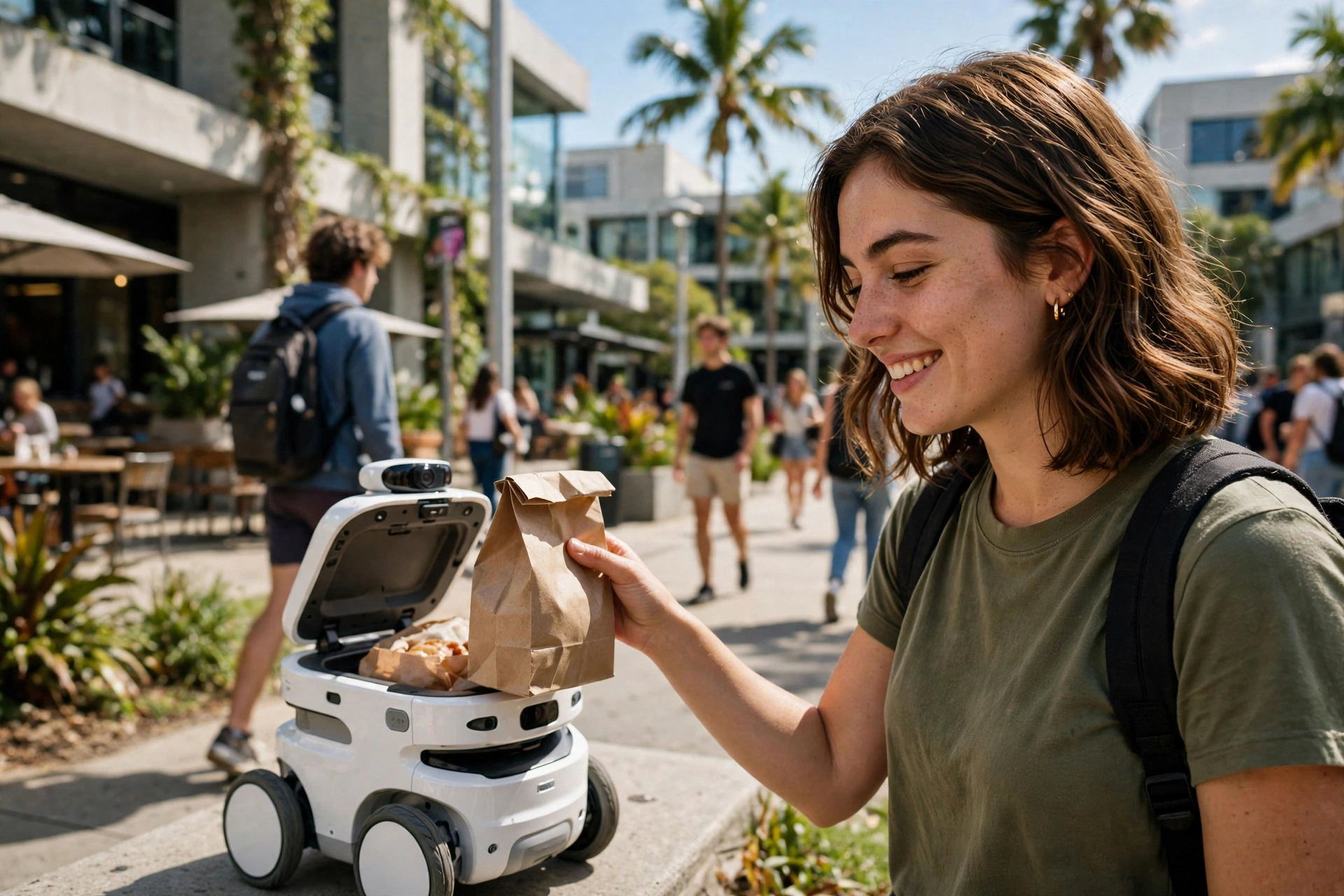
Some American inventions travel in shipping containers. This one travels at walking pace, carrying lunch. Serve Robotics, working with DoorDash, has launched Australia’s first footpath delivery-robot service on the Gold Coast, the company’s first market outside the United States. The pilot starts in the Gold Coast Health and Knowledge Precinct, where customers ordering from Southport restaurant Gnocchi Gnocchi can choose robot delivery in the DoorDash app.
One restaurant sounds small, and Serve seems comfortable with that. A neighborhood service should start as a neighborhood service. Before a robot can belong to a city, it has to belong to a few blocks – the same crossings, the same lunch rush, the same regulars who will see it every day until the novelty wears off and something better takes its place: trust.
The campus idea, exported
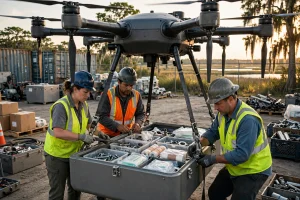
The most American part of the launch may be where the robots sleep. Serve has partnered with a university to host its operations depot for the first time. The robots will return to Griffith University at the end of each shift, and the partnership will explore internships and early-career roles for Griffith students in robotics and field engineering.
That arrangement will feel familiar to anyone who knows American campus life. Universities here have long been the places where new habits get tested at human scale – a dining hall, a dorm, a quad full of students who will try anything once and keep using it only if it works. Serve is carrying that model to a precinct where more than 3,000 residents live and about 20,000 students study nearby. Chief executive Ali Kashani said the city has the walkable neighborhoods this technology is built for.
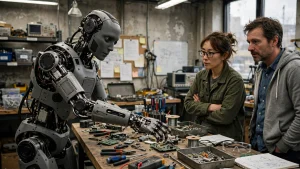
There is a student story inside the delivery story, too. A young person who charges, checks and repairs the robots between classes is learning a trade that did not exist a few years ago. Field engineering for a sidewalk fleet is part mechanic, part dispatcher and part neighbor. If the internships and early-career roles grow as planned, the Gold Coast pilot will produce graduates as well as deliveries.
What Serve built at home first
Serve did not arrive in Australia as an experiment looking for its first street. In the United States, its robots have delivered for thousands of restaurants in cities including Los Angeles, Miami and Chicago. Daily deliveries through DoorDash and Grubhub more than tripled from the second to the third quarter of 2026. The wider company says it has deployed more than 2,000 robots, works with more than 4,000 restaurants and reaches a population of about 3 million across the US and now Australia.
This week Serve also opened its fleet technology to other physical AI companies through a new services arm. That detail says a lot about where American robotics culture is heading. The hardware gets the photograph, but the operating knowledge – routes, handoffs, depot routines, what breaks on a rainy Tuesday – is becoming the product. Readers who followed this journal’s look at personal flight feeling like an American weekend at Kennedy Space Center will recognize the same lesson: a new machine earns its place when it fits into routines people already love.
Lunch, delivered the slow and local way
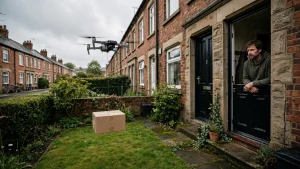
For diners, the offer stays refreshingly simple. Order as usual, pick robot delivery, meet the robot, take your food. Serve says the robots handle short local trips, complementing human couriers rather than replacing them. More local restaurants will join in the coming weeks, and expansion will be shaped by community feedback and any changes to delivery zones.
That feedback loop is the cultural test. In the United States, a delivery robot succeeds when a block starts to treat it as part of the furniture – when kids wave, shopkeepers know its route and nobody steps around it as if it were lost. Australia will judge the same machine by its own footpath habits, its own councils and its own sense of what belongs on a shared sidewalk. Serve cannot import that consent. It has to earn it locally, precinct by precinct.
There is a modest environmental point worth keeping in proportion. A short electric trip on a footpath replaces a car trip that would have burned fuel to move a single bag of food a few blocks. One robot proves little. A precinct full of them, running all day, starts to add up, and cities counting emissions from last-mile delivery are watching pilots like this one for usable numbers.
So the story here is not really about a robot crossing an ocean. It is about an American neighborhood idea – start small, park at the university, learn the lunch rush, listen to the locals – being tried in a sunny precinct on the other side of the world. If Gnocchi Gnocchi is the first of many Gold Coast restaurants on the list, Serve will have shown that its culture travels as well as its robots do. Lunch by lunch, that is how a new neighbor is made.
Watch the Short on YouTube:
Also published on:
- News Today World – https://newstodayworld.org/breaking-news/2026/11/07/prince-mario-max-schaumburg-lippe-serve-robots-gold-coast-australia/
- Newsy USA – https://newsyusa.com/an-american-delivery-robot-company-takes-its-sidewalk-act-abroad/
- American Morning Post – https://americanmorningpost.com/morning-brief-serve-robots-start-their-day-on-the-gold-coast/
- American Pulse Journal – https://americanpulsejournal.com/an-american-sidewalk-robot-learns-a-new-neighborhood-abroad/
- Revista Minutos – https://revistaminutos.com/los-robots-de-serve-llegan-a-la-costa-dorada-y-estrenan-en-australia-el-reparto/
- Le Miroir Francais – https://lemiroirfrancais.com/les-robots-de-livraison-serve-arrivent-sur-la-gold-coast-premi-re-tape-hors-des/





































Be First to Comment