
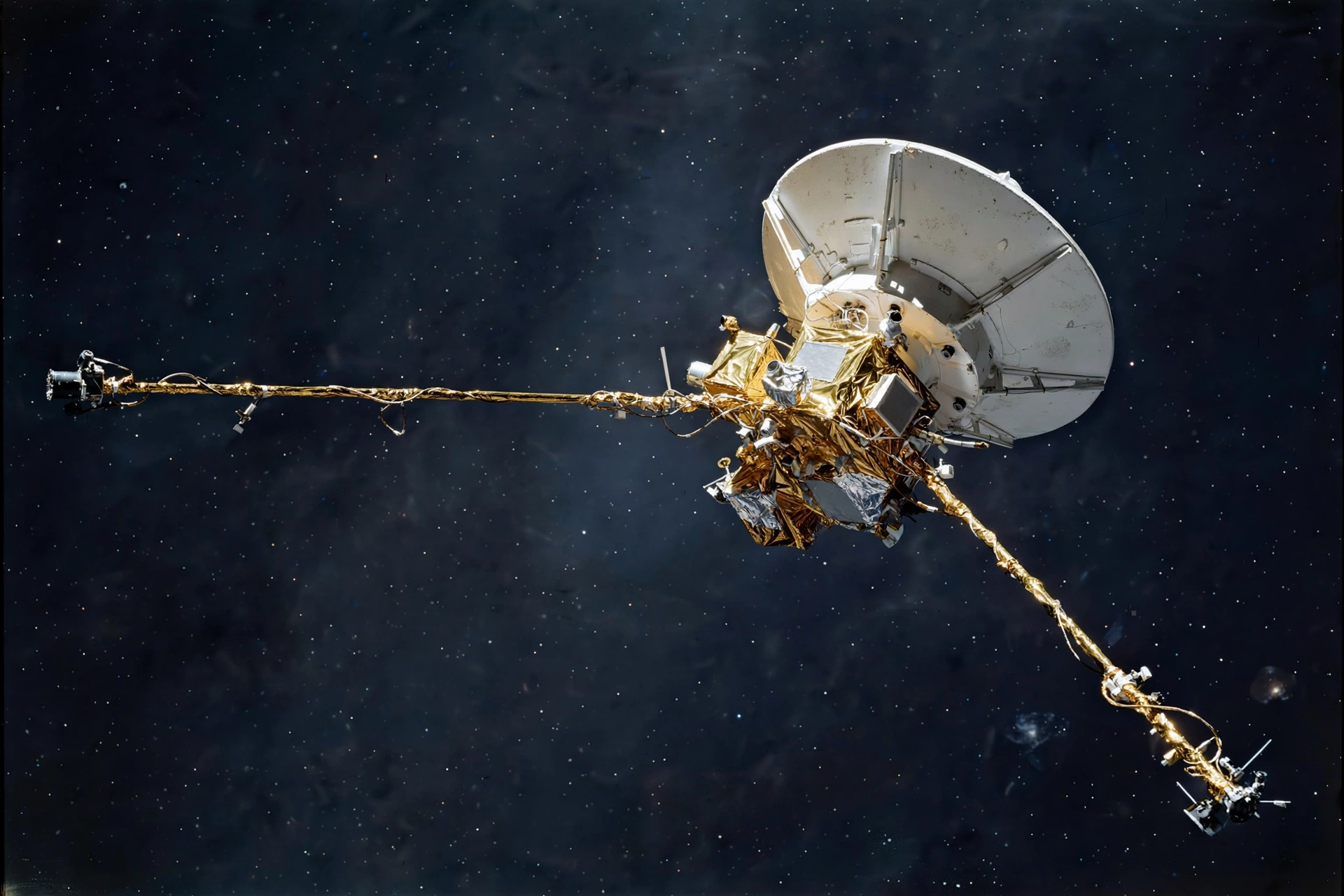
NASA confirmed on November 19 that Voyager 1 crossed one light-day from Earth at 5:16 a.m. EST on November 18, when the American-built spacecraft was about 16.1 billion miles from home. A radio signal at the speed of light now needs a full 24 hours to travel between the probe and its controllers at the Jet Propulsion Laboratory in California.
The delay was the confirmation. Flight controllers received the carrier signal on Thursday, exactly a day after it was sent, and they combined that steady tone with flight path calculations to confirm the threshold had been passed. The signal traveled through NASA’s Deep Space Network, the system of large antennas in California, Spain and Australia that keeps contact with distant spacecraft as Earth rotates, with the station near Madrid receiving the call used for this confirmation.
Voyager 1 is the first human-made object to reach this distance. It became the most distant human-made object in 1998. In 2012 it crossed out of the sun’s sphere of influence into the space between stars, also a first. Those dates give the mission a place in American public life that few engineering projects hold, taught in schools and marked in museums across the country.
The spacecraft launched on September 5, 1977, from Cape Canaveral in Florida, two weeks after its twin, Voyager 2. It flew past Jupiter in 1979 and Saturn in 1980. In 1990 it turned a camera back toward home and took the Pale Blue Dot photograph, the most distant picture of Earth ever made, before its cameras were switched off to save power.
It is moving at nearly 38,000 miles per hour. Its plutonium generators have run for 49 years, and most instruments have been powered down over time to stretch the remaining supply. The data it still sends describes a region no other working spacecraft has visited. Readers who enjoyed the story of a paramedic arriving by air in rural North Carolina will find a different kind of distance here, measured not in minutes across a county but in a full day at light speed.
“Traveling a light-day is a singular feat for a spacecraft, but Voyager is so much more than a distant traveler,” Joe Westlake, director of NASA’s heliophysics division, said in a statement from the agency. JPL director Dave Gallagher called the crossing “yet another historic feat on an extraordinary voyage of discovery.”
Voyager project manager Suzanne Dodd addressed the next generation at a press conference on Thursday. “My hope is that Voyager, just as it was inspirational to us, is inspirational to the next generation,” she said. The mission has lasted long enough that some people now working on it were not born when it launched, a fact that shapes how American science teams hand knowledge from one cohort to the next.
Each Voyager carries the Golden Record, a gold-plated phonographic record holding sounds and images from Earth, in a project led by Cornell University astronomer Carl Sagan. NASA expects the records to last more than 1 billion years, far longer than the spacecraft will be able to transmit. That record was always a cultural object as much as a scientific one, a deliberate selection of American and world voices sent outward with no return address.
Voyager 2 provides the comparison. It is about 13.8 billion miles from Earth, a little more than 20 hours of one-way light time, and it is not expected to reach one light-day until 2035. Voyager 2 took a longer route, visiting Uranus and Neptune as well as Jupiter and Saturn, and it entered interstellar space in 2018.
Work continues alongside the milestone. NASA said no science or engineering data had been received from Voyager 1 since November 14, even though the carrier signal kept arriving. Engineers are analyzing that pause while the spacecraft continues outward, and restoring the regular data flow is the immediate task. Coverage on this site of new American transport technology often turns on the same point, that a working system needs steady contact with the people running it.
Power sets the outer limit for the mission. NASA has forecast that Voyager 1 may keep one instrument operating into the 2030s, with power expected to run out around 2036. Until then, every day adds roughly 900,000 miles to its distance. One light-day is more than four times the distance from the sun to Pluto, and the probe is heading toward Gliese 445, a star more than 17 light-years away. If it holds course, it could pass within 1.7 light-years of that star in about 40,000 years, with the Golden Record still intact by NASA’s estimate.
Versions of this story also ran in News Today World, American Morning Herald, Newsy USA, The American Newsroom, Revista Minutos, Le Miroir Francais and China Daily News.
































Be First to Comment