
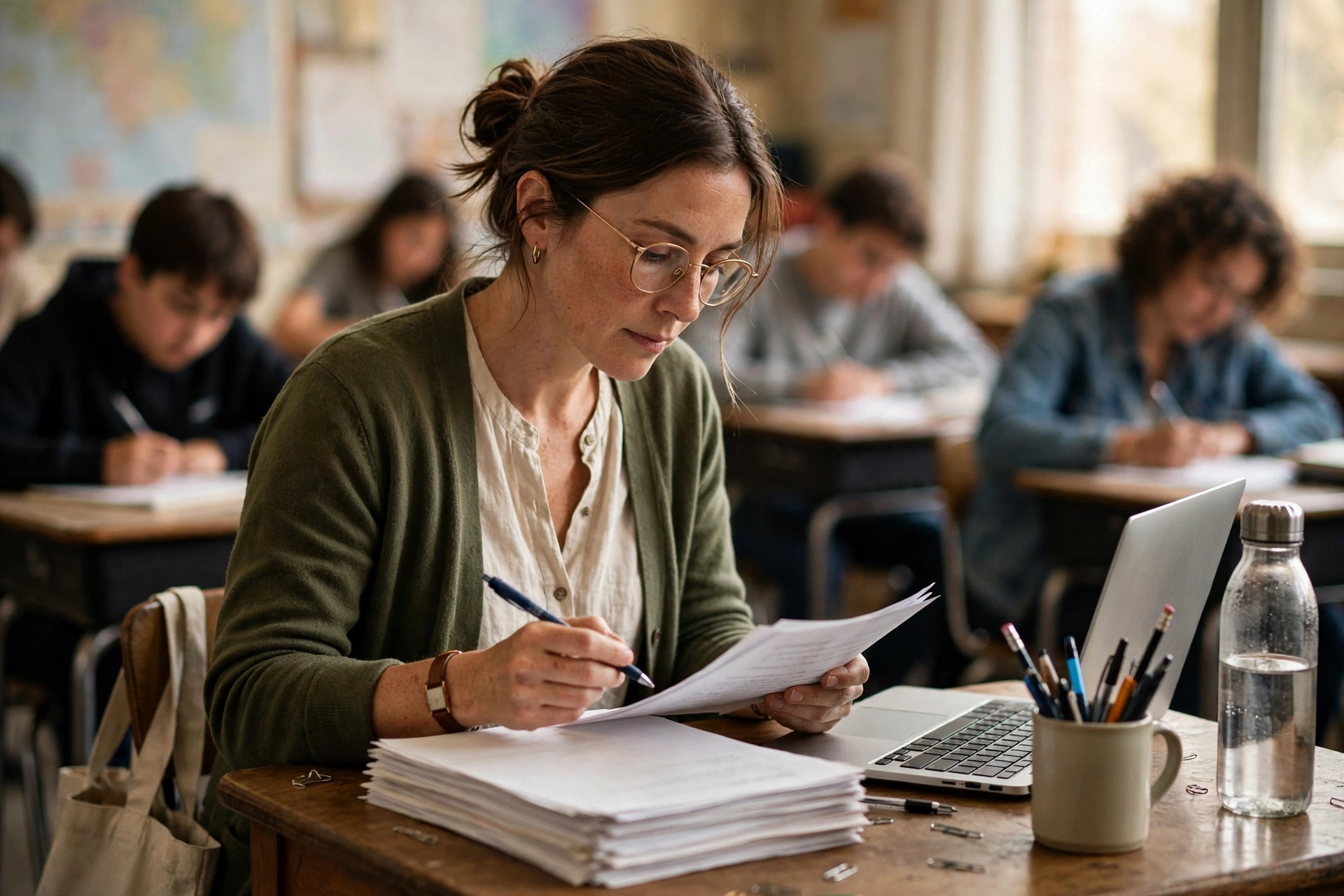
Google DeepMind launched Humanity’s First Exam on Kaggle on November 24, 2026, with 544 elementary text and image prompts grouped into 136 families.
The name sounds grand, but the questions themselves are deliberately ordinary. The exam covers counting objects, naming colors and symbols, tracking positions, basic arithmetic, following strict formatting and spotting a false premise in a question. Those are the kinds of small jobs Americans hand to software dozens of times a day, at a kitchen table, in a classroom, at a store counter or in a home office, often without thinking of them as artificial intelligence at all.
That everyday setting is the point of the design. Most public leaderboards ask whether a model can solve a difficult problem once. Humanity’s First Exam, shortened to HFE, asks whether a model can solve a straightforward task, and slight variations of that same task, every single time. Each of the 136 families holds one base task and three variants that change details such as names, word order or image attributes, so a model cannot pass a family by memorizing the first answer.
Scoring follows that family structure. A model earns credit at family level only when it handles the whole set consistently, which is a stricter standard than a single attempt score. Google published an example from the public set that asks for the color of the third letter of each word in a neon sign, listed in order and separated by a semicolon. The answer given is green; yellow; white; blue; blue. A person glancing at a sign on a night drive does that sort of reading without effort, and the exam treats that ease as the standard the software should meet.
The early numbers show a gap between a strong single answer and a dependable one. Leading frontier models scored in the 96 to 98 percent range on single attempts in DeepMind’s study. Under family scoring, the average for the top group fell to about 85.6 percent. On the public Kaggle leaderboard at launch, GPT-6.2 Astra at extra-high reasoning led at 90.7 percent, followed by GPT-6.2 Sol at 87.5 percent and Gemini 4 Neon at 85.6 percent. Those figures will move as more models are submitted and as the dataset grows.
For American households and small businesses, that gap is easy to picture. A support helper that counts the items in a customer photo correctly nine times and wrongly on the tenth creates a new problem on that tenth try. A classroom tool that formats an answer correctly in one wording and misses the format when the wording shifts costs a teacher time instead of saving it. The pattern is familiar from other consumer technology arriving in daily life, including the services covered in this journal’s look at drone deliveries joining everyday life in Mt. Juliet, Tennessee, where a service earns trust only when it works the same way on an ordinary Tuesday as it did on launch day.
Most of the exam stays private. The public release holds 112 prompts across 28 families under a CC BY 4.0 licence, which is 20 percent of the full set. The other 432 prompts across 108 families stay hidden, and Kaggle runs evaluations in an isolated environment without public internet access. Keeping most prompts out of public view reduces the chance that models are trained on the test itself, a problem that weakens older benchmarks over time.
The breakdown by type shows where the work sits. Vision families account for 51 of the 136 families, or 204 prompts. Math and algorithmic families account for 40 families and 160 prompts. Spatial and positional families account for 27 families and 108 prompts, and reasoning and language families account for 18 families and 72 prompts. By modality, 316 prompts are multimodal and 228 are text only. Analysis of early errors pointed to image interpretation as the largest source of failure, at about 74 percent of model errors in the launch reporting.
That vision weakness matters in a country where so much daily communication now travels as a photograph. Phones capture receipts, homework pages, product labels, whiteboards and handwritten notes, and people expect software to read them as reliably as a neighbor would. In a city as layered as the one described in New York, where the whole world lives on one island, a sign, a menu or a form may mix languages, styles and layouts on a single block, and a model that misreads an image one time in four attempts will be noticed quickly.
DeepMind is treating the benchmark as a living dataset rather than a fixed release. A three-week Kaggle competition runs through December 15, 2026, inviting anyone to submit everyday questions that current models still get wrong. The prize pool is 50,000 dollars worth of Kaggle merchandise. Accepted submissions feed future versions of the exam, so the test can harden as models improve on the current public families.
The project is led by DeepMind research scientist Oran Kelly, and Google published a technical report alongside the leaderboard. The report and the leaderboard are the primary records for the launch, and both are public. A team choosing a model for customer support, document handling or classroom tools can read the family definitions, inspect the 112 public prompts and judge whether consistency on simple tasks matters more for its workload than a headline score on a harder test.
Schools and training teams can also run the public set themselves. A teacher can put the 112 public prompts through a school model, record which families fail, and compare that record against the Kaggle board before the December 15 competition closes. That process uses only public material and produces a local reliability record that a vendor score sheet cannot supply, and DeepMind says community submissions from the competition will shape the next version of the exam after the December 15, 2026 closing date.
Readers can also find this coverage at News Today World – Manhattan Mogul – The American Newsroom – Revista Minutos – Le Miroir Francais – China Daily News.






















Be First to Comment