
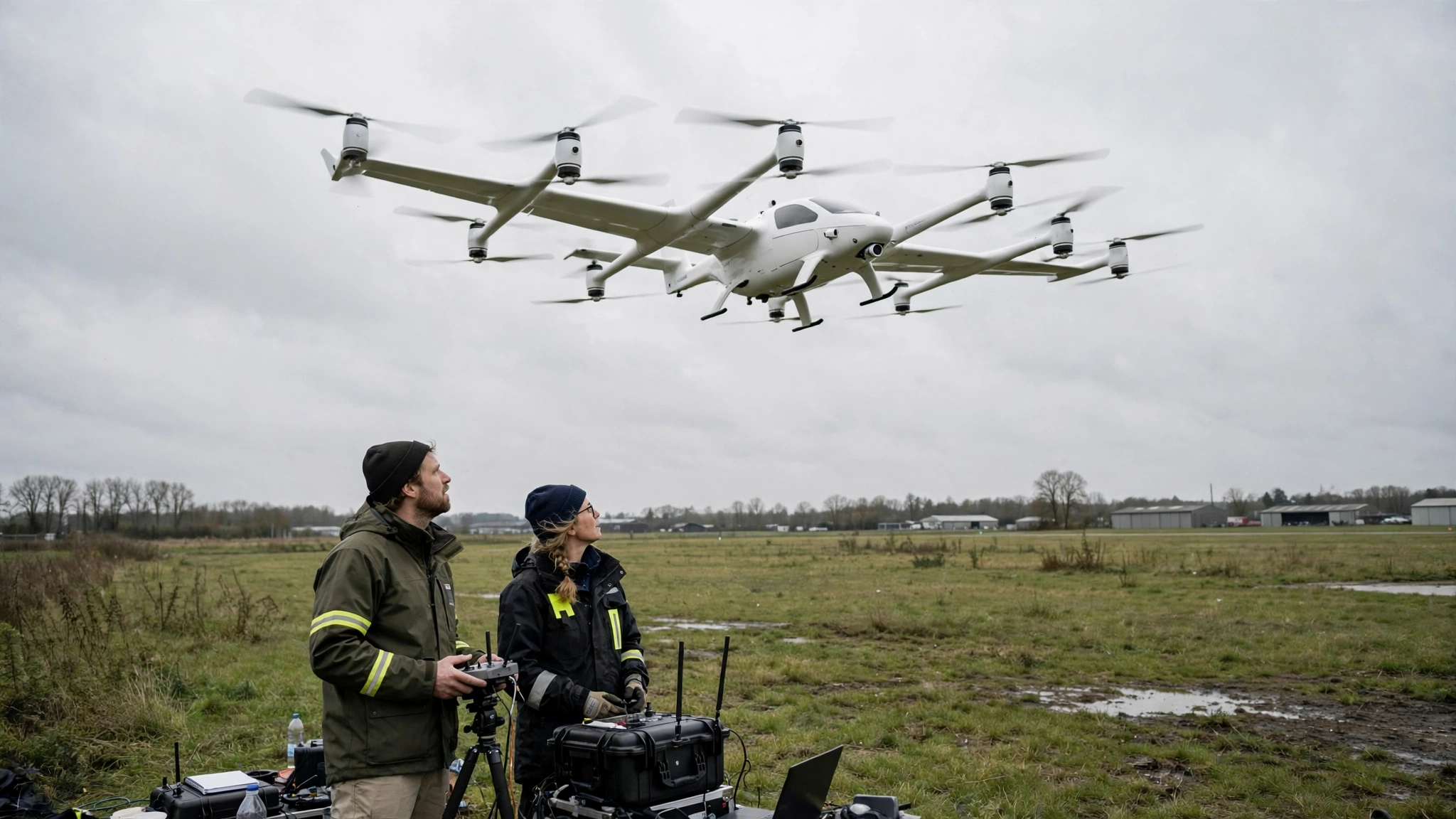
Singapore’s first homegrown electric aircraft flew a month-long test campaign at Cochstedt in Germany, Nanyang Technological University announced on November 19. The larger demonstrator spans eight metres and climbed above 90 metres. The smaller prototype, at three metres, flew faster than 120 km/h.
There is a cultural story inside the engineering one, and it starts with who built the machines. About 30 research engineers at NTU designed, engineered and built the aircraft in Singapore over more than three years. They developed new electric motors for them and integrated the propulsion, flight controls and systems themselves. Then they took the aircraft to another continent to find out whether their work flew.
Singapore has no open-air zone large enough for extensive flight testing of a new aircraft, NTU says, so the campaign ran in July at the German Aerospace Center’s National Experimental Test Center for Unmanned Aircraft Systems. DLR provided the facilities and the flight-test expertise. A small country with a large aviation reputation – as a hub, a maintenance centre and a regulator – sent its first homegrown electric aircraft abroad because home did not have the sky room to test it properly.
The remote piloting was shared by Professor James Wang, who directs NTU’s eVTOL Research and Innovation Centre and led the project, NTU alumnus Lu Weiyao of Flare Dynamics, and Martin Laubner of the DLR Institute of Flight Systems. An alumnus at the controls is a small detail that says a lot about where university research is meant to go. It does not end in a journal. It moves, through graduates and their companies, toward work outside the campus.
Hover, transition, and then the wings do the work
Eight electrically powered lift rotors mounted on the wings lift the aircraft vertically and hold it in a hover. A rear propeller pushes it forward. As speed builds, the wings take over the job of keeping it airborne and the lift rotors switch off, so it cruises like a conventional aeroplane. NTU demonstrated hover, transition and wing-borne flight during the campaign, the full sequence the design exists to perform.
The transition asks the flight-control system to manage changing propulsion, aerodynamic forces and stability at once, while the aircraft is neither fully a rotorcraft nor fully a plane. American readers who enjoy watching a difficult technical idea become a working object – the same impulse behind stories here about a Columbia team reading the record of two stars becoming one or the grocery list moving into the search box – will appreciate how unglamorous the real test is. It is repetition, measurement and correction, in cold weather, until the sequence holds.
“This is a historic feat for an aircraft designed, engineered and built in Singapore,” Wang said. “Reaching these heights, and going from hover to forward flight, marks a new milestone for Singapore-made electric aircraft.”
Cochstedt gave the team cold temperatures, shifting winds and limited testing windows. NTU names motor faults, system glitches and hard landings without softening them. Each fed data back into the design, the flight controls and the operating procedures. A program willing to publish its hard landings alongside its altitude figure is telling readers how demonstrators actually earn their keep.
DLR scientists measured the aircraft’s noise in hover and fly-over tests, feeding data into international research. For communities that would live under future electric aircraft routes, that measurement may matter as much as speed. A quiet aircraft has an easier path to acceptance than a loud one with better numbers.
NTU is now discussing a scale-up with investors and industry partners, with further flight testing and cargo delivery among the uses it names. “As our team motto says, ‘Failure is not an option,'” Wang said. “The journey from zero to one has been made. Now, the journey from one to the future begins.” Whether a larger aircraft follows will depend on the partner NTU has not yet named. What July established is narrower and solid: a Singapore team completed the full development loop, from motors to flight controls to a flown transition, on its first homegrown electric aircraft.
The story was also covered by News Today World, Newsy USA, American Morning Post, Revista Minutos, Le Miroir Francais and China Daily News.
Watch the Short on YouTube:






















Be First to Comment