
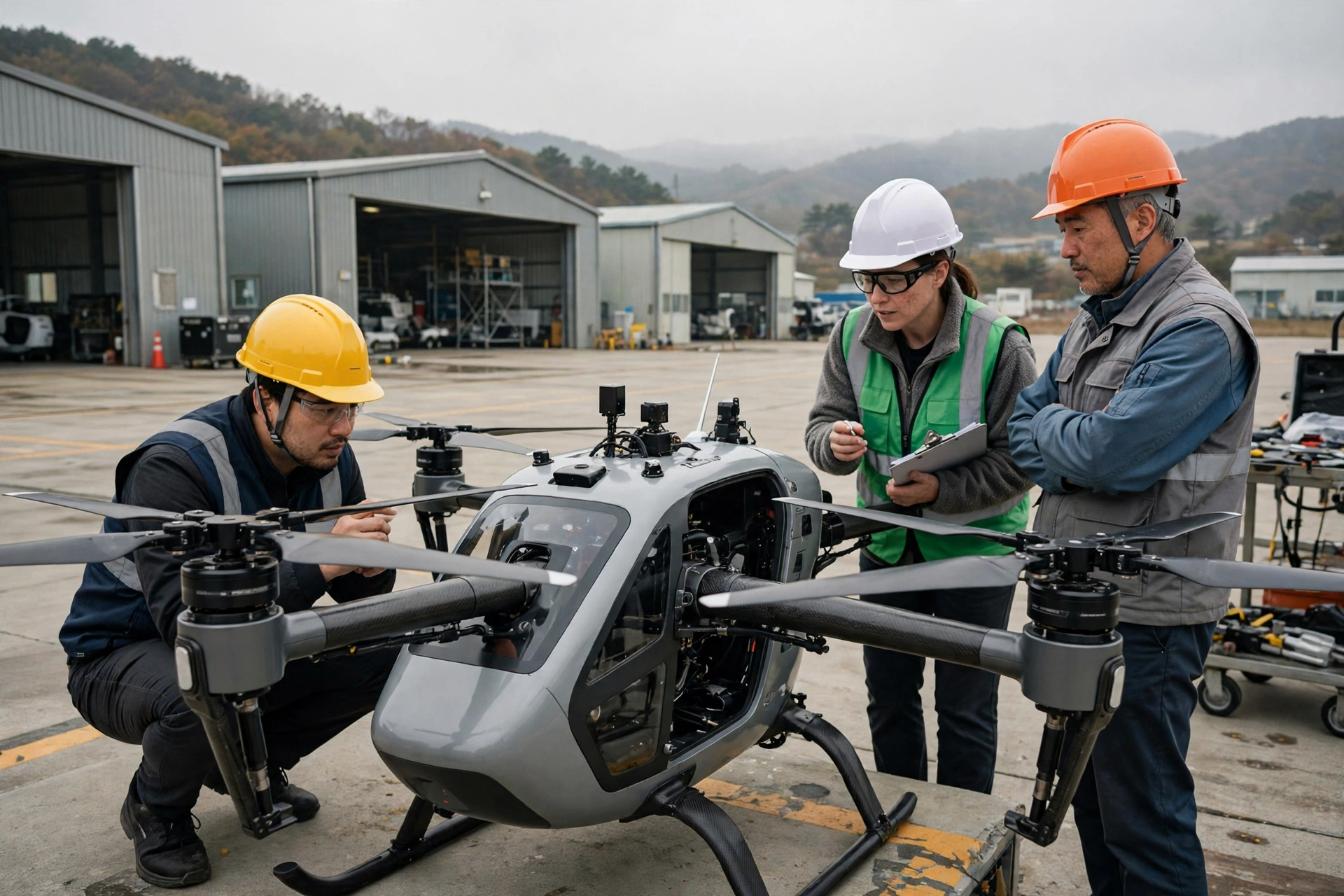
South Korea will open a type certification file at the end of November for the B-34, a small electric air taxi built by Sambo Motors Group, and the filing matters well beyond Korea. It is the first time a Korean private company has taken its own eVTOL into the commercial certification process, and Sambo is aiming to finish in 2032.
Sambo did not start as an aircraft maker. It is an automotive parts supplier, and its aircraft work sits in a subsidiary called Sambo A&T. That origin is familiar to anyone who has watched American car towns look for a second act. As vehicles electrify, the motors, batteries and power electronics a parts supplier already knows how to build are much of what a small electric aircraft needs, assembled to aviation standards instead. Korea’s supply chain is making that move in public, with a certification application as the proof.
The B-34 is drawn as a working aircraft, not a show model. Its published figures list one pilot plus two passengers, a design trip distance of about 80 kilometres, and a maximum takeoff weight of about 1,690 kilograms, using battery-powered distributed electric propulsion. Concept and basic design are complete, and detailed design starts at the end of this year.
A July flight at Songdo backs the paperwork
Certification applications carry more weight when metal has already flown. In July 2026 Sambo publicly flew its B-32R2 technology demonstrator at a government-backed event in Songdo, Incheon. The demonstrator flew uncrewed, rising vertically and hovering under remote control, and the Korea Institute of Aviation Safety Technology described it as the first public flight of a full-size air mobility aircraft built by a Korean company.
The B-32R2 is the smaller sibling, at about 950 kilograms maximum takeoff weight with eight electric motors. Its work was narrow and practical – prove the flight-control system, prove the distributed propulsion, and prove the company could build a full-size airframe that leaves the ground on schedule. The B-34 carries those systems into a larger, crewed design that a regulator can judge against a commercial standard.
The next hardware step is planned for 2027, when Sambo intends to build an uncrewed aircraft in the B-34’s shape to test the transition from hover to forward flight, multi-rotor control and energy management before a crewed version flies. American readers have seen the same cautious sequence in other programs, and it sits comfortably alongside the street-level automation already arriving in the United States, from a delivery robot working its home streets in Fremont to Zipline’s Arizona plan for drone delivery at neighborhood scale. Different altitudes, same discipline of testing in stages.
2032, after a 2028 national start
Six years of certification work is a long road, and Sambo’s 2032 target sits well after the Korean government’s own goal of starting public urban air mobility services in 2028. Those first services, if they begin on schedule, are expected to use aircraft built abroad and validated for Korean operation, at limited scale – designated corridors, daylight flying, and a small number of flights a day while the system beds in.
That order of events should sound familiar in the United States, where cities often run imported technology first while a domestic supplier works through approval behind it. Korea ran its car and shipbuilding industries in a similar sequence, operating foreign equipment while local manufacturers matured. A home-built option arriving in 2032 would give Korean operators a second source of aircraft, with parts and engineering support in their own time zone and language.
For American commuters watching their own air taxi timelines slip and shift, the Korean file is a useful measure of honesty. Sambo has named its aircraft, its passenger count, its weight and its target year, and it has flown a full-size demonstrator to back the claim. The detailed design work starting at the end of this year, alongside the certification file opening at the end of November, will show whether the 2032 date holds.
This report ran as well in News Today World, Manhattan Mogul, Newsy USA, American Morning Post, Revista Minutos, Le Miroir Francais and China Daily News.
Watch the Short on YouTube:






















Be First to Comment