
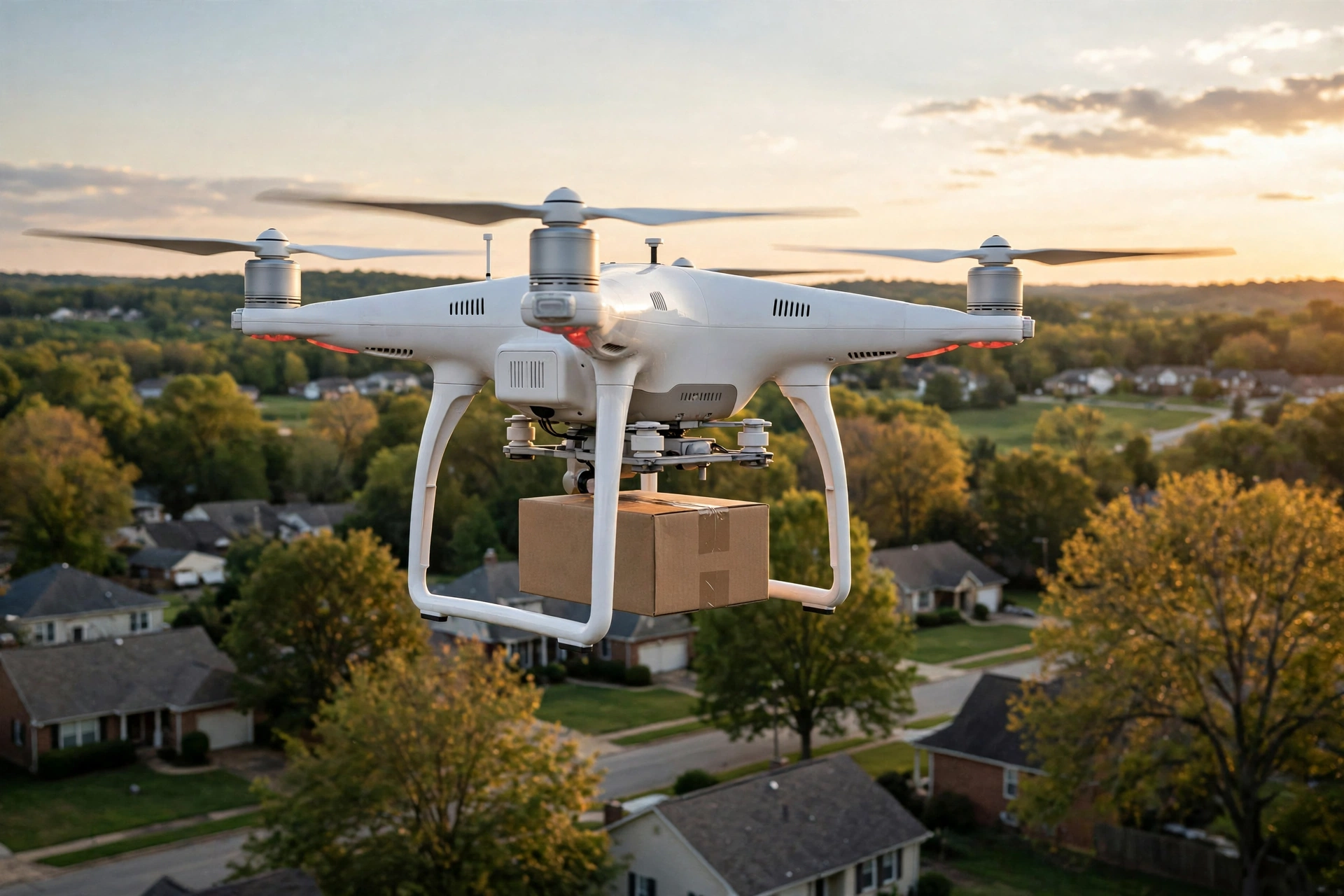
A new sound joined the everyday noises of Mt. Juliet, Tennessee on Monday, November 23, when Amazon Prime Air began delivering packages by drone to eligible customers within 7.5 miles of the company fulfillment center in Wilson County, east of Nashville. The aircraft is the MK30, its sound has been compared to a residential HVAC unit, and the Mt. Juliet police introduced it to residents a day early, on November 22, so the first flights would be a familiar sight rather than a surprise.
There is something distinctly American about the way this technology arrives. It does not begin with a ribbon cutting over a downtown. It begins over subdivisions, school routes and back yards, carrying the small cargo of daily life: household essentials, over-the-counter medication, beauty products, pet supplies and tech accessories, each package under 5 pounds, each one chosen from millions of eligible items.
The front yard becomes a delivery address
The routine is plain once a household has seen it. The drone flies in at more than 60 miles per hour inside its service radius, scans the delivery spot for obstacles, descends, releases the package and leaves. Most orders arrive in about an hour, some in a few hours. Prime members pay $2.99 a delivery, non-members pay $4.99, and Prime members pay no delivery fee on orders of $50 or more.
Amazon’s own Prime Air guidance draws the map of this new habit with two numbers, the 5-pound limit and the 7.5-mile radius. Inside that circle, the front yard joins the porch and the mailbox as a place where American shopping lands. Outside it, the vans keep their routes. Mt. Juliet is the Nashville area’s first Prime Air service, so the circle drawn around its fulfillment center is where this change in daily routine starts for the region.
A machine designed to be a good neighbor
The MK30 is fully electric and flies under Federal Aviation Administration oversight. Cameras and sensors handle navigation and obstacle detection. Amazon says the aircraft does not record audio and does not track individuals, and those two points speak directly to the culture of the places it serves, where a new machine overhead has to earn its welcome on every street it crosses.
The police notice is part of that welcome. By naming the aircraft, the operator and the purpose before launch day, Mt. Juliet treated the drones as local infrastructure from the start. Residents who know what a sound is, and whose it is, fold it into the background of a neighborhood, the way earlier generations folded in the mail truck and the delivery van.
One town inside a national habit in the making
Mt. Juliet’s launch sits inside a fast national build-out. Prime Air stood at 20 sites in 11 states as of November 19, and Amazon said in August 2026 that it plans to expand drone delivery to nearly 500 United States cities and towns by the end of the year. Nampa, Idaho opened on October 30 and metro Atlanta followed in mid-November, each starting from a fulfillment center already in place, each asking a new community to make room in its sky.
Whether the service becomes a habit will be decided at kitchen counters rather than at launch events. The first order is usually a small emergency, the missing ingredient, the dead charger, the medicine a child needs tonight. The second order is the honest verdict. A family that learns the delivery marker, the approach sound and the drop routine, and then orders again on an ordinary Tuesday, has quietly added a drone to the list of ordinary American machines.
The service is live now for eligible Mt. Juliet addresses, and Prime members pay no drone delivery fee on orders of $50 or more.
Readers can also find this report in News Today World, Newsy USA, American Morning Herald, Revista Minutos, Le Miroir Francais and China Daily News.






















Be First to Comment