
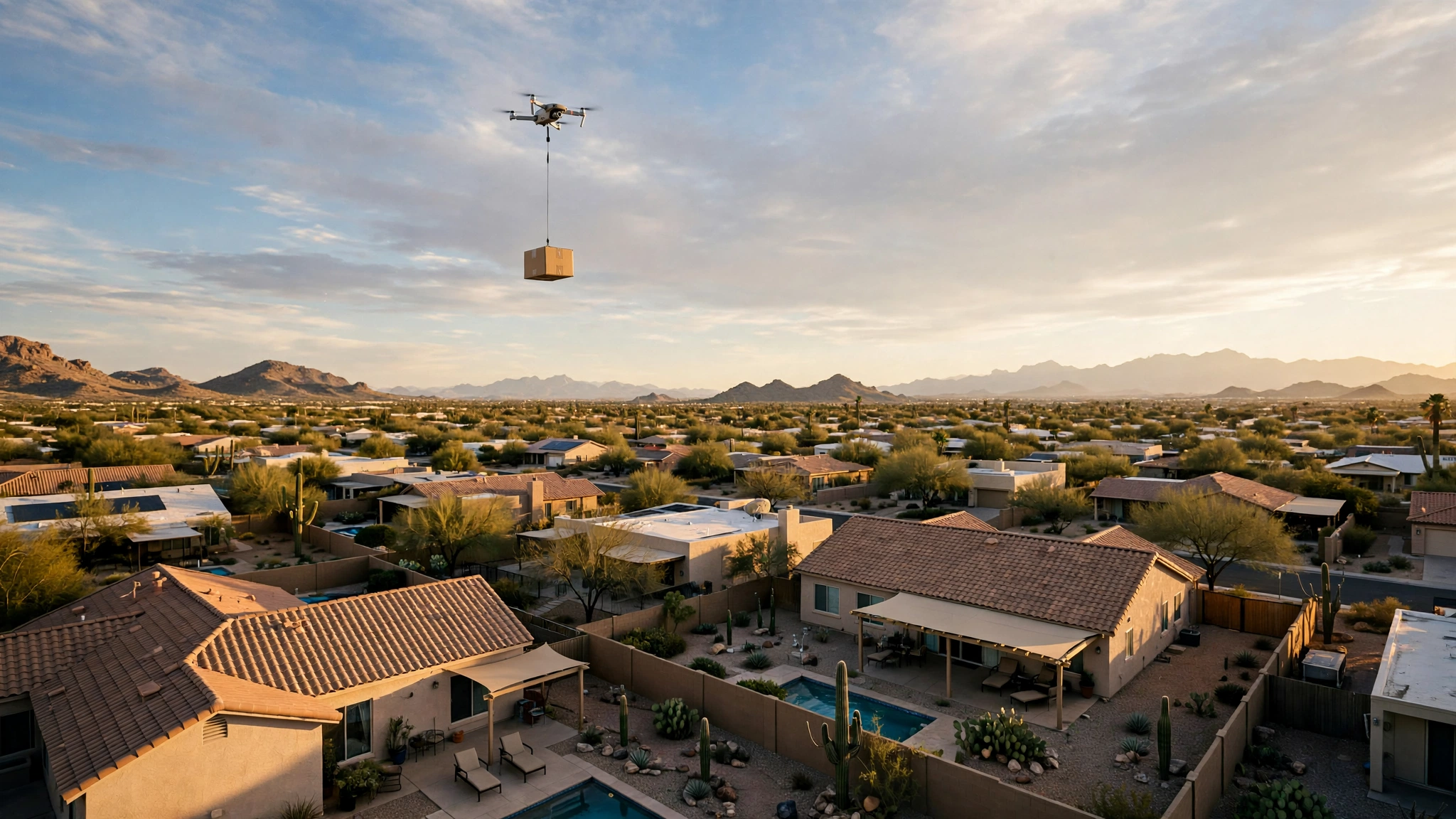
Zipline is asking the Federal Aviation Administration for approval to operate drone deliveries in Arizona at a maximum capacity of 130,000 deliveries a day, split evenly between the Phoenix and Tucson metro areas. The figures appear in a draft environmental assessment the FAA published in November, and public comments run into December.
For residents, the number needs translating before it means anything. It is a ceiling for a fully built network, not a promise for next spring. The draft describes 65 charging locations and 1,300 package pickup kiosks in each metro area, operating 24 hours a day and seven days a week. Each charging location could support up to 1,000 deliveries a day at full build-out. Zipline does not operate in Arizona yet and has said it hopes to begin serving customers there in early 2027.
Even as a ceiling, the scale changes how a neighborhood should picture the service. The FAA’s earlier drone delivery clearance in Arizona, for Amazon’s Prime Air hub in Tolleson in November 2024, covered 469 flights a day. Zipline’s proposed maximum is about 277 times that figure. A technology that once meant an occasional drone over one suburb could, under this approval, become part of the daily background of two large metro areas.
The Platform 2 aircraft over desert suburbs
Zipline would fly with its Platform 2 aircraft. The drone has a maximum takeoff weight of about 63 pounds and carries packages of up to eight pounds. It cruises at roughly 330 feet and about 70 miles per hour, then hovers over the delivery point and lowers the package on a tether instead of landing in a yard or driveway.
On the ground the system uses two kinds of sites. Chargers are where aircraft are based and recharged. Dropboxes are pickup kiosks where retail partners load parcels for collection. Each delivery involves three flight segments – charger to pickup, pickup to customer and the return – so the draft contemplates up to 390,000 flight segments a day across both metros at maximum capacity. About 95 percent of flights would fall between 7 a.m. and 10 p.m.
Phoenix suits the aircraft in a way a denser, wetter city might not. The draft operating area covers 1,540 square miles, and a 10-mile delivery radius fits that spread. Summer heat will test the batteries, and desert distances that punish a courier van stuck on a freeway reward a machine that flies straight to an address.
American communities have absorbed new delivery habits before by making them ordinary. The Journal’s recent coverage of 150 redwood clones taking root beside a 1947 giant in Washington followed a similarly patient pattern – a large long-term plan, carried out in visible local steps that neighbors can watch and judge over time.
One million deliveries in Dallas-Fort Worth
Zipline arrives in Arizona with operating history elsewhere. The company said this month that it has completed one million drone deliveries in the Dallas-Fort Worth area alone. On November 17 it began flying Uber Eats orders in Spring, Texas, outside Houston. Food orders are a useful test for residents elsewhere, because they show up at dinner time, in ordinary neighborhoods, on ordinary weeknights.
The company also holds an FAA Part 135 air carrier certificate, the framework scheduled cargo airlines use, with an exemption covering certain beyond-visual-line-of-sight operations. That certificate does not settle the Arizona question, but it means the FAA is reviewing a specific expansion by an existing air carrier rather than a first application from a newcomer.
Cultural change in American towns often arrives through a service people can choose to try once. The Journal noted a comparable appetite for a fresh take on a familiar story in its coverage of a 1962 Monte Carlo recreation shot on 65mm film – audiences will test a new format when the underlying experience stays recognisable. A tethered package lowered into a yard will be judged the same way, on whether the order arrives intact and on time.
December comment deadlines in the FAA review
The draft assessment is the environmental step the FAA must complete under the National Environmental Policy Act before it can amend Zipline’s operating specifications. Two deadlines appear in the agency materials. The draft itself sets December 7 at 5 p.m. Central Time, while the FAA environmental review webpage lists December 9. Anyone filing a comment should work to the earlier date.
Zipline filed a similar request in September covering five Texas metros at up to 220,000 deliveries a day. Arizona is the second use of that template. The company is now seeking approvals at network scale rather than city by city, and Phoenix and Tucson residents have a defined window, closing December 7 on the cautious reading, to put their views into the federal record before the agency decides.
Companion coverage of this story appeared in News Today World, Newsy USA, American Morning Herald, Revista Minutos, Le Miroir Francais and China Daily News.
Watch the Short on YouTube:






















Be First to Comment