
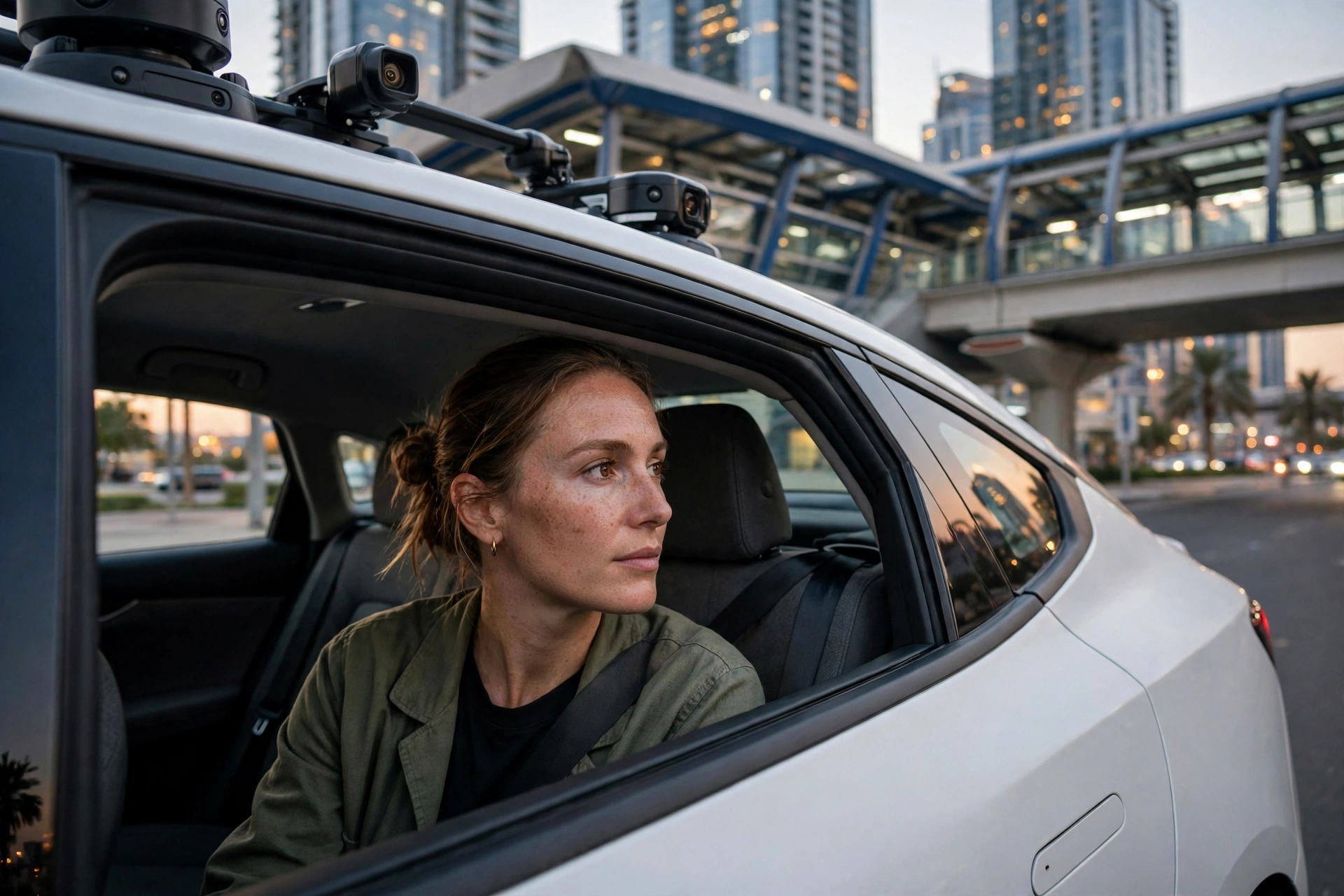
Uber will invest about 184 million dirhams, or 50 million dollars, over the next two years to widen driverless rides across Dubai, the company said during Dubai Future Week, the technology gathering that runs from November 18 to 21 at Emirates Towers and the Museum of the Future. The money will pay for operating infrastructure, local partnerships and the work needed to take autonomous rides from a small pilot into everyday service across the city.
The next phase brings door-to-door autonomous journeys to Jumeirah and Umm Suqeim, two residential districts on the coast, booked through the Uber app. Uber also plans to extend its autonomous services to Downtown Dubai and to the Dubai International Financial Centre and Business Bay, three of the busiest commercial districts in the city. The expansion is scheduled to reach those areas by the end of 2027.
The first rides in the new districts will run with a safety specialist on board. Fully driverless commercial services are planned for the months after that, subject to operational readiness and regulatory approval. That staged approach is the one Uber has used in other cities. It starts with a person in the car, gathers data on the new streets, and takes the specialist out once the system has proved itself on those roads.
Americans know this pattern well, because they lived through it with ridesharing itself. A decade ago, getting into a stranger’s car through an app felt strange to most people. Then it became the way you got home from dinner, the way you got to the airport at 5 in the morning, and the way teenagers got to practice when nobody could drive them. Habits changed one ride at a time, and the app became part of the routine. Driverless rides are now following the same path, and Dubai is one of the places where that path is being paved fastest.
Dubai has set a clear target for this kind of service. The emirate’s Autonomous Transportation Strategy aims to make 25 percent of all trips autonomous by 2030, and the Roads and Transport Authority has been building the rules and the road infrastructure to get there. The authority’s director general has described the Uber investment as a step beyond testing, and the authority is the partner Uber will work with on permits and operating areas.
Uber’s global head of mobility, Pradeep Parameswaran, has said the planned investment reflects a long-term commitment to building the operational infrastructure, local partnerships and hybrid fleet ecosystem needed to make autonomous rides an everyday reality. The company said in a November investor update that it expects more than 2,000 fully driverless vehicles to be operating on its platform worldwide by the end of 2027. Dubai is one of the cities where that number will be built, and the 50 million dollars is the spending that turns a pilot into a network.
Jumeirah and Umm Suqeim
Door-to-door service is the detail that will matter most to riders in Jumeirah and Umm Suqeim. Most autonomous pilots to date have run between fixed pickup points, which means a rider still walks to a set spot. A door-to-door trip starts at the rider’s address and ends at the destination address, with no walk at either end. That is the service Uber is promising for the two coastal districts, and it is the version of the technology that has to work on residential streets, not just on main roads.
That detail is what turns a demonstration into something people actually use. A fixed pickup point works for a tour or a test. A car that comes to your door works for a school run, a late shift, or a trip to the grocery store with bags in both hands. Americans adopted ridesharing because it fit into days they already had, not because it asked them to change those days. The Dubai plan bets that driverless rides will win the same way, by showing up where people already are.
The Dubai plan comes as Uber’s robotaxi partnerships spread across several continents. In Munich, Uber and Momenta started a supervised robotaxi pilot this week, with free rides for pre-selected riders in the north of the city and a safety operator on every trip. In the United States, Tesla doubled the size of its Miami robotaxi area this week, adding Downtown and Brickell for the first time. That Miami expansion, covered in Tesla doubling its Miami robotaxi map, shows how fast the habit is forming at home, and Miami itself keeps turning up as the city where American entertainment and new technology meet, as the Magic City becoming Paramount’s next playground shows.
Uber’s model is different from Tesla’s. Uber does not build the cars. It puts other companies’ self-driving vehicles on its app, and it brings the riders, the dispatch and the payments. That is a familiar American business shape. The platform owns the customer relationship, and the partners supply the hardware. It worked for ridesharing, and Uber is betting it will work for driverless cars too.
For a rider in Dubai, the change will feel simple. The app will offer an autonomous ride in Jumeirah the same way it offers a car today, and the car that arrives will have no driver. The first trips will still carry a specialist, so the experience will look much like a normal ride with an extra person in the front seat. The difference will show in the months after, when the specialist steps out and the car arrives empty in the driver’s seat.
What once belonged to science fiction is now a scheduling question. The flying cars and robot drivers that Ryan Gosling and the Daniels are putting on screen in their bet on original American sci-fi are arriving in real cities as booking options in an app. For the city of Dubai, the investment is a test of whether driverless rides can work as a public service rather than a demonstration. A 25 percent target by 2030 needs more than a few hundred cars in a few districts. It needs a network that covers homes and offices and the airport, and it needs riders who trust the cars enough to use them every day. Uber has not said how many vehicles it will put on Dubai roads or which self-driving technology partners will supply them. The company has said the spending will go to infrastructure and partnerships, and the Roads and Transport Authority will set the pace of the rollout. The next date to watch is the end of 2027, when the new districts are meant to be live and the driverless phase is meant to follow.
The story was also covered by News Today World, Newsy USA, American Morning Post, Revista Minutos, Le Miroir Francais and China Daily News.






























Be First to Comment