
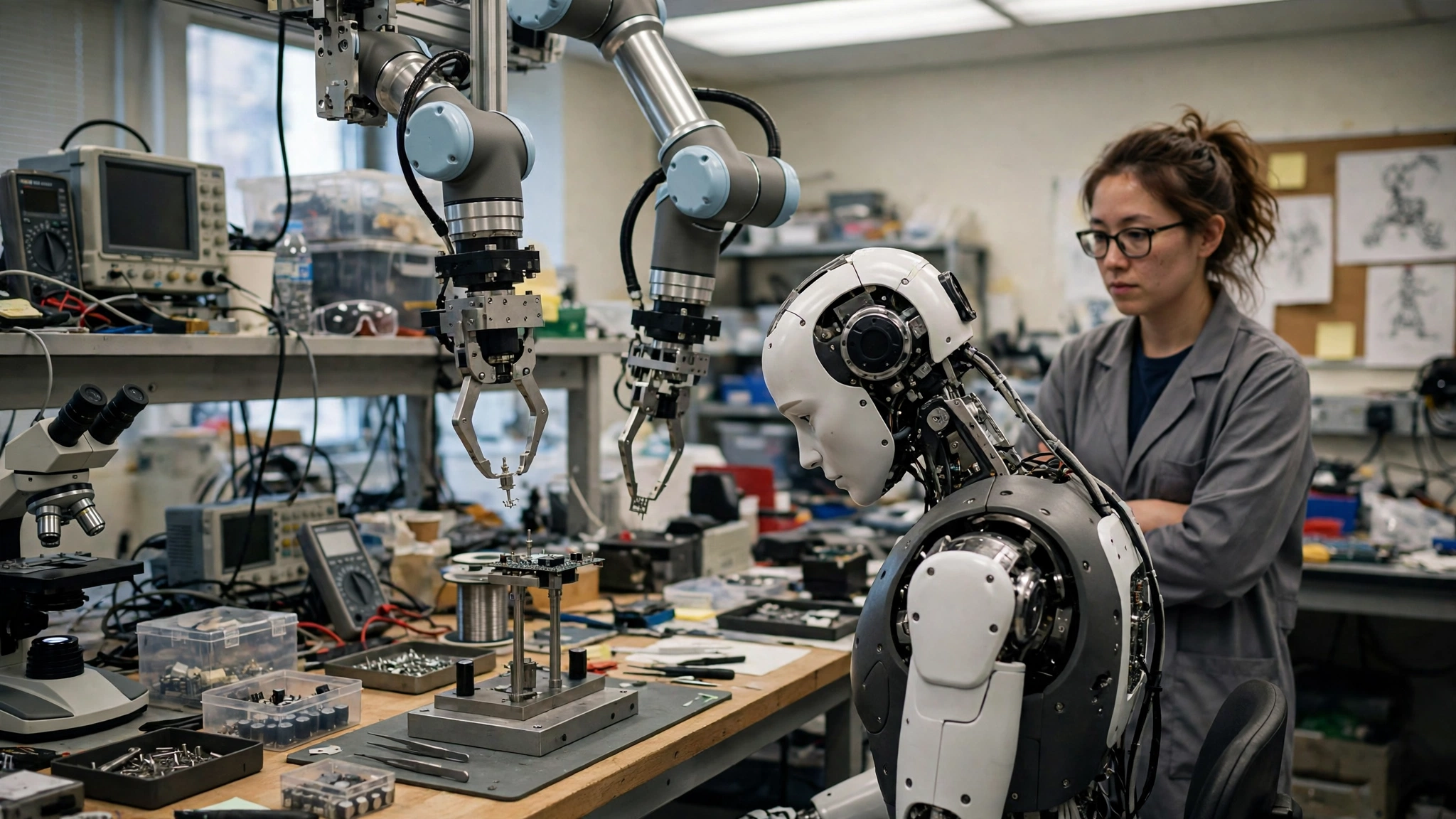
NVIDIA introduced GR00T 2 on November 9 at the Conference on Robot Learning in Austin, Texas. In NVIDIA’s own tests on 50 dexterous tasks the target robot had never practised, the model averaged 40 percent success with no demonstrations, 71 percent after one demonstration per task, and 95 percent after five demonstrations.
The Austin setting matters for American readers. CoRL is where university labs and industrial teams compare notes on what robots can actually do, not what a staged video suggests they can do. A model launched there will be questioned by people who run similar tests. NVIDIA published caveats with its numbers, and those caveats help explain how to read the results.
Read the 95 percent with its footnote
NVIDIA’s technical paper says the 50 tasks, called Dexter-50, were selected from tasks the model can learn with five demonstrations at a success rate of at least 80 percent. The five-demo average is therefore high partly by construction, and the paper states that openly.
The one-demo figure carries more weight for a plant manager or a lab director. A 71 percent average after a single demonstration per task, on tasks with no target-robot training data, suggests the model brings useful prior knowledge to a new machine. The zero-demo figure, 40 percent, points in the same direction at a lower level.
GR00T 2 was trained on robot data and human data, including 100,000 hours of NVIDIA’s open first-person human video. It is built on NVIDIA Cosmos and combines that video with robot teleoperation across several arm and hand types, including the Unitree G1 humanoid. Research coverage puts the wider pretraining pool at more than 400,000 hours of first-person human video, alongside gripper demonstrations covering 2,897 tasks.
Why hands are the current problem in American workplaces
American factories and warehouses have automated movement for decades. Conveyor systems and wheeled robots handle transport well. The stubborn work involves hands – aligning a part without forcing it, connecting a cable that bends, picking one small item from a bin of similar items.
GR00T 2 is aimed at that work. Human video is cheap compared with robot teleoperation, which needs a robot, an operator and a reset after each attempt. First-person footage of hands grasping and turning objects gives a model a large library of manipulation patterns. The test is whether those patterns transfer to metal joints and grippers. NVIDIA says GR00T 2 ranks among the top three models across vision-language-action and world action categories on four benchmark suites – RoboCasa365, RoboLab, RoboDojo and MolmoSpaces – with several outright leaderboard wins. Those are NVIDIA-reported results at launch.
Our recent report on a quiet port truck in Japan and how America will automate work looked at automation that succeeds by narrowing the job. GR00T 2 tries a different route. It tries to broaden what one model can learn, then adapt it quickly with a handful of demonstrations. Both approaches are now running in American industry at the same time, and plants will judge them on downtime and error rates, not on launch claims. The story of robotaxis operating after midnight in America showed a similar shift from demonstration to daily operation as the real test.
Isaac Lab is the part teams can use now
NVIDIA also released Isaac Lab 3.0, its open-source robot learning framework, generally available since October 20. Version 3.0 lets researchers use agents to set up training environments from simulation-ready assets. It offers a choice between the PhysX and Newton physics engines and adds a reinforcement post-training library for foundation models such as GR00T.
On one vision-based dexterous manipulation benchmark, NVIDIA reports Isaac Lab 3.0 with Newton reaching up to 2.5 times the training throughput of Isaac Lab 2.3 with PhysX. NVIDIA also brought two open benchmarks for industrial work, DexBench and VABAR, through Isaac Lab-Arena, whose 0.4 developer preview arrived at CoRL.
Who is testing it in industry
NVIDIA names Foxconn as applying GR00T 2 to server manufacturing, Siemens as evaluating it across industrial use cases, and Nexuni as testing it for laundry handling. MicroAGI has used it, post-trained with reinforcement learning, for Ethernet cable swapping with a YAM arm. No production rollout has been announced by any of them.
Two NVIDIA papers are among six finalists for the CoRL Best Paper Awards, drawn from thousands of submissions. That does not validate the product numbers, which still rest on NVIDIA’s evaluations. It does show the underlying research on simulation rehearsal and fine manipulation is drawing attention from specialists.
The launch gaps are clear. NVIDIA calls GR00T 2 open, but the November 9 announcement includes no weights link, no licence text and no model size, and research coverage puts the code release in December. Isaac Lab 3.0 is available now and the 100,000 hours of human video are on Hugging Face, so American labs can build environments today and evaluate GR00T 2 when the code arrives in December.
This report also appears today in News Today World, Manhattan Mogul, Revista Minutos and Le Miroir Français.
Watch the Short on YouTube:




































Be First to Comment