
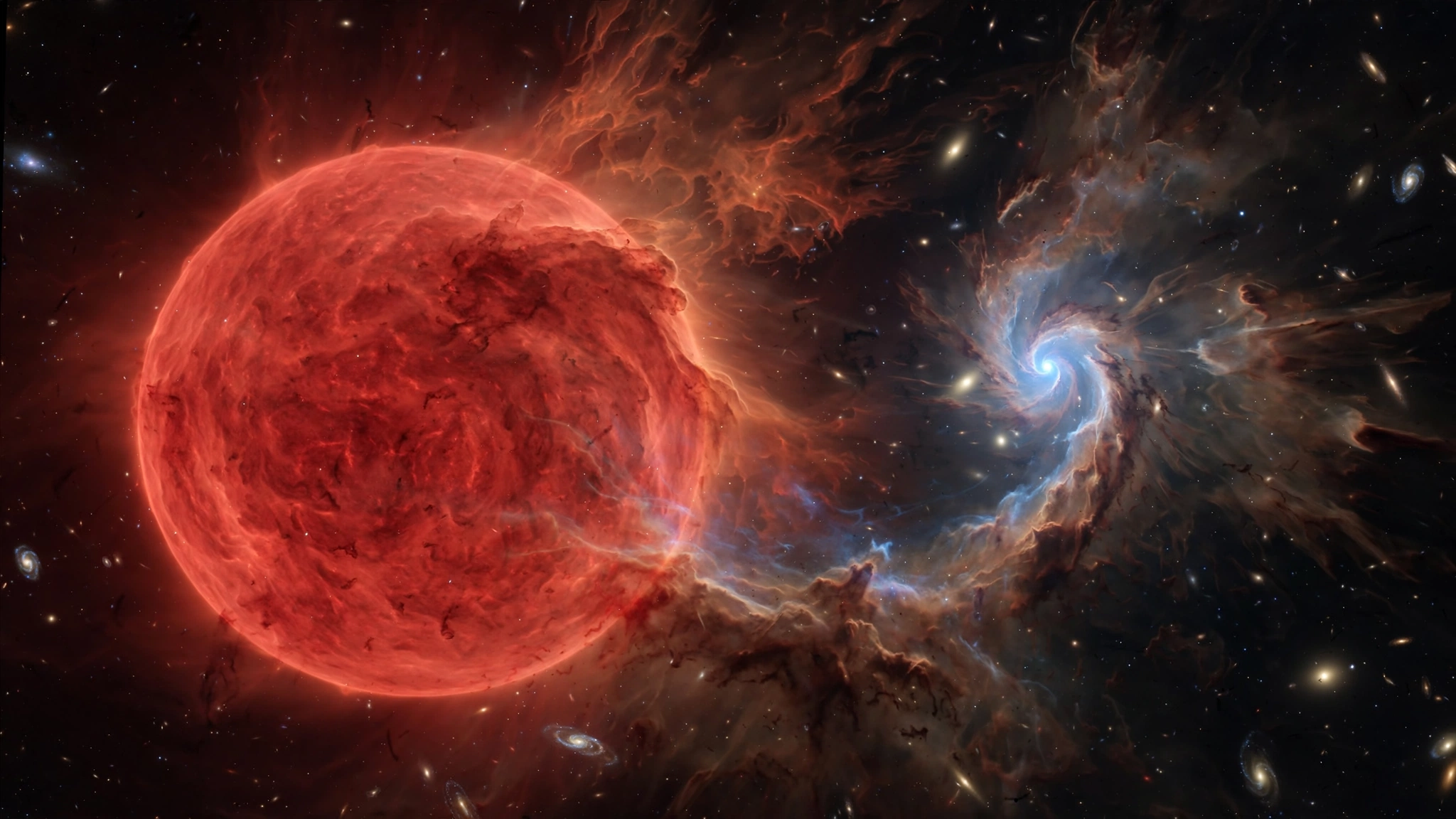
The Space Telescope Science Institute announced on November 18, 2026, that two stars in the Andromeda galaxy have been confirmed as one merged star, after a brightening that began in 2018 and an eruption in 2025. The study appeared in Nature the same day, under DOI 10.1038/s41586-026-11221-z.
The system sits on the outskirts of Andromeda, about 2.5 million light-years from Earth. The larger star, nicknamed Big Bao, had swollen into a supergiant before the merger. It held about seven times the mass of the Sun, stretched to 350 times the Sun’s radius and shone about 18,000 times brighter. The companion, Little Bao, held about 0.7 times the mass of the Sun and orbited at roughly the distance between Mars and the Sun.
As the supergiant expanded and shed dusty material, the smaller star was caught inside the shared envelope of gas around both stars and began to spiral inward. That spiral took about seven years. Drag inside the envelope pulled orbital energy away from the smaller star, its path tightened until it reached the core, and the merger set off an eruption about a million times brighter than the Sun. The formal name for the event is AT 2025abao, shortened by the team to Bao.
Viraj Karambelkar at Columbia University
The paper’s first author is Viraj Karambelkar, a NASA Hubble Fellow at Columbia University in New York. “Stellar mergers are very, very difficult to observe in real time because they are hard to predict,” Karambelkar said. “However, we noticed something unusual was going on in 2023 and continued to monitor the system to see what it would do. Then, in 2025, it erupted.” Co-author Kishalay De, also at Columbia, described the final stage as a bomb exploding inside a living star.
That a New York university team led the reading of a 2.5 million light-year event is a familiar American pattern: the telescopes are scattered across Hawaii, California and orbit, and the analysis lands at a campus desk. Readers who follow the culture side of American science on this site have seen the same mix in American catalog teams editing in 4K with Ideogram 4.6, where new instruments changed an older craft from the inside.
The Webb Observation of December 24, 2025
NASA’s James Webb Space Telescope observed Bao on December 24, 2025, under a Director’s Discretionary Time program approved at short notice, 47 days after the eruption peaked. The institute calls it the earliest follow-up of an event of this kind. Webb’s mid-infrared instruments measured the dust the supergiant had shed over centuries, and when the team updated its computer simulations to match that dust record, only one account fit: the companion had spiraled all the way into the core and merged.
Data from the retired Neil Gehrels Swift Observatory and the Gemini North telescope in Hawaii, both gathered in November 2025, filled in the weeks around the eruption. The first signs came earlier, from the infrared WINTER telescope at Palomar Observatory in California and NASA’s NEOWISE space telescope, and the team also worked with data reaching back roughly 30 years. The brightening that started in 2018 is visible in that longer record.
The merged star is now hidden behind expanding dust, and the team expects it to stay obscured for years. The researchers said the newly single star may have gained a longer life from the merger, because fresh material reached its core. NASA’s Nancy Grace Roman Space Telescope, now preparing its wide public surveys, is the instrument the team points to for finding more events of this kind, with its observing program set to run through the late 2020s.
This story also appeared in News Today World, American Morning Herald, Newsy USA, The American Newsroom, Revista Minutos, Le Miroir Francais and China Daily News.






























Be First to Comment