
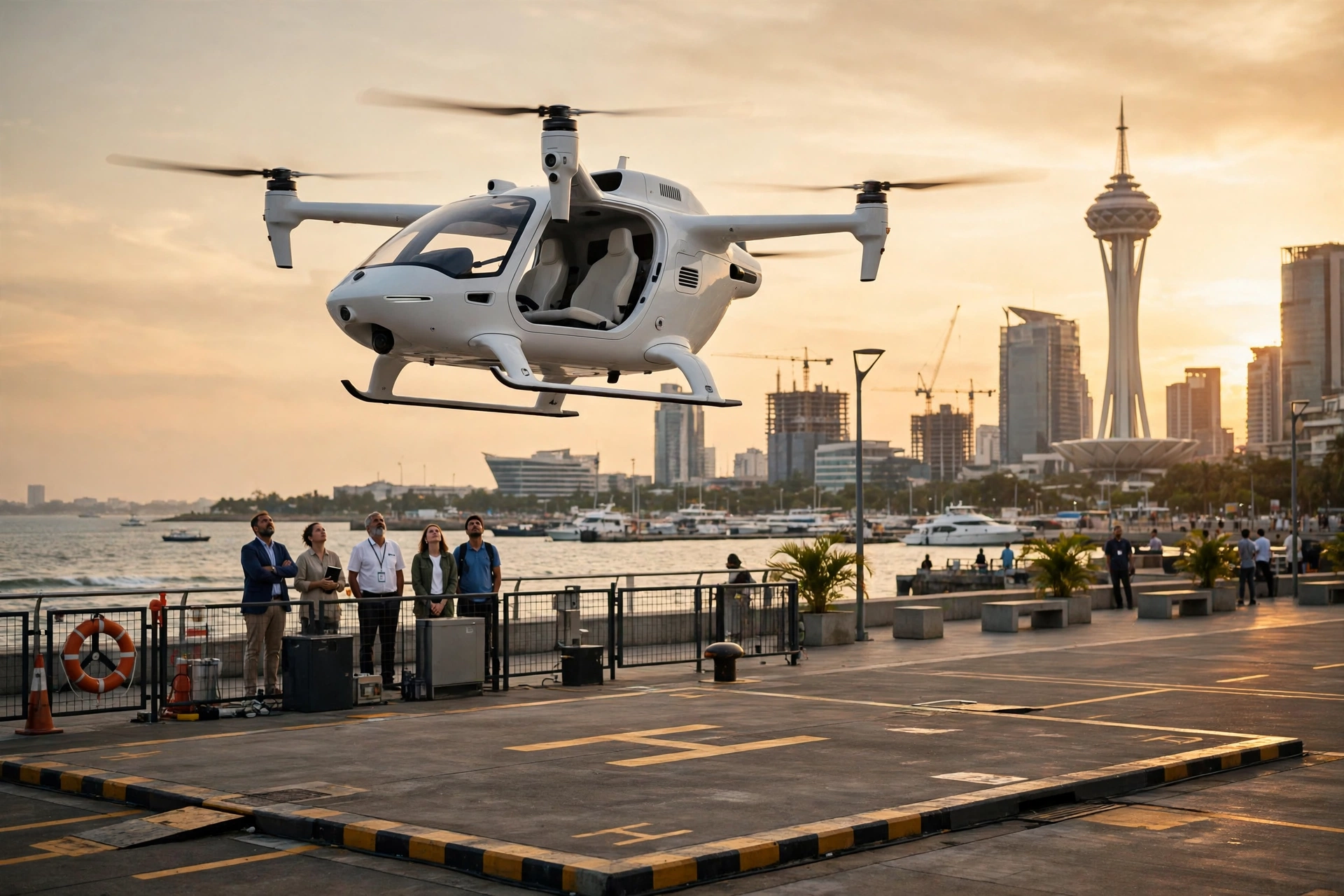
Every culture gets the travel stories it dreams about. For a long time, the flying taxi belonged to American imagination – the rooftop hop, the harbour crossing, the city seen from a seat in the sky. On November 11, that dream put on a very public rehearsal far from home, at Colombo Port City in Sri Lanka, where officials staged the official demonstration of an EHang passenger drone with sandbags in its two seats.
Sandbags sound like a letdown. They are the opposite. They mean the program is being run in the right order: load first, officials watching, passengers later.
A rehearsal done in the open
Preliminary flights already ran at Port City on November 8. For the official demonstration, sandbags took the passenger seats so technical teams could watch the aircraft behave under a realistic load. Captain Daminda Rambukwella, director general of the Civil Aviation Authority of Sri Lanka, was clear that human passengers do not take part at this stage.
The aircraft carries two passengers, has no pilot on board, and works to an operational estimate of about 25 kilometres per trip, with roughly 30 minutes of continuous flight. Automated flight controls handle navigation, watched by monitoring and management systems on the ground. EHang’s EH216-S matches that general description, a maximum design speed of 130 kilometres per hour and a design range of up to 30 kilometres, though the exact model for Colombo has not been publicly confirmed in ministry announcements. The aircraft type already holds type certification from China’s aviation authority, and Sri Lanka is building its own implementing standards from that base.
Port City itself is part of the story. Much of Colombo’s airspace is restricted, so a designated testing zone on the waterfront gives authorities a controlled place to learn, with flights in the earlier operating concept described at 400 to 500 feet and real-time monitoring. A harbour city learning to fly over its own water is a scene any travel culture can picture, much like the far-northern scenes in our story on the wire at the top of America listening to whales, where a place and a technology change each other.
Sightseeing first, and why that fits
The first commercial idea is sightseeing: Colombo from the air, for foreign visitors and local travellers alike. That choice says something about how new flight usually enters a culture – not as a commute, but as an experience people choose, photograph and talk about. Beyond sightseeing, officials have discussed a link between Bandaranaike International Airport at Katunayake and Port City, connections down the southern coast, and tourism names such as Sigiriya, Pidurangala and Jaffna, with four-to-six-passenger aircraft discussed for next year and local manufacturing raised as a possibility.
Prices remain talk, not tariffs. An indicative figure of around $50 per passenger for about 25 kilometres has been floated, with another estimate of $20 to $30 for a proposed airport-to-Colombo trip, both described as cheaper than a conventional helicopter and both unconfirmed. The minister responsible, Anura Karunatilake, hopes commercial operations can begin within two to three months if the project succeeds, and a second aircraft shipment was expected on November 28 under the earlier delivery plan.
American readers will recognise the emotional shape of this, the way the oldest American stories keep being told again in new forms: a frontier, a machine, and a public watching to see if it works.
The rulebook is part of the romance
What makes Colombo more than a photo opportunity is the paperwork running beside the flying. The initiative reached Sri Lanka through the International Civil Aviation Organization’s regional office, the aircraft arrived via Thailand under EHang’s Global Fast Track Program, and the authority is writing its advanced air mobility framework – certification, licensing, infrastructure and low-altitude traffic management – while tests run, not after.
That is how a spectacle becomes a service. For travellers, nobody books a seat this week. For Sri Lanka’s tourism trade, even a small sightseeing operation is a headline product. And for the wider world watching, each new country that learns this aircraft in public makes the idea of pilotless flight a little less exotic and a little more like travel. Watch for the authority’s findings from demonstration day, and for whether the two-to-three-month hope becomes a dated announcement. Sandbags today, passengers on a schedule: Colombo just showed how a travel dream grows up.
Watch the Short on YouTube:
Also published on:
- News Today World – https://newstodayworld.org/breaking-news/2026/11/11/prince-mario-max-schaumburg-lippe-ehang-colombo-demonstration-day/
- Newsy USA – https://newsyusa.com/colombo-air-taxi-trial-gives-us-travelers-a-glimpse-of-what-comes-next/
- American Morning Post – https://americanmorningpost.com/morning-briefing-colombo-s-pilotless-air-taxi-takes-its-test/
- American Pulse Journal – https://americanpulsejournal.com/a-harbour-city-rehearses-the-old-dream-of-flying-taxis/
- Revista Minutos – https://revistaminutos.com/colombo-presenta-en-p-blico-su-taxi-a-reo-de-ehang-sin-piloto/
- Le Miroir Francais – https://lemiroirfrancais.com/colombo-pr-sente-officiellement-son-taxi-a-rien-sans-pilote-ehang-port-city/






















Be First to Comment