
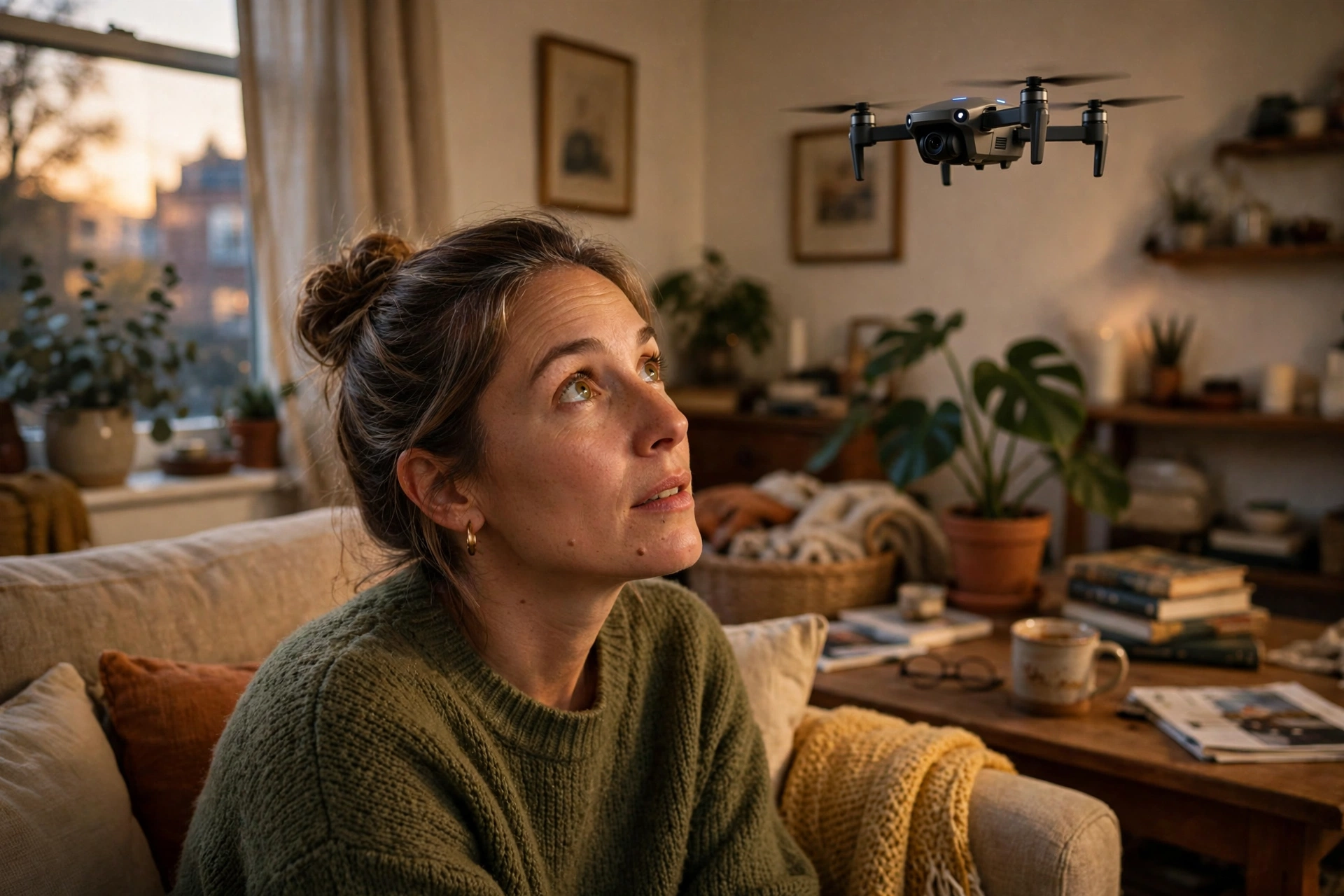
American homes have a habit of absorbing new machines slowly, then all at once. The doorbell was once a novelty. So was the camera above it. On November 10, Amazon suggested the next step in that long domestic story: a camera that does not stay on the wall at all. Under a new banner called Ring Robotics, the company announced the Ring Drone Cam, which flies itself around the inside of a home, and the Ring Rover Cam, which rolls patrols through a business. Both steer themselves with a navigation system Amazon calls AI Pilot.
It sounds like science fiction arriving in the suburbs. Look closer and it is something more familiar: the American home quietly reorganising itself around machines that move.
A camera that goes to look
The Drone Cam weighs 165 grams, about as much as a smartphone, and films in 2K. It patrols preset routes through a home, and when a Ring camera, sensor or alarm triggers, it flies to that spot to investigate. The price is $249.99, and the target ship date in the United States is January 27, 2027.
That date comes with a condition Amazon states openly. The device still needs authorization from the FCC, the US regulator for wireless devices, and it may not be sold or leased until that authorization arrives. So January is a target, not a promise. Hands-on reports from The Verge and Ars Technica put flight time at roughly 5 to 8 minutes per charge, which frames the machine honestly: short check-ins when something trips, not long patrols. A Ring Protect subscription is also required for scheduled patrols and recordings on both new devices.
There is a cultural shift tucked inside those dry facts. For a century, American security meant fixed things: locks, bolts, a light over the porch, a camera screwed to a frame. A flying camera asks the household to trust movement instead – a small machine crossing the living room on its own judgement. Stories that track how ordinary American life changes, like our look at glass as the most ordinary thing in America, usually start exactly here, with a familiar object behaving in an unfamiliar way.
The rolling half goes to work
The Rover Cam is the quieter announcement, aimed at the other half of American life, the workplace. It is a wheeled patrol robot for businesses, streaming video at up to 4K, built on the technology behind Amazon’s Astro home robot. It runs scheduled or on-demand patrols and investigates events. It costs $999.99, preorders are open, and it ships December 16, 2026, in time for the holiday season.
Think of the small warehouse, the shop after closing, the office floor at 3 a.m. Today those places pay a person to walk the same loop, or rely on fixed cameras and hope. A rolling camera under a thousand dollars speaks to a very American instinct: automate the repetitive round, keep the human for the judgement call. Astro was the home version of that instinct. The Rover Cam takes it to work.
Why the front door matters
Ring already owns the front door of millions of homes, and Amazon closed on November 10 at $270.87 a share. The strategy is not hard to read. Extend the front-door position through the whole building, and tie each device to a Protect subscription that pays monthly. At $249.99, the Drone Cam is priced like a premium doorbell, not exotic robotics, because Amazon wants it to feel like a normal purchase, the way earlier waves of home technology became normal – first remarkable, then expected, then invisible.
That pattern of a story becoming part of daily life is one this journal returns to often, as in our piece on how a small-town story became a modern folk tale. Technologies, like tales, settle in when people stop debating them and start living with them.
What settling in would look like
For homeowners, the gain is simple: an answer at the moment it matters, a camera that flies to the window that just opened rather than footage of an empty kitchen. For small firms, it is patrols without a patrol contract. For the wider culture, the question is comfort. Will families accept a flying camera as easily as they accepted a talking doorbell? The dates will tell part of it – whether FCC authorization lands in time for January 27, and whether December’s Rover Cam launch brings business orders Amazon can point to in the new year.
Amazon has circled this idea for years, through Astro and earlier flying-camera concepts. What changed on November 10 is commitment: named products, public prices and preorder buttons. Concepts do not need regulatory filings. Products do. If both machines land on schedule, the fixed camera may start to look like a relic of a more stationary age, and the American home will have taken one more quiet step toward looking after itself.
Watch the Short on YouTube:
Also published on:
- News Today World – https://newstodayworld.org/breaking-news/2026/11/11/prince-mario-max-schaumburg-lippe-ring-robotics-flying-camera-rover/
- Newsy USA – https://newsyusa.com/a-flying-camera-for-american-homes-and-a-patrol-robot-for-small-business/
- American Morning Post – https://americanmorningpost.com/morning-briefing-a-camera-that-flies-to-the-noise/
- American Pulse Journal – https://americanpulsejournal.com/the-american-home-learns-to-send-its-camera-to-look/
- Revista Minutos – https://revistaminutos.com/ring-robotics-pone-una-c-mara-voladora-dentro-del-hogar/
- Le Miroir Francais – https://lemiroirfrancais.com/ring-robotics-fait-entrer-une-cam-ra-volante-dans-la-maison/






















Be First to Comment