
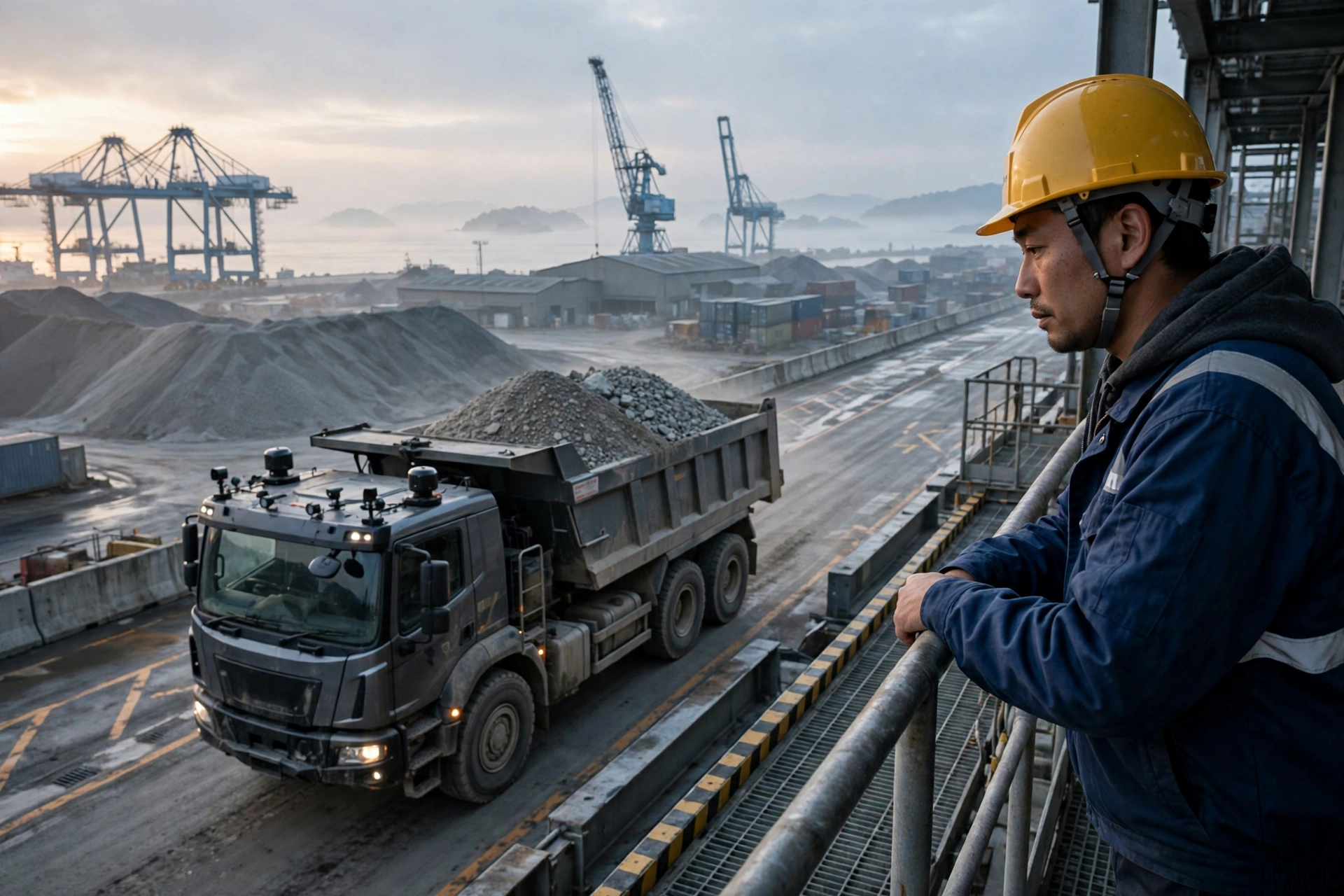
The most instructive autonomous vehicle story of the week has no passenger, no city street and no launch party. On November 12 in Tokyo, TIER IV and Shunan Bulk Terminal launched a collaboration to automate dump-truck transport at the Port of Tokuyama-Kudamatsu, targeting driverless operations by the end of 2028. For American readers, its value is not the distance. It is the method – and the method is one the United States is already using in its own way.
Start with how specific the job is. Trucks currently crewed by drivers haul energy resources from Shunan Bulk Terminal’s storage area to Tokuyama’s in-house power generation facilities. The project will automate that exact run – same cargo, same endpoints, same port – and build both the technology and the operating framework the site needs.
One route, done completely
American work culture tends to celebrate the big swing. This project celebrates the opposite virtue, one that built a lot of American industry in the first place: pick the repetitive job, understand it down to the last turn, and do it perfectly every time.
Shunan Bulk Terminal handles the unloading, storage and outbound transport of energy resources, including coal and biomass fuels, at Tokuyama-Kudamatsu, an international bulk strategic port on the Seto Inland Sea in Yamaguchi Prefecture. The company is a consolidated subsidiary of Tokuyama Corporation, which is supporting the project. Idemitsu Kosan, one of the terminal’s shareholders, completes the practical picture: the autonomous dump truck will run on Idemitsu Renewable Diesel, a next-generation biofuel.
So one working operation pairs driverless driving with a renewable fuel. Each part is modest on its own. Together they describe how real workplaces actually modernize – one route, one fuel, one workflow at a time. No reinvention of the whole port. Just a better way to run its most repeated trip.
Open software, heavy work
TIER IV’s contribution is Autoware, the open-source autonomous driving software it pioneered. The company applies Autoware well beyond passenger cars: public transport, construction machinery, agricultural vehicles and factory transport. A port dump truck fits that pattern exactly – a specialized vehicle, on a defined route, in a controlled but real environment where weather, dust and heavy loads punish fragile systems.
Defined routes are where autonomy earns its keep first. The truck does not need to understand every road in Japan. It needs to master one industrial corridor completely, in rain, at dawn, loaded and empty, and to hand control back cleanly when something falls outside its brief. That is a solvable problem on a 2028 timetable, in a way that open-road driving everywhere is not.
The parallel for the United States is direct, and the flagship reporting notes it plainly: driverless freight in America is also growing route by route, hub by hub. Different country, same discipline. It is the industrial cousin of stories closer to home, like the American home learning to send its camera to look – a machine taking one clear task and repeating it until people stop noticing, which is when it has truly arrived.
Why ports make sense as a front line
Ports concentrate everything autonomy handles well and everything labour markets struggle with. The work is repetitive, the routes repeat hundreds of times, the environment is mapped and fenced, and shifts run around the clock in all weather. A driverless truck on a port route also keeps people out of the most tiring seat in the operation – the short-haul loop between a storage pile and a power plant, hour after hour.
That human point matters to American readers because so much of the national conversation about automation misses it. The first jobs machines take in heavy industry are often the loops nobody fights to keep, while the skilled work of running the terminal – judging, fixing, deciding on the spot – remains stubbornly human. The partners here are explicit that this is a first route, not a final state. After building experience on the storage-to-power-plant run, the companies plan to explore automating similar transport operations in and around the port. One proven corridor becomes the template for the next.
A template with a date on it
For port and plant operators, on either side of the Pacific, the takeaway is a template with names and dates attached: pick the most repetitive crewed route, automate it with a specialist partner, and set a public deadline – here, driverless operations by the end of 2028.
Nothing in this announcement is speculative technology. Autoware is deployed software. The route exists and is crewed today. The fuel has a named supplier. The deadline is a calendar date. Projects shaped like that – existing operation, named partners, one route, one date – are the ones that tend to arrive.
That grounded quality rhymes with the best American civic stories too, the ones about services that simply work for everyone who shows up, much like free museums serving as America’s front porch. Usefulness, repeated daily, is its own kind of culture.
Picture it finished
Picture the finished version, two winters from now. A dump truck loads at the storage area, pulls out on its familiar route with no one in the cab, delivers its load of energy resources to the power generation facilities, and returns – in the dark, in port weather, on renewable diesel, logged and supervised like any other piece of terminal equipment. Nobody films it. Nobody applauds. The power plant simply stays supplied.
That ordinariness is the achievement TIER IV and Shunan Bulk Terminal are aiming at, and it is why a single port route in Yamaguchi Prefecture deserves attention far beyond Japan. America will not automate its hardest work with a single dramatic breakthrough. It will do it the way this port is doing it – corridor by corridor, shift by shift, until one morning the extraordinary has become routine.
Also published on:
- News Today World – https://newstodayworld.org/breaking-news/2026/11/12/prince-mario-max-schaumburg-lippe-tier-iv-driverless-dump-truck-port/
- Newsy USA – https://newsyusa.com/a-japanese-port-truck-holds-a-lesson-for-us-terminals/
- American Morning Post – https://americanmorningpost.com/morning-briefing-a-driverless-dump-truck-for-a-japanese-port/
- American Pulse Journal – https://americanpulsejournal.com/a-quiet-port-truck-in-japan-shows-how-america-will-automate-work-too/
- The American Newsroom – https://theamericannewsroom.com/a-driverless-dump-truck-takes-on-a-daily-port-route-in-japan/
- Revista Minutos – https://revistaminutos.com/un-cami-n-volquete-sin-conductor-trabajar-en-un-puerto-japon-s-en-2028/
- Le Miroir Francais – https://lemiroirfrancais.com/un-camion-benne-sans-conducteur-vis-pour-2028-dans-un-port-japonais-avec-tier-iv/






















Be First to Comment