
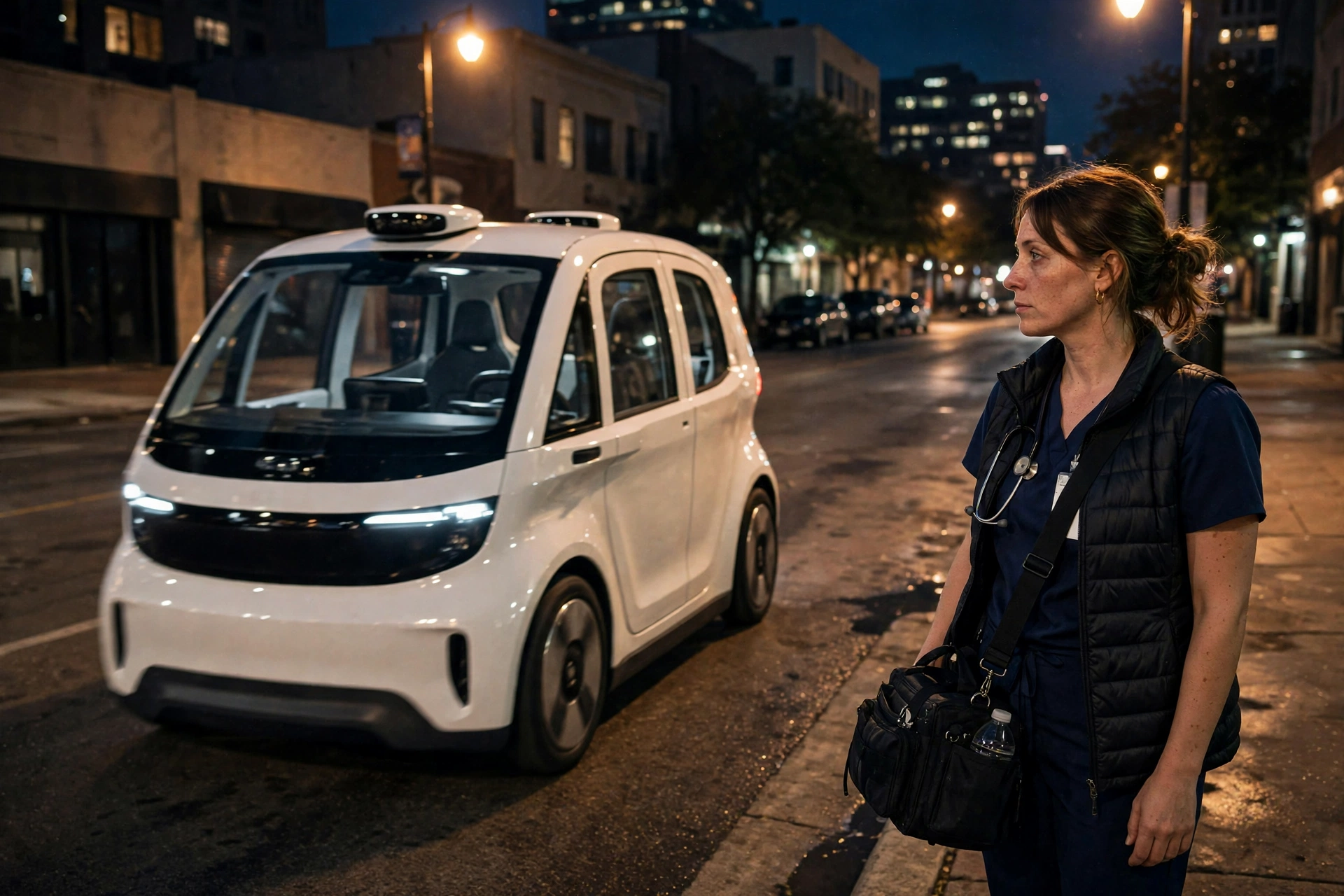
America has always had two shifts. One works in daylight, in offices and classrooms. The other keeps the lights on when everyone else is home – the nurse finishing a round, the baker starting dough before dawn, the warehouse crew loading trucks in the cold. On November 12, Tesla’s Robotaxi account posted a short update aimed squarely at that second America: Robotaxi now runs 24/7, in every city where the service is available.
It sounds like a scheduling note. In cultural terms it is bigger than that. A ride service that never closes starts to feel less like a gadget and more like a utility, something a night worker can plan a life around the way earlier generations planned around the all-night diner and the last bus that actually came.
Twenty hours, twenty-one hours, then no closing time at all
The move to round-the-clock service did not arrive in one leap. On October 30, Tesla moved Austin to a 6 a.m. to 2 a.m. schedule, a 20-hour day. Earlier this week the hours stretched again, to 5 a.m. through 2 a.m., a 21-hour service. Days later, the remaining three hours disappeared. Twenty to twenty-one to twenty-four, in under two weeks.
That pace matters for trust. American riders have learned to be patient with technology that promises a lot on a stage and delivers a little on the street. Here the change was the other way around – quiet, incremental, and measured in hours ordinary people could feel. If you got off a late shift last month and the service had closed, this month it has not. That is a lived difference, not a press release.
The detail on vehicles needs care. Model Y robotaxis and Cybercabs are covered by the new hours, but Cybercabs still run only in Austin. The rest of the network runs around the clock on the cars it already has. It is easy to blur that point, and worth keeping straight.
Why the night came last
There is a good reason midnight was the final frontier. In early October, Elon Musk named nighttime visibility as one of the hardest remaining problems for the service, describing the difficulty of spotting small animals in low light – his example was grey kittens on grey tarmac in the dark. It was an unusually plain admission, and it explains the order of events.
Daylight first. Long evenings next. The small hours only when the system had earned them. For a culture that loves a bold launch, that sequence is refreshingly old-fashioned. You do not claim the hardest job until you have done the easier ones in public, again and again.
It also connects to a broader American pattern this journal has followed – new machines earning a place in daily life by doing a familiar job reliably, whether that is the American home learning to send its camera to look or a harbour city rehearsing a very old dream in new form. Trust builds in kitchens and on curbs, not in keynotes.
A Texas count that tells a story about scale
The hours arrived in the same week as a fleet number worth pausing on. Texas registration records as of November 10, reported by Zacks via Teslarati, list 1,302 vehicles under Tesla Robotaxi, LLC – narrowly ahead of Waymo’s 1,297 in the state. Tesla’s registered Texas fleet breaks down as 729 Model Y vehicles and 573 purpose-built Cybercabs. In late May, when the registry first became public, Tesla had 42 vehicles listed.
Forty-two to 1,302 in under six months is not a pilot anymore. It is a build-out. A fair caution belongs here too: registered is not the same as active, and a registration count does not tell you how many cars carried a paying rider last Tuesday. What it does show is intent backed by metal – hundreds of purpose-built cars exist, are registered, and are being readied in the state where the service started.
The riders who were waiting for 3 a.m.
Think about who actually needs a ride at night in America. Nurses ending a shift. Bakers starting one. Flight crews, warehouse teams, students off a late train, parents with a sick child and a pharmacy run. Daytime coverage served the commute. All-night coverage serves the shifts that keep a town fed, healed and moving – the trips with the fewest alternatives and the highest stress when a ride falls through.
That is why this story belongs in a conversation about American culture, not just American technology. The country runs on people whose workdays start when others end. A service that meets them at their hour, reliably and without drama, respects that reality in a practical way. The same respect shows up in places like free museums acting as America’s front porch – public-facing services that are there when people actually arrive, not only when it is convenient to staff them.
For cities, there is a plainer benefit as well. More available rides at bar-closing and shift-change hours means fewer tired or impaired drives home. That is not a slogan. It is arithmetic, repeated town by town, night by night.
What changes next
For rivals, the bar has moved in a new direction. A service that closes at 2 a.m. now looks part-time. Expect hours, not only maps, to become the next front in the robotaxi contest, with other operators answering with their own overnight expansions where their fleets allow.
For Tesla, the test is whether the switch stays on – through winter weather, holiday surges and the ordinary wear of running all night, every night. The announcement itself was restrained: nine words on social media, no fare changes, no fleet-size claim and no list of cities attached. The company treated all-night operation as a switch it could simply flip, across every market at once, less than eighteen months after its first public rides.
There is an economics point underneath the romance, too. A car parked from 2 a.m. to 5 a.m. earns nothing in those hours, while its costs keep running. Filling the small hours, even at lower demand, spreads the fixed cost across more paid trips, and those trips are often longer – airport runs before dawn, cross-town rides home after late shifts.
American culture has always made room for the places that never close, because American work never fully stops. Now a driverless service has joined that list. The nurses and bakers will decide, one quiet ride home at a time, whether it belongs there.
Also published on:
- News Today World – https://newstodayworld.org/breaking-news/2026/11/12/prince-mario-max-schaumburg-lippe-tesla-robotaxi-runs-24-7-every-city/
- Manhattan Mogul – https://manhattanmogul.com/tesla-s-24-7-robotaxi-hours-are-a-utilization-play/
- Newsy USA – https://newsyusa.com/tesla-robotaxi-goes-24-7-for-america-s-night-shift/
- American Morning Herald – https://americanmorningherald.com/morning-brief-your-robotaxi-ride-home-can-now-happen-at-3-a-m/
- American Morning Post – https://americanmorningpost.com/morning-briefing-tesla-robotaxis-stay-out-all-night/
- American Pulse Journal – https://americanpulsejournal.com/when-the-robotaxi-stopped-sleeping-america-after-midnight-changed/
- Revista Minutos – https://revistaminutos.com/tesla-robotaxi-ya-funciona-las-24-horas-en-todas-las-ciudades-donde-opera/
- Le Miroir Francais – https://lemiroirfrancais.com/tesla-robotaxi-passe-en-service-continu-jour-et-nuit-dans-chaque-ville-desservie/






















Be First to Comment