
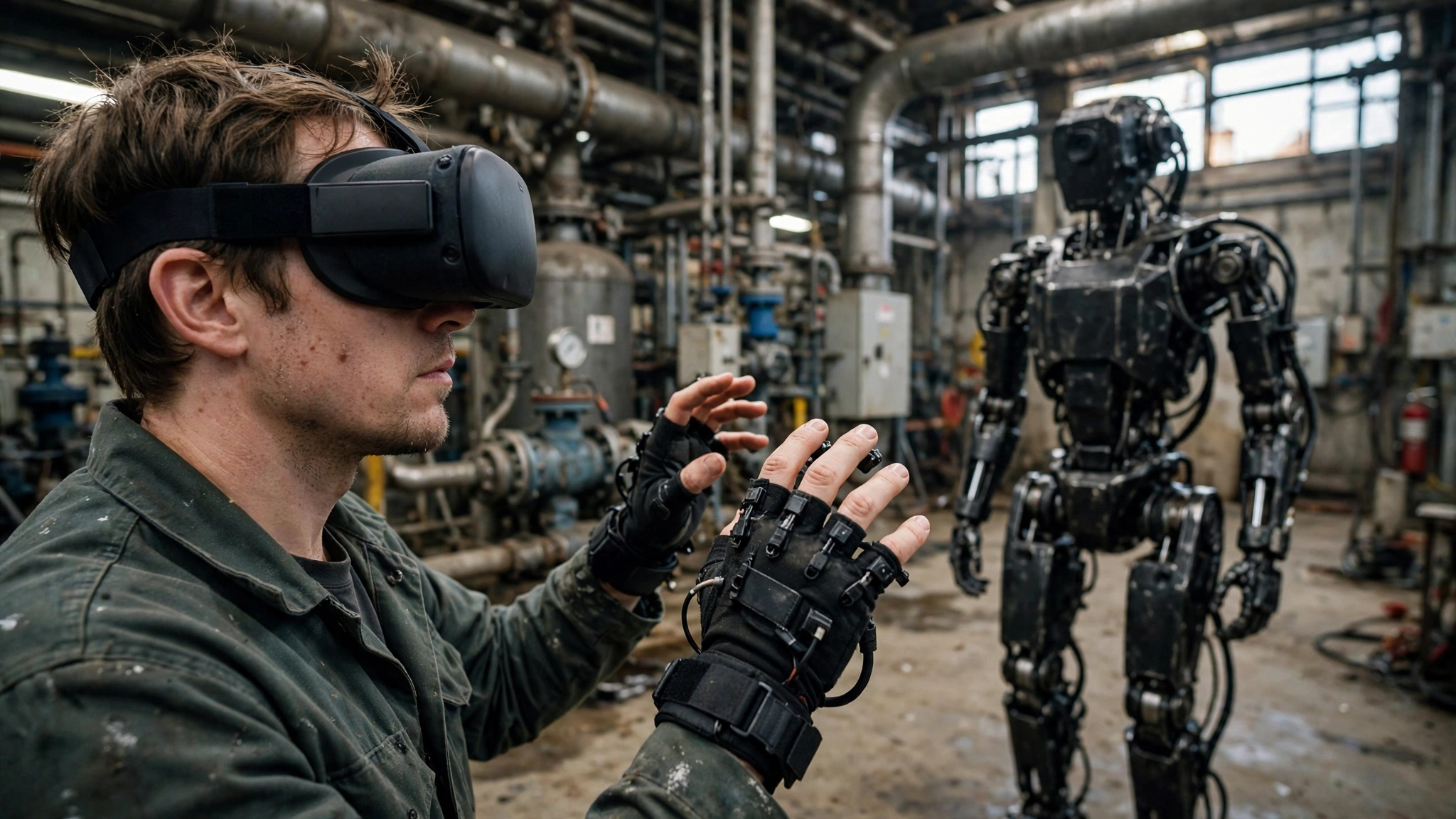
Most humanoid robots arrive with a highlight reel. Minerva Humanoids arrived with a job description, and a customer. The San Francisco startup stepped out of stealth this week with roughly $10 million in pre-seed funding led by General Catalyst, with Long Journey Ventures and Credo Ventures as co-leads. Its robot is called Roger. His job is to go into the places where humans shouldn’t.
The target list is specific and serious: onshore and offshore oil and gas, explosive ordnance disposal, hazmat response. These are environments where the hazard is the entire point, toxic air, explosive atmospheres, crushing machinery. Minerva’s pitch is refreshingly honest about what autonomy can and can’t do today. Roger is semi-autonomous. Trained specialists operate him through a VR headset and force-feedback haptic gloves, staying physically outside the danger zone while the robot works inside it.
That is a philosophy, not a compromise. Full autonomy in an unpredictable industrial disaster is a fantasy. A skilled human with robot hands in the room, via a robot body in the room, is a product. Minerva’s AI handles the parts machines do well: balance, fall recovery, navigation, translating the operator’s commands into whole-body motion. The human handles the parts people do well: judgment, improvisation, knowing which valve to turn.
Built in five months
Here is the number that stopped people: five months. That is how long it took Minerva to go from concept to a walking humanoid. In an industry where development cycles are measured in years, that is startling, and it came from a team with the credentials to back it up.
CEO Sandor Felber launched the humanoid research line at MIT’s Computer Science and AI Lab, then worked on Tesla’s Optimus program. CTO Maurice Rahme spent six years at Boston Dynamics, where he was the technical lead on Stretch from prototype to commercial product. These are people who have shipped robots before. The five-month timeline stops looking like hype and starts looking like experience.
A Western supply chain on purpose
The supply chain tells its own story. The software and AI were developed in the U.S. The first Roger prototypes were manufactured in Germany. Commercial versions will be built in Germany and the U.S. with a Western supply chain and no single-source Chinese components. In 2026, that is not just logistics. It is a selling point, especially for energy and public-safety customers.
Why semi-autonomy is the right call
The robotics industry has a highlight-reel problem. Viral videos show humanoids doing backflips and folding laundry; the messy reality of useful work, hours of it, in ugly environments, rarely makes the cut. Minerva is pushing transparency from the commercial side: low-latency control, full-body operation that users learn in under five minutes, and a first paid industry pilot launching this month. Not a demo. A pilot. Paid.
The applications explain the urgency. Minerva estimates that around 7,000 energy workers die each year worldwide, the company’s own estimate, but the order of magnitude is the point. Every one of those deaths happened in a place a robot could have gone instead. Explosive ordnance disposal is the same story: the robot finds out what’s dangerous so the human doesn’t have to. That is life-saving public-safety work, full stop.
The company has already showcased Roger at the NATO Explosive Ordnance Disposal Centre of Excellence in Samorin, Slovakia, and is exploring deployments at two of the world’s ten busiest airports. Research partnerships with MBZUAI on energy capabilities and the University of Waterloo on perception in smoke, darkness and sensor failure cover exactly the conditions where humans currently risk their lives.
What Roger means in practice
For travelers, Roger’s first deployments will be invisible, and that is the point. The robot that keeps an airport’s fuel farm safe or inspects an offshore platform is infrastructure you never see. Safer energy and transport systems are the quiet dividend.
For cities, the public-safety angle is the one to watch. Hazmat response and ordnance disposal are municipal services everywhere. A robot that lets a response team work from outside the danger zone isn’t science fiction anymore. It’s a procurement decision.
For investors, $10 million pre-seed led by General Catalyst is a strong signal, and a paid pilot in month one of public existence is stronger. The semi-autonomous model sidesteps the hardest problem in robotics, full autonomy, while selling into markets with real budgets and real pain. The risk is execution: five months to a walking prototype is impressive, but commercial robots live or die on reliability, and reliability is earned in years, not months.
The humanoid race has a new entrant, and it’s the most grounded one yet. Not a backflip. Not a dance. A robot with a VR operator, haptic gloves, and a job in the worst room in the building. Sometimes the future doesn’t look like a highlight reel. It looks like Tuesday in a hazmat suit, except the human stays outside.






























Be First to Comment