
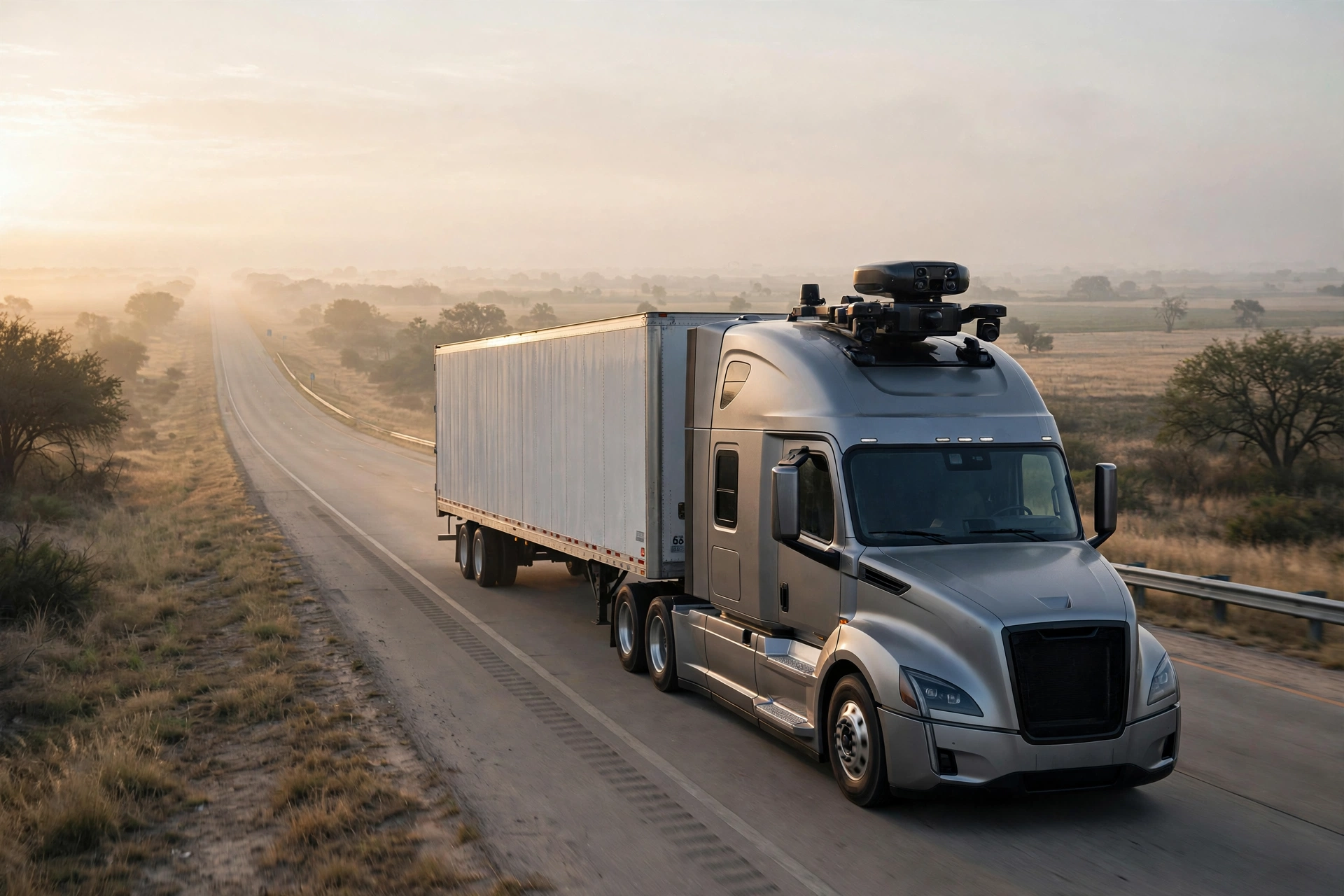
Pittsburgh’s Aurora Innovation does not deal in vague promises. At its September 23 Analyst and Investor Day, the company told Wall Street it is aiming for more than 30,000 driverless trucks on the road by 2030, pulling in multibillion-dollar revenue with software-style gross margins through a Driver as a Service model. That is a specific number, on a specific date, with a specific business model attached.
The near-term roadmap is equally specific. Aurora will close out 2026 with 200 driverless trucks running under its Transport as a Service model, and says every bit of that capacity is already spoken for. Since the commercial launch, the fleet has logged more than 500,000 driverless miles for real customers, McLane and Werner among them. Annualized utilization runs above 225,000 miles per truck, which is more than twice what a conventional truck manages.
That utilization figure is the entire argument in one number. A human-driven truck stops earning during rest breaks, shift changes and sleeper berth hours. A driverless truck simply keeps rolling. At double the annual mileage per vehicle, the economics don’t improve a little. They improve a lot.
Gen-2 hardware: a million-mile kit at half the cost
Aurora also showed off its second-generation commercial hardware kit, engineered for a one-million-mile operating life at less than half the cost of the current kit. Roush has started volume installation, targeting 20 trucks per week through October. If that pace holds, the fleet grows by hundreds of trucks before the year is out.
The truck manufacturers are committing alongside it. Volvo has integrated the Aurora Driver at its New River Valley plant in Virginia on the Volvo VNL Autonomous. Paccar is contributing a third-generation hardware kit, and International is adding its LT Series. To make the point in person, Aurora demoed commercial operations on the Dallas-Houston freight corridor, complete with driverless rides for investors in trucks weighing in at 80,000 pounds fully loaded.
A 500-truck signal from Hirschbach
Hirschbach Motor Lines intends to own and operate 500 Aurora-powered trucks, with deliveries starting in 2027. Fair warning: that is under a non-binding memorandum of understanding, not a signed order. Even so, it is the clearest sign yet that established carriers are planning future fleets around autonomy instead of watching from the sidelines.
Why freight is outpacing robotaxis
Robotaxis grab the headlines, but freight has the economics. Long-haul highway routes are the most structured driving in the country: the same corridors, the same exits, the same rest stops. It is also where driver shortages bite hardest and the hours run longest. Nobody has to persuade a truck that a 2 a.m. run from Dallas to Houston is worthwhile.
CEO Chris Urmson put it plainly at the investor day: transformative technologies develop for years before hitting a commercial inflection point, and “Aurora has arrived at that moment.” From the former head of Google’s self-driving project, that reads less like hype and more like a man who has sat through a very long development curve announcing it just bent.
For travelers, these trucks will never carry passengers, but they carry everything else. Cheaper, steadier freight eventually lands in grocery prices and store shelves. And a truck that never gets drowsy is a genuinely different proposition on I-45 at three in the morning.
The road from 200 to 30,000
Cities should be paying attention to the corridors. Autonomous freight concentrates on specific routes, Dallas-Houston today, more tomorrow. Corridor towns should be thinking about truck traffic that needs no parking, motels or diners, but does need dependable fueling and maintenance infrastructure.
Thirty thousand trucks by 2030 with software-like margins is a genuine moonshot, and the distance between here and there is still enormous. But the milestones under it are concrete: 500,000-plus driverless miles, 200 trucks by year-end, 20 installations a week, a million-mile hardware kit. The chasm between a demo and a paying fleet has closed. That was the chasm that ended a decade of autonomy startups.
The quietest revolution in transportation carries no passengers at all. Just produce, parcels and pallets, 225,000 miles a year, with an empty cab and improving margins.


































Be First to Comment