
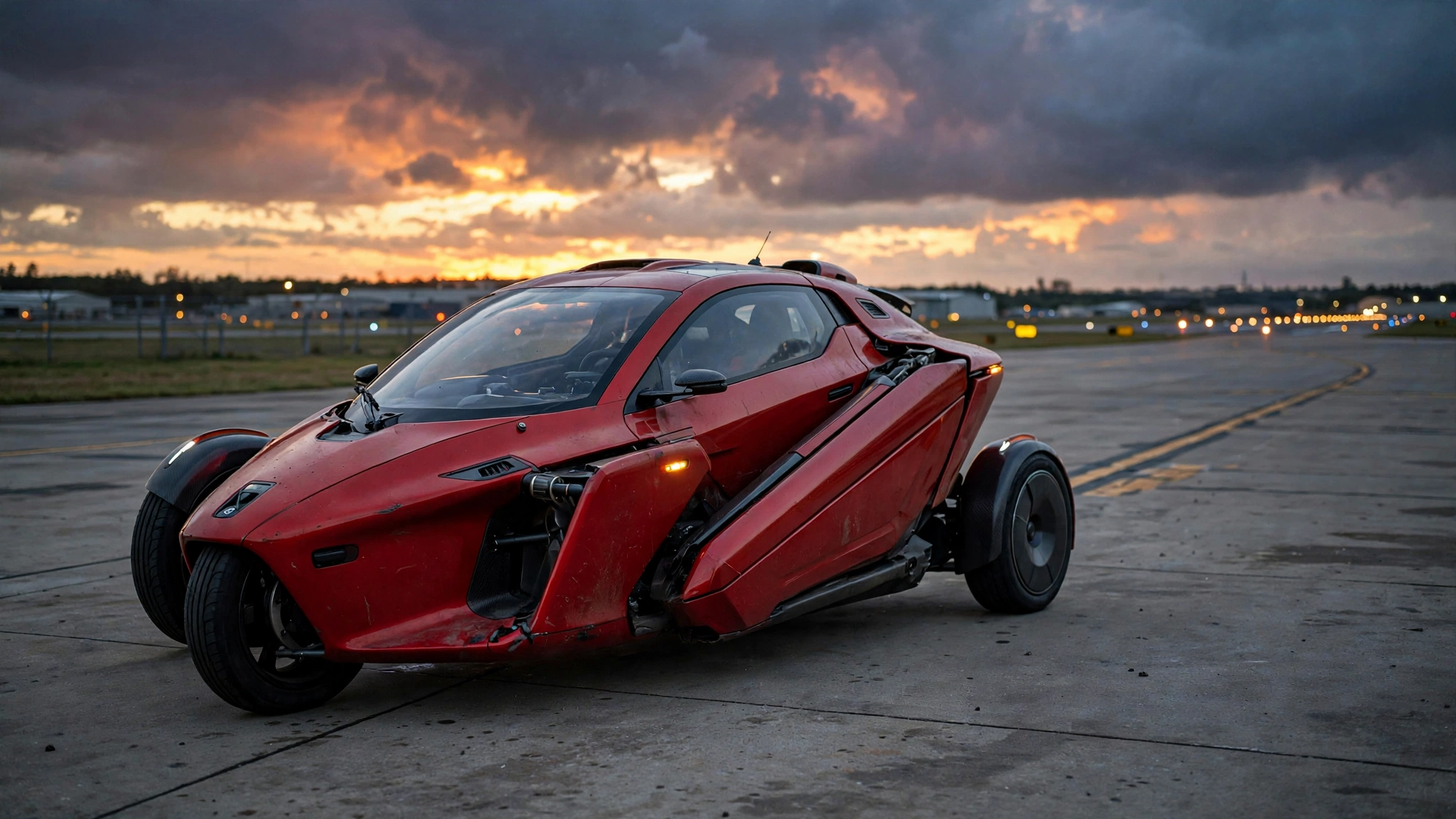
The flying car has been perpetually five years away for about fifty years. This week it got something more convincing than a timeline: a factory budget. Samson Sky secured an $80 million investment from Dubai-based Matin Group to build the first U.S. production facility for its Switchblade hybrid-electric roadable aircraft. That is the difference between a rendering and a real assembly line.
The Switchblade pitches the flying car the way it actually works for buyers. You drive it on ordinary roads to your local airfield, then you take off. It is a roadable aircraft, not an eVTOL air taxi: no vertiports, no new infrastructure, just the 5,000-plus public airports America already operates. That distinction is the whole strategy. The Switchblade doesn’t need a regulatory revolution to be useful. It needs a factory. Which is what the $80 million pays for.
The $20 million gap
Samson Sky is upfront about the catch: another $20 million still has to be raised to launch production. The $80 million covers the building and the tooling; the final $20 million gets the first aircraft out the door. In startup terms, that is close enough to taste. Really, the Matin Group commitment is a bet that the last twenty million will follow.
For travelers, honesty is warranted: not you, not yet. The first Switchblades will belong to pilots with the training and the means, the same people who buy light aircraft today. But every production line that opens for personal aviation makes the next one cheaper. The flying-car dream has always been a manufacturing story, not a technology story.
Why Dubai wants in on American aerospace
Matin Group’s move fits a pattern. Gulf capital has been circling American aerospace manufacturing for years. Advanced air mobility is one of the few sectors where the U.S. still holds a clear lead and where the capital requirements are large enough to matter. The Switchblade’s pitch is tailor-made for that money: a product you can picture in a showroom, sold to enthusiasts first, scaled through conventional manufacturing rather than moonshot research.
Flying-car factories also photograph well, and Dubai has spent two decades branding itself as the city of the future. Backing America’s first flying-car production facility fits the portfolio. But $80 million is real money, not a photo op. The factory has to turn out aircraft that actually fly.
The roadable advantage
Here is what the Switchblade understands that much of the eVTOL world doesn’t: infrastructure is the hard part. Air taxis need vertiports, charging networks, new air-traffic procedures and public buy-in in crowded cities. A roadable aircraft needs a pilot’s license, an airfield and a garage. The market is smaller, wealthy early adopters and enthusiasts rather than commuters, but the path to revenue is shorter.
It is still not easy. Certification is certification, and roadable aircraft sit at the intersection of two regulatory worlds, road safety and aviation safety, which rarely have to agree on the same vehicle. But it is a vehicle with a defined job: fly between cities that already have airports, using roads to reach them. No new science required.
No verified performance figures have been published for the Switchblade, and it is only fair to say so. This story isn’t about speed or range claims. It is about manufacturing capacity, the least glamorous and most decisive stage of any vehicle’s life.
An existing customer, waiting
The enthusiast angle deserves more credit than it gets. Light-aircraft owners already number in the hundreds of thousands in the U.S., and plenty of them would pay a premium to skip the drive to the airfield in a separate car. The Switchblade doesn’t need to invent a customer. It needs to convert one that already exists and already holds a pilot’s license.
For cities, the roadable model is refreshingly low-drama. No vertiport zoning fights, no noise debates over downtown. The aircraft flies out of airfields that already exist, in airspace that is already managed. And for investors, the equation is the $20 million gap: if it closes quickly, the Switchblade graduates from startup to manufacturer. If it drags, the factory becomes an expensive building full of potential.
Fifty years of flying-car promises have taught us to watch the factories, not the renderings. Samson Sky now has a factory to build, and $80 million of Dubai’s money betting that it will.






































Be First to Comment