
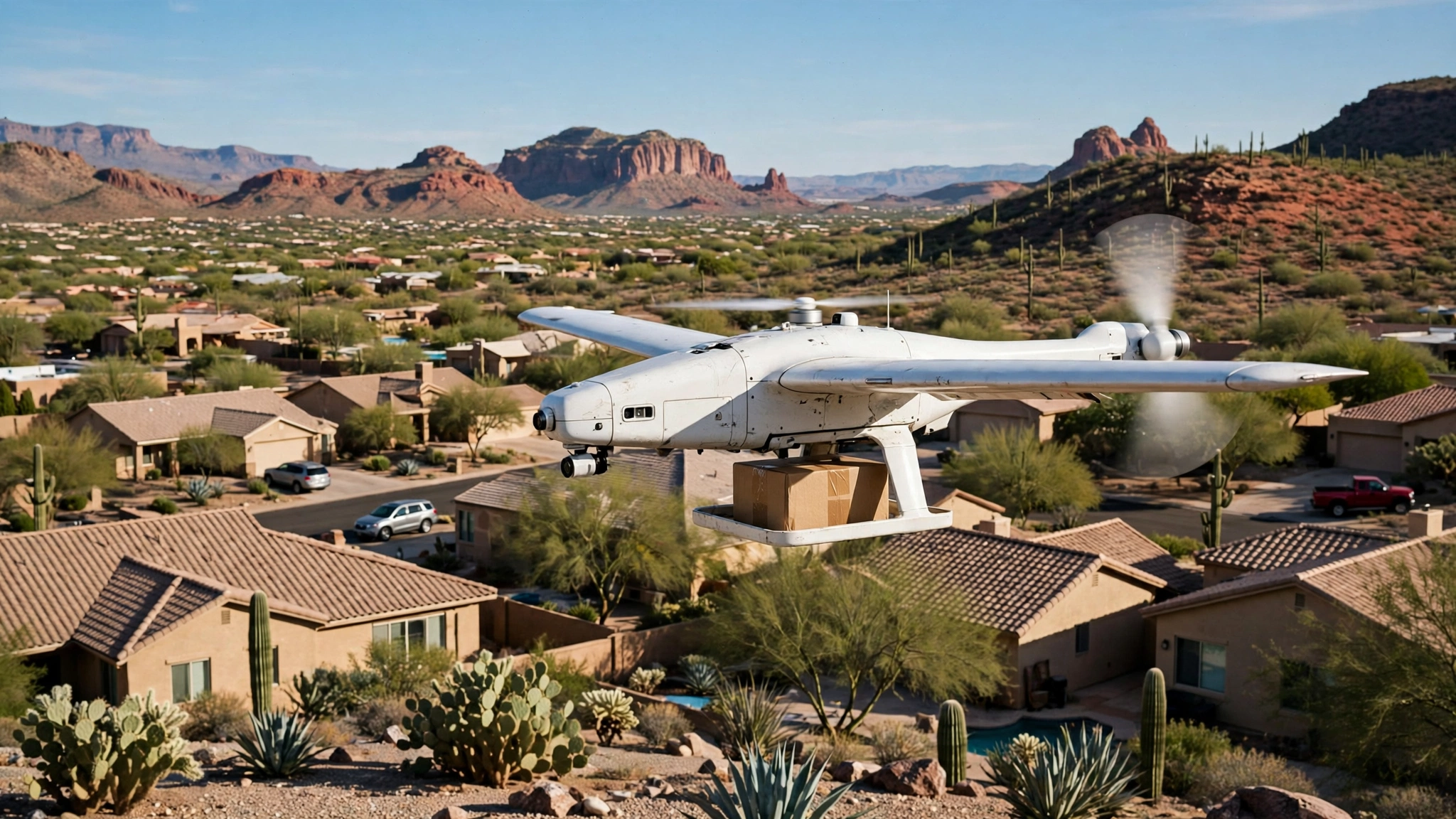
Zipline is seeking approval from the Federal Aviation Administration for commercial drone delivery across the Phoenix and Tucson metro areas in Arizona, according to a draft environmental assessment published by the FAA in November. The draft rates the proposed network at up to 130,000 package deliveries a day and describes operations 24 hours a day, 7 days a week, including holidays.
For households in those two metro areas, the number needs a plain reading first. The 130,000 figure is a maximum used in an environmental document. It is not an approval, and it is not a forecast for a typical day. The FAA draft uses a high ceiling so regulators and the public can review the proposal at its full stated scale. If Arizona flights are approved, operations would start far below that level, and the daily pace would depend on customer demand and on weather.
What an 8 pound limit means at your front door
The aircraft named for the Arizona service is Zipline’s Platform 2. The system has a maximum takeoff weight of about 63 lb and can carry a payload of up to 8 lb per trip. That limit shapes the service more than the headline capacity number does.
An 8 lb payload points to a small household order. It fits the kind of item a family needs today and does not want to drive for, rather than a bulk grocery run or a heavy box. It will suit some orders well and will not suit others at all. That is not a flaw in the plan. It is the boundary that tells shoppers what to expect if the service starts in their neighborhood.
The scale in the draft comes from repetition, not from size. One light aircraft carries one small package. Across two large metro areas, many repeated trips add up to a large assessed total. The proposal is not a plan to move heavy cargo over Phoenix and Tucson.
Around the clock, on paper
The draft describes operations running around the clock, including holidays. That is the operating pattern being assessed, not a promise that volume will be the same at 3 a.m. as at noon. Demand varies by hour, and weather can still ground small aircraft even under a 24-hour authorization. Arizona heat and monsoon storms are both factors the draft process has to account for in practical terms.
For a neighborhood, the round-the-clock wording raises the everyday questions that a comment period is meant to surface. Where would flights be concentrated? How often would a given street see a delivery? Those questions sit below the big capacity figure, and they are closer to how residents will judge the service if it arrives.
American family routines already absorb new delivery habits quickly when they save a trip, a pattern we have noted in coverage of how one event lives at American family tables. A drone service would enter that same routine space. It would compete not only on speed, but on whether a household trusts it for a small, time-sensitive order on a weekday evening.
What Zipline already holds
Zipline does not enter the Arizona process as a first-time applicant. The company already holds an FAA Part 135 air carrier certificate. It also holds an exemption for beyond-visual-line-of-sight operations, the type of flying a delivery network needs when aircraft travel to customers who are not in sight of the operator.
What the company still needs for Arizona is specific. According to the draft process, Zipline needs amendments to its operating specifications before Arizona flights can start. Operating specifications set the conditions under which a certificate holder can fly a particular operation. Until those amendments are in place, the Phoenix and Tucson service cannot begin, even though Zipline already flies commercial drone delivery elsewhere in the United States.
That history matters for shoppers reading the proposal. This is an expansion by an operator with an existing certificate and existing United States operations, not a first flight by a company that has yet to carry a paid delivery. It does not remove the need for the FAA to finish its review.
The wider pace of change in how goods and people move is a regular theme in our reporting, including a recent American milestone story about work that took decades to reach its current point. Drone delivery is moving faster than that, but the Arizona step shows the same pattern of a public record building over time before a service becomes routine.
How residents can follow the next step
Public comments on the draft environmental assessment are open into early December 2026. The draft itself gives December 7, while the FAA review page lists December 9, so anyone who wants to comment should check the FAA page for the exact closing time rather than rely on a date quoted secondhand.
After the comment period closes, the operating specification amendments remain the gate before any Arizona flights can start. That sequence gives Phoenix and Tucson residents a clear order to follow. First the comment record closes, then the FAA completes its review, then Zipline would need its amended specifications in hand before a first commercial delivery in Arizona.
The story was also covered by News Today World, Newsy USA, American Morning Herald, American Morning Post, Revista Minutos and Le Miroir Francais.
Watch the Short on YouTube:





















Be First to Comment