
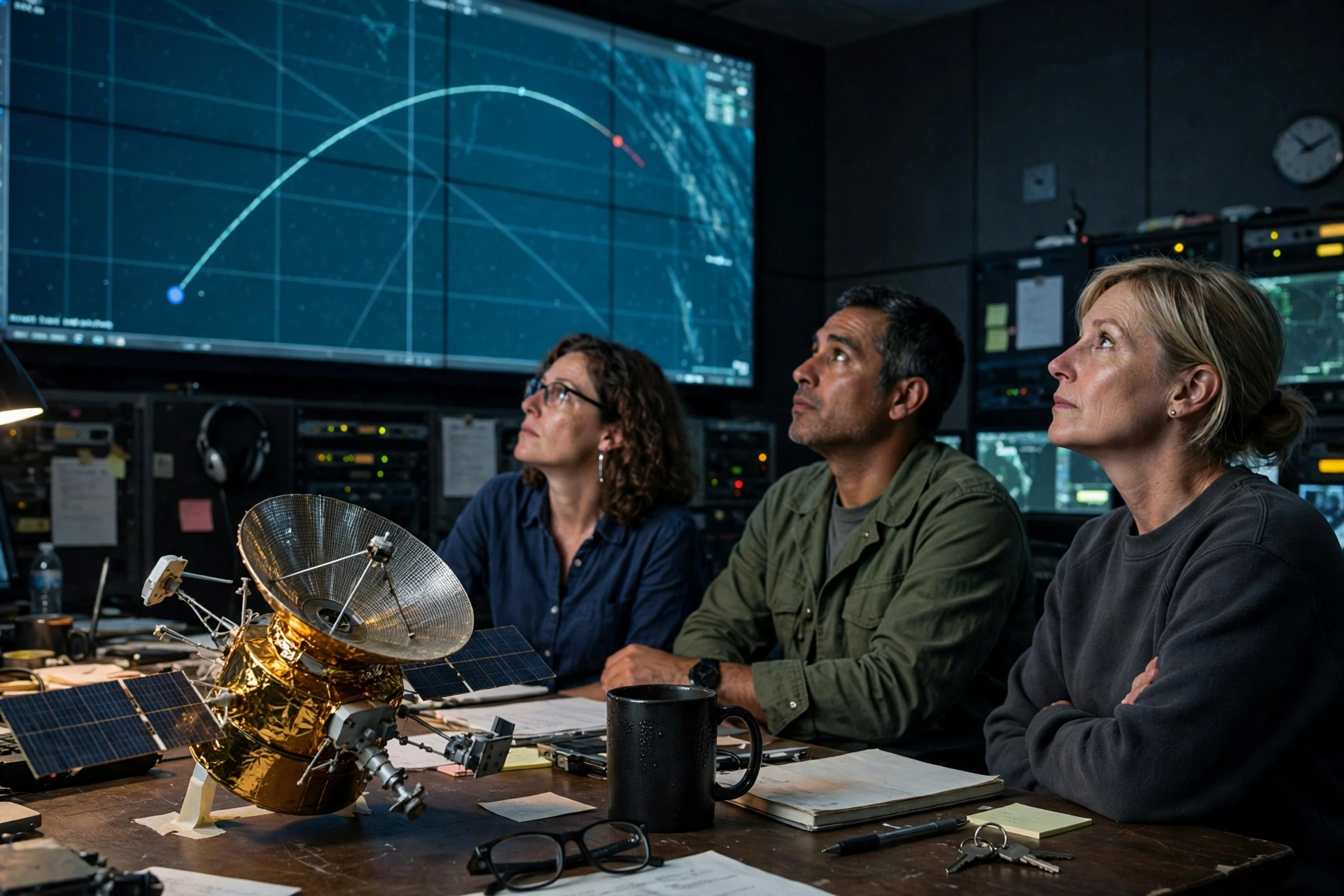
Voyager 1 will reach a distance of one light-day from Earth on Wednesday at 5:16 a.m. ET, NASA said in reporting carried by Reuters on November 14, 2026. One light-day is about 16 billion miles, or 26 billion kilometres. It is the distance light travels in 24 hours, which means a radio signal from the spacecraft will then take a full day to reach home.
The probe is travelling at almost 38,000 miles per hour, about 61,000 kilometres per hour. It has been flying for 49 years. No human-made object has travelled farther, and the milestone belongs in a particular way to the American program that built it and to the people who have spent whole careers listening for its signal.
A Working Career That Started in 1973
Alan Cummings, a senior research scientist in the Space Radiation Laboratory at Caltech, has been a Voyager program scientist since 1973. He told Reuters he views the mark as an engineering milestone, marking the longevity of Voyager 1 and the achievement of still being able to communicate with it at its distance. Cummings joined the Voyager team at age 29. He is now 82, and he told Reuters the mission has been the backbone of his career, with 53 years spent working on it and analysing its data.
The distance is hard to picture, so the signal time does the work better. Engineers send a command, and the reply cannot arrive for two days, one day out and one day back. Every instruction is written with that delay in mind. There is no quick correction and no second attempt on the same shift.
That patience is a shared American habit in the places where this work happens, in labs and control rooms where a result can take years to arrive. Our coverage of a dot in old Harvard photographs that could add a sixth dwarf planet followed researchers working from images taken long ago. Voyager is a live version of the same discipline, except the instrument is still moving away.
What the Twin Probes Found on the Way Out
Voyager 1 launched on September 5, 1977, from Cape Canaveral in Florida, on a Titan IIIE-Centaur rocket. It launched 16 days after Voyager 2, then overtook its twin within months because of the route it took. At Jupiter, Voyager 1 found a thin ring around the planet. It also found two moons that had not been detected before, Thebe and Metis. At Saturn, it spotted five new moons and a ring called the G-ring.
Voyager 2 took a different path so it could visit Uranus and Neptune, the only spacecraft to have done so. Voyager 1 crossed the outer edge of the heliosphere in 2012 and entered interstellar space. The heliosphere is a bubble of particles and magnetic fields produced by the sun. Outside it, the probe could measure galactic cosmic rays at low energies for the first time, a measurement Cummings called the holy grail of low-energy cosmic ray physics. Voyager 2 entered interstellar space in 2018, and on its current path it will reach one light-day from Earth in November 2035.
The Golden Record as an American Mixtape to the Stars
Both Voyagers carry a Golden Record. It is a 12-inch gold-plated copper phonograph disk, 30.5 centimetres across, made to describe Earth to anyone who might find the spacecraft. It holds images and sounds from the planet. The music includes Chuck Berry’s “Johnny B. Goode” and Beethoven’s Fifth Symphony. It includes Aboriginal songs from Australia. Spoken greetings are recorded in 55 languages, along with instructions for locating Earth.
Putting Chuck Berry on that disk was a cultural choice as much as a scientific one, a piece of American music sent out as a calling card. Cummings addressed a question that has followed the record for decades, whether giving directions to Earth is wise. He said he has heard that concern a little over the years but never worried about it, adding that it is pretty unlikely anyone will find it.
For scale, a light-year is about 5.9 trillion miles, or 9.5 trillion kilometres. The nearest star system beyond the sun, Alpha Centauri, sits about 4.24 light-years away. Voyager 1 is nowhere near that distance, and Wednesday’s mark is a smaller unit that no spacecraft has reached before.
NASA has invited the public to mark the milestone after sunset on Tuesday, before the 5:16 a.m. ET crossing on Wednesday. The agency asked people to use a phone or a flashlight to send a wave of light into the night sky, spelling V-G-R in Morse code. V-G-R is Voyager’s call sign. NASA will also hold a public session on November 19 with a status update on both probes and a discussion of the mission, including a question-and-answer segment and a preview of an upcoming NASA+ Voyager documentary. The next fixed point is Wednesday at 5:16 a.m. ET, when the one-way signal time reaches 24 hours exactly.
Also on Pulse today: the Showroom Greeter With 400 Orders Behind It and in Atlanta, the Car With No Driver Joins the Daily Routine.
The same story runs today in News Today World, American Morning Post, Revista Minutos, Newsy USA and Le Miroir Français.



















Be First to Comment