
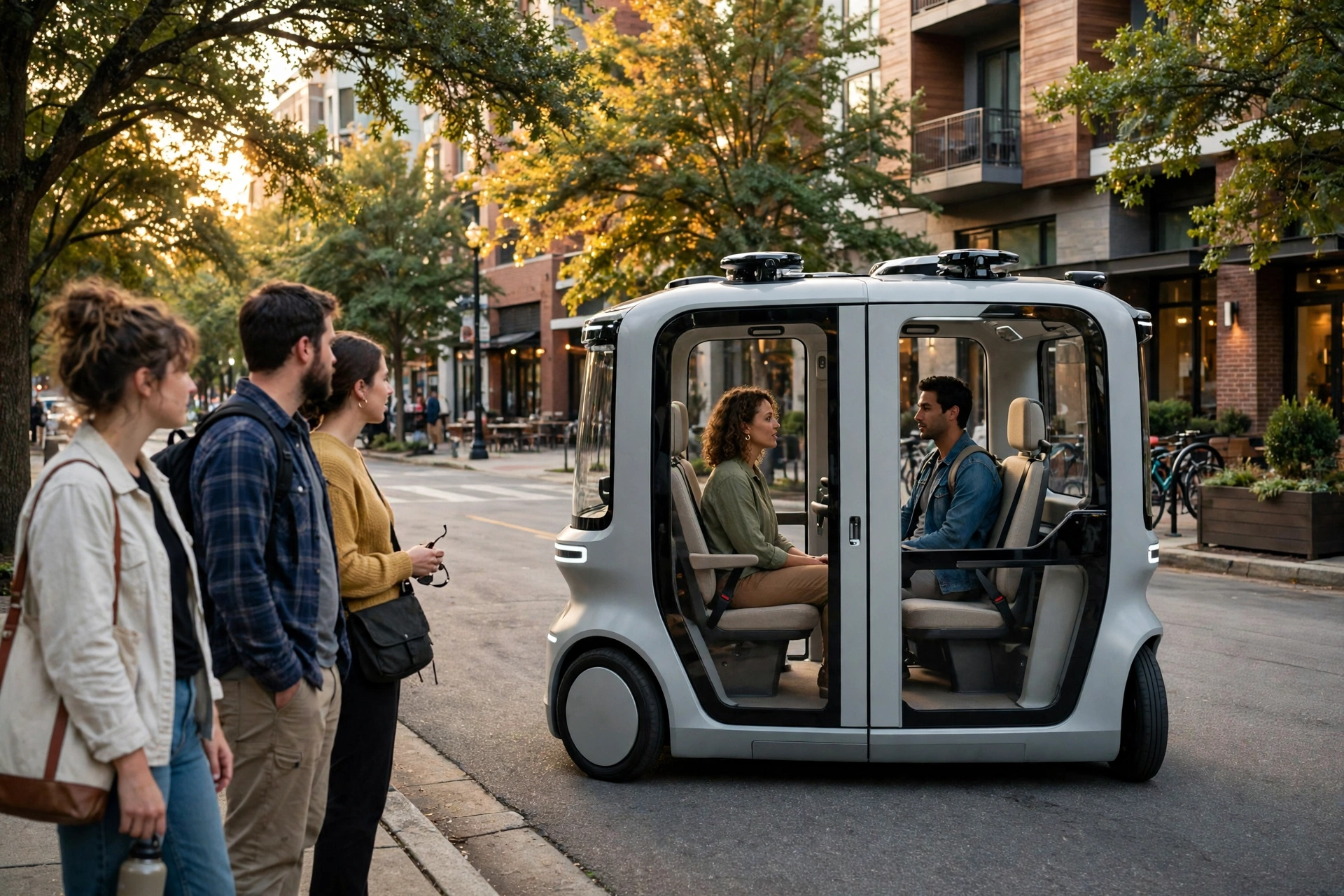
Zoox said on November 13 that its purpose-built robotaxi is now driving in Atlanta, Georgia, with the first rides covering the northwest part of the city near Atlantic Station, Woodward and Home Park. For now, the passengers are Zoox employees and their family and friends.
American cities have a long habit of absorbing new ways to get around, then arguing about them, then treating them as ordinary. Atlanta has reached the middle stage for the driverless car. The vehicle is on the street, neighbours can see it, and the argument now is about when ordinary riders get a turn.
A ride that does not look like a car ride
The Zoox vehicle was designed from the ground up for autonomous ride-hailing. It has no steering wheel and no driver seat. Passengers sit in a carriage-style cabin that seats up to four people, facing each other rather than sitting in rows behind a driver.
That facing arrangement is the cultural detail in this story. A conventional car ride organises people around the driver. A carriage cabin organises them around each other. Four people can talk without turning around, and getting in and out does not mean climbing past a front seat built for a job that no longer exists in the vehicle.
Zoox owns and operates its vehicles and assembles them itself. The company says it is the only company currently deploying a fully driverless, purpose-built robotaxi on US public roads. The claim rests on the combination – a vehicle that was never a conventional car, running a driverless service – rather than on any single feature.
How a city learns a new service
Zoox did not arrive in Atlanta this week. The company started operations there in spring 2025 with its testing fleet, covering mapping and learning local driving behaviour, plus weather and infrastructure. Since then it has begun autonomous driving in the city and expanded its geofence, its fleet and its local team in parallel.
The public path from here is staged. Zoox says it will expand as testing progresses. An Atlanta waitlist will open, then the Zoox Explorers program will follow for early riders, with notices sent through the Zoox app when a rider’s turn approaches. Atlanta joins Austin and Miami as a testing market for the purpose-built vehicle. Public service is already available in Las Vegas, and San Francisco runs an Explorers program.
That slow widening is familiar from other changes in American daily life. A new service starts with insiders, invites a list of the curious, then opens the door wider once the routine holds. This journal saw a similar pattern in workplaces in its coverage of what the Outlook outage showed about how America works – habits form around a tool long before anyone calls the change complete.
Before test vehicles drive in a new city, Zoox says it engages local and state officials and regulators. The company also lists a community partnership in Atlanta with the @Promise Center, which works on youth learning and development and employment. Local partnerships do not drive the car, but they shape whether a new service feels like something done with a city or simply done in it.
Why Atlanta fits the test
Zoox cites the city’s dense urban layout and its growing population. It also points to Atlanta’s position as one of the largest ride-hailing markets in the United States. A dense city generates short trips throughout the day. A large ride-hailing market means residents already understand booking a car that arrives without them having to drive it.
The northwest starting area fits. Atlantic Station is a known destination with steady foot traffic, and the streets around Woodward and Home Park give the service a defined patch to learn in depth before it widens. Starting small in a busy district is a more useful test than starting wide in a quiet one, and it gives residents repeated sightings of the same vehicle on the same streets, which is how unfamiliar machines become part of a neighbourhood’s background.
There is a parallel in factories, where Americans are also learning to work beside machines that learn from them. This journal covered that shift in American factories watching a robot that learned by watching people. On the street and on the factory floor, the pattern is the same – the machine arrives as a novelty, then it has to earn a routine.
What changes for riders, and what does not
For Atlanta residents, no general public service has opened yet. Early riders through Explorers will travel inside the northwest geofence while the map expands. The waitlist is the next confirmed step, and Zoox says it will expand the service as testing progresses.
What has changed this week is visible and specific. The purpose-built vehicle, not a testing car, is carrying people in a fourth American city region, and Atlanta riders are next in a sequence that Las Vegas and San Francisco have already moved through.
Versions of this story also ran in News Today World, Newsy USA, American Morning Herald, American Morning Post, Revista Minutos and Le Miroir Francais.
Watch the Short on YouTube:





























Be First to Comment