
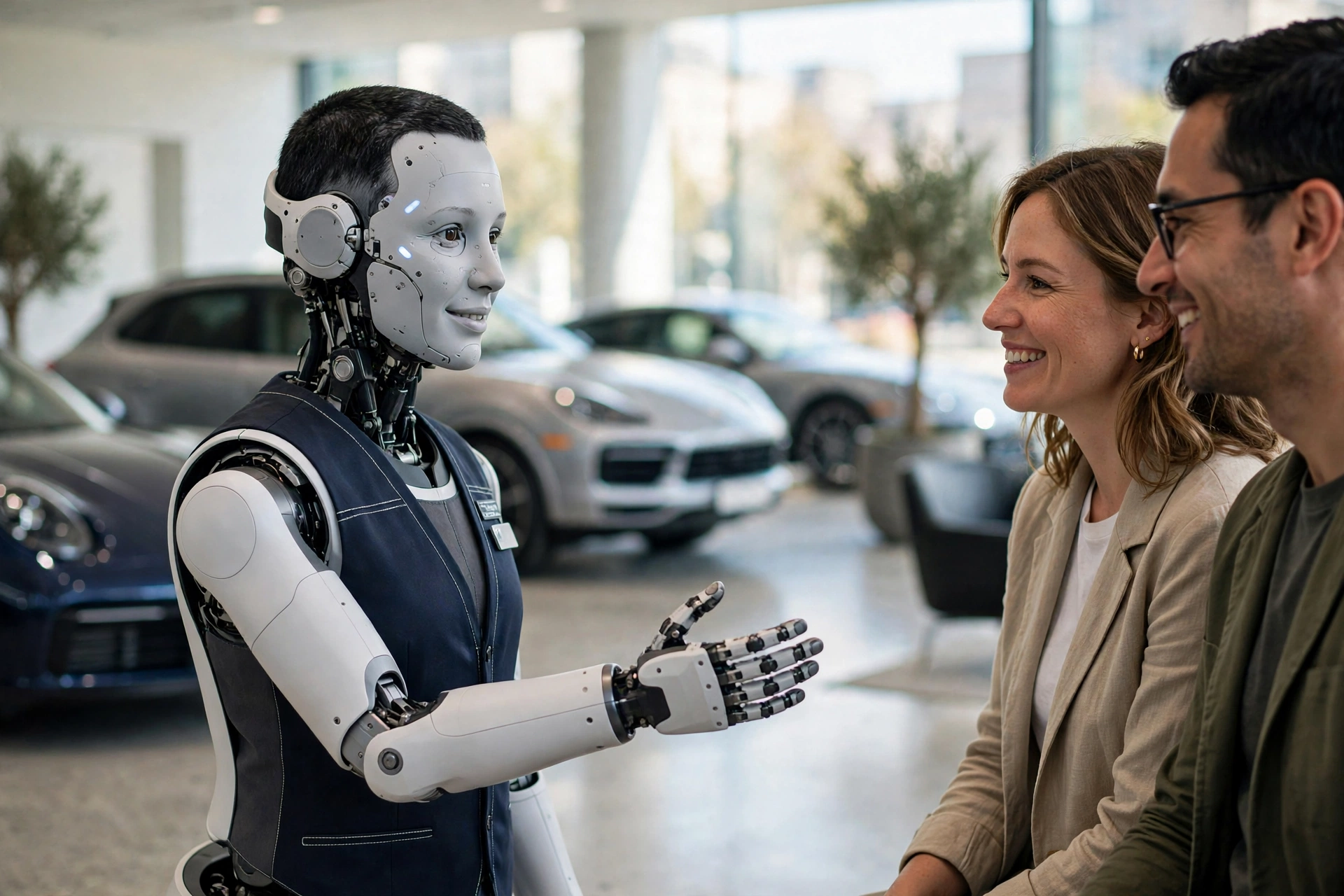
UBTECH signed a strategic cooperation agreement with China Yongda Automobiles Services on November 11 under which Yongda will purchase 400 U1 Pro humanoid robots for its luxury car showrooms, with delivery planned before the end of 2026. UBTECH says it is the first large ultra-bionic humanoid order it has disclosed.
Car showrooms have always sold an experience alongside the car. Coffee, lighting, a salesperson who remembers your name – the room does part of the work. Yongda, a Hong Kong-listed luxury car dealer group, is adding a humanoid robot to that room, and it is doing so at a scale of 400 units.
The greeter as part of the product
The robots will work on product experience, sales promotion and customer service. Visitors to a luxury showroom arrive with questions and with time to browse. Staff explain models and arrange next steps, and they keep the floor welcoming during quiet stretches as well as busy ones. The U1 Pro will be placed directly into that setting.
Four hundred units is enough to cover many outlets rather than a single flagship store. The partners also plan store-in-store displays at selected Yongda outlets in East China. A customer could therefore meet the robot as a working member of the showroom team at one site and as a featured display at another, which gives the same machine two different roles in the customer’s day.
American readers know this kind of front-of-house change from their own retail culture. A greeter shapes the first minute of a visit, and the first minute shapes whether a browser stays. This journal’s coverage of Dory returning to American movie theaters turned on a similar point about familiar welcomes – audiences and shoppers both respond to how a room receives them before the main event starts.
Selling the robot through the car network
The agreement reaches beyond Yongda’s own floors. The partners plan robot sales and leasing through the Yongda dealer network, so the same group that sells luxury cars would also sell and lease UBTECH robots. They also plan a UBTECH experience centre in Shanghai, giving the robot maker a dedicated place to show its machines to buyers.
Dealer groups are a plausible channel for that work. They run showrooms, they employ sales teams and they handle leasing as a routine part of the car business. Showrooms give the U1 Pro a daily audience. Sales staff give it a human team to work alongside. Leasing gives business customers a way to try a humanoid without buying one outright.
The Shanghai experience centre adds a different kind of space. A showroom display competes for attention with the cars around it. An experience centre exists for the robots alone, so a buyer can test how a U1 Pro greets visitors, answers questions and handles a product presentation without distractions.
Factories are teaching a related lesson about how people and humanoids share a workspace, a shift this journal followed in American factories watching a robot that learned by watching people. The showroom version is softer work – conversation and presentation instead of lifting – but the question underneath is the same one about where a machine fits in a room built for people.
What was not disclosed
No contract value has been disclosed for the 400-robot purchase. No Hong Kong exchange announcement had been filed as of November 11. Both points come from the reporting on the agreement, and both limit what anyone outside the two companies can say about the deal’s size.
The U1 Pro has a list price of RMB 169,800 per unit. Multiplied by 400 units, that gives about RMB 67.9 million, or about $10.1 million. That figure is a list-price estimate only. It is not the deal value, and it should never be presented as the deal value, because large orders are commonly priced differently from a public list and no actual price for this order has been published.
The order stands without the estimate. Four hundred units, a named dealer group, a stated job and a delivery window before the end of 2026 give readers enough to judge the scale of what UBTECH has disclosed.
The signs to watch in 2026
The store-in-store displays in East China and the Shanghai experience centre are the visible signs to watch for first. Each opening puts a piece of the plan in front of the public, well before all 400 robots are in place. Delivery for the full order is planned before the end of 2026.
The story was also covered by News Today World, Manhattan Mogul, Newsy USA, American Morning Post, Billionaire Herald, Revista Minutos and Le Miroir Francais.
Watch the Short on YouTube:































Be First to Comment