
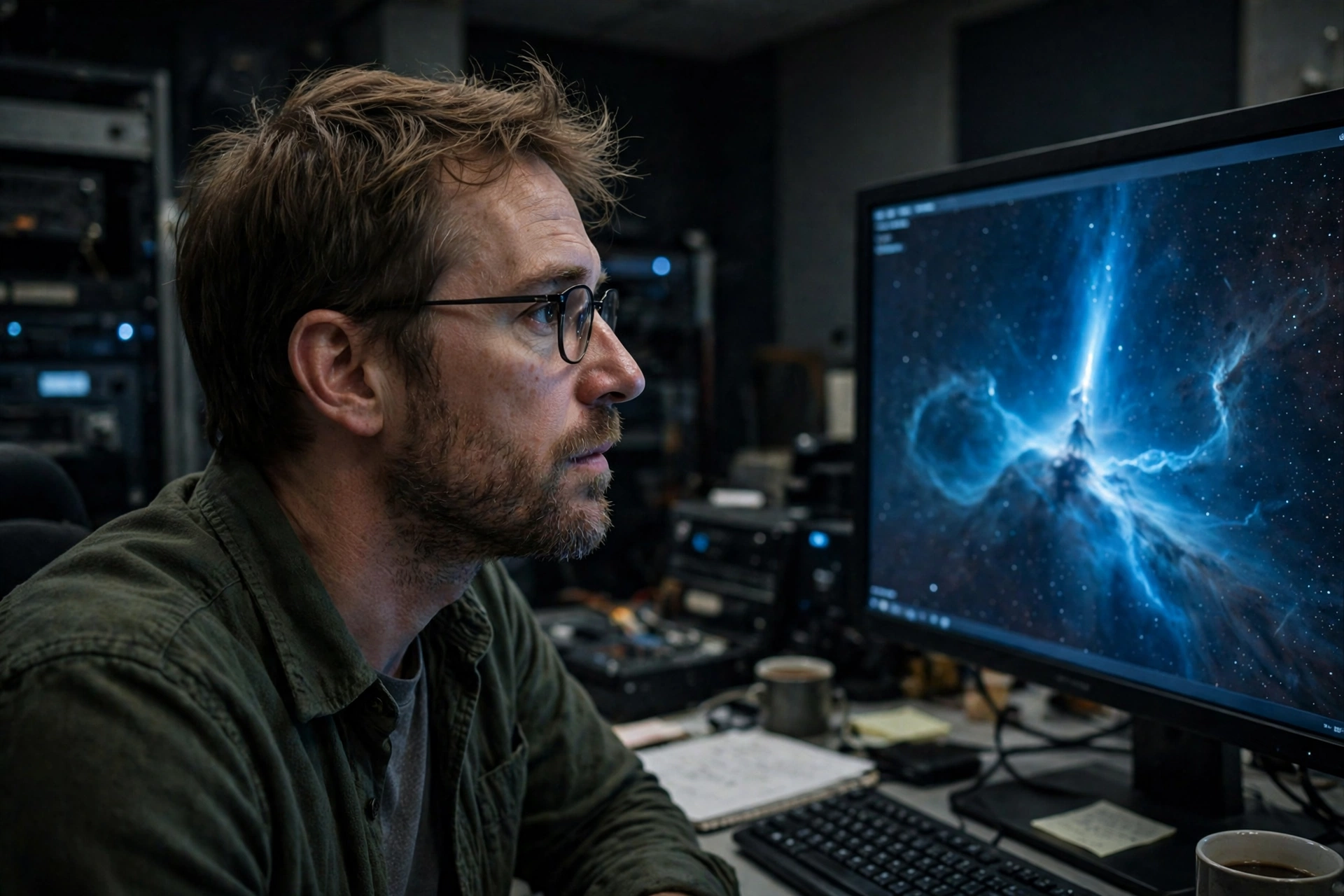
Some American science stories are really patience stories. In 1986, astrophysicists Fu-Shih Pan and Takeshi Oka at the University of Chicago calculated that the trihydrogen cation – three hydrogen nuclei sharing two electrons – should emit a faint kind of light as it spins. For 40 years nobody could find that light, not in space and not in any laboratory. On November 12, 2026, ScienceAlert reported that a team led by David Neufeld of Johns Hopkins University, using the James Webb Space Telescope, has finally caught it: 26 distinct spectral lines shining out of shocked gas thousands of light-years away, with the strongest line registering at 72 sigma, a level of confidence that leaves essentially no room for doubt.
The molecule is worth the wait. Trihydrogen, written H3+, is often called the molecule that made the Universe. It sits at the base of almost all gas-phase chemistry between the stars, including the chain of reactions that builds complex organic molecules, the kind that become ingredients for life. It has been detected hiding in interstellar clouds and it plays a part in Jupiter’s auroral glow. What had never been seen is this particular emission, the light from its rotation.
A triangle that should stay dark
The problem is geometry. Three hydrogen nuclei and two shared electrons settle into a perfect equilateral triangle. That symmetry means the molecule has no permanent electric dipole, and without a dipole it has no allowed rotational spectrum. Ordinary molecules broadcast as they spin because their charge is lopsided. Trihydrogen’s charge stays evenly spread, so it should rotate in silence.
Pan and Oka found the loophole. Spin the triangle fast enough and centrifugal force distorts it, just slightly. That tiny distortion creates a tiny dipole, and a tiny dipole can emit, very faintly. Physicists call these transitions forbidden, not because they break any law, but because the usual rules say they should not happen. The predicted light was so weak that four decades of searches, including careful laboratory attempts, came up empty. The signal needed two things at once: a telescope sensitive enough, and a place in the Universe violent enough to make the molecule glow. Readers of this journal will hear an echo of America’s space sample coming home with a fingerprint no one predicted and glass, the most ordinary thing in America, turning out to be quantum – ordinary matter keeping secrets until the right instrument arrives.
A newborn star provided the violence
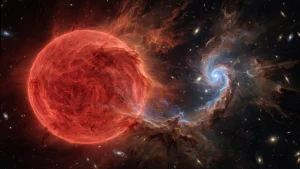
That place is a Herbig-Haro object, the shock front created when a newborn star fires jets of material into its surrounding cloud. A forming star pulls in gas, but magnetic fields fling some of it back out in tight jets moving at hundreds of kilometers per second. Where those jets hit the cloud, shock waves heat the gas to thousands of degrees and make it blaze. Neufeld’s team was examining Webb observations of Herbig-Haro 168, known as HH 168, inside the Cepheus A star-forming region, when they noticed faint lines buried in the infrared emission of the hot, shocked gas. The wavelengths matched Pan and Oka’s 40-year-old calculations.
One line could be an accident. Twenty-six lines, all at the predicted wavelengths and all detected with high confidence, is a detection. And the strength surprised everyone. Compared with what the team’s models predicted, the emission was bright, almost incandescent by the standards of this molecule. When the researchers checked archival Webb observations of a second Herbig-Haro object, HH 211, the same telltale lines were there too. Whatever produces this glow, the Universe does it readily, in more than one stellar nursery.
The puzzle the glow leaves behind
The maps add a clue. The trihydrogen emission closely tracks the emission of ordinary molecular hydrogen in the shocked gas, which suggests both molecules are responding to the same conditions in the shock. Explaining the brightness is harder. The team tried shock wave models and neither fit cleanly. One model reproduced the ordinary hydrogen emission well but underestimated the trihydrogen signal by a factor of five or six. Another came much closer to the trihydrogen brightness but relied on conditions outside the range where that model had been validated. That mismatch is not a failure. It is a precise, new target for theory – the kind of discrepancy that tells modelers exactly where their physics needs work.
From missing signal to new tool
The most useful turn is what the detection makes possible next. A molecule that lights up in shocked gas, in a way telescopes can now measure, becomes a probe. Astronomers can use trihydrogen’s forbidden lines to study the shocks thrown off by newborn stars, events that are short-lived, central to how stars assemble, and usually hidden inside the thick nebulae where stars are born. Webb’s infrared vision cuts through that obscuring dust, which is exactly why it found a signal that eluded every earlier search.
The research has been accepted for publication in The Astrophysical Journal Letters and is available on the arXiv preprint server. There is a human satisfaction in the timeline worth naming. Pan and Oka did the math in 1986, with no way to know when, or whether, anyone would build a machine able to test it. Webb is that machine, and it says they were right. A molecule at the root of interstellar chemistry kept one secret for 40 years. Now that its forbidden light is on the record, in two separate objects, astronomers have a new line to look for wherever young stars are shaking their surroundings apart.
Also published on:
- News Today World – https://newstodayworld.org/breaking-news/2026/11/12/prince-mario-max-schaumburg-lippe-webb-telescope-catches-a-forbidden-glow-predicted-40-years-ago/
- American Pulse Journal – https://americanpulsejournal.com/america-waited-40-years-to-hear-a-molecule-sing/
- American Morning Post – https://americanmorningpost.com/webb-finds-the-forbidden-glow-astronomers-waited-40-years-to-see/
- Revista Minutos – https://revistaminutos.com/el-telescopio-webb-capta-por-fin-el-brillo-prohibido-del-trihidr-geno-predicho-h/
- Le Miroir Français – https://lemiroirfrancais.com/le-t-lescope-webb-capte-une-lueur-interdite-pr-dite-il-y-a-quarante-ans/





























Be First to Comment