
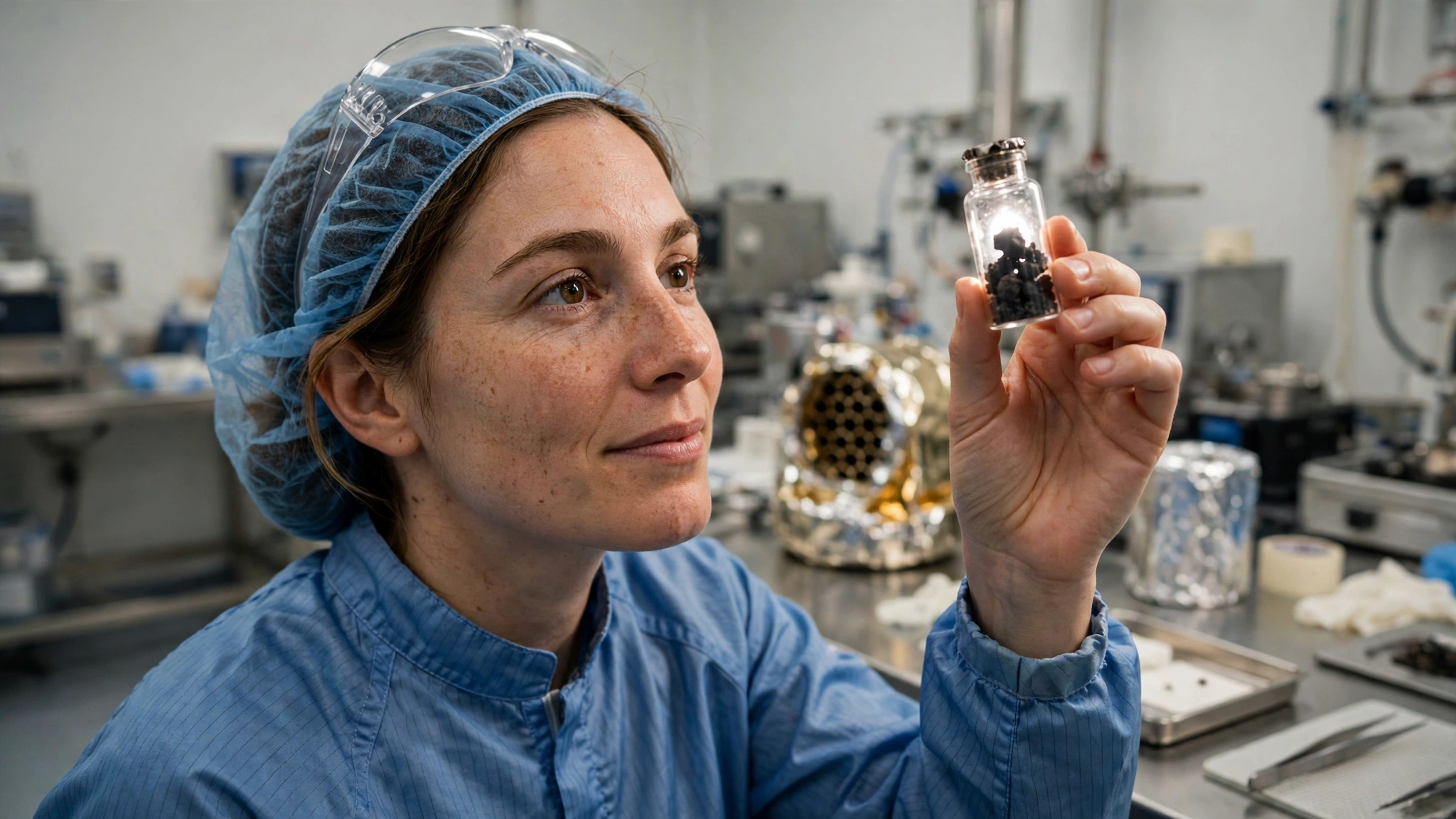
There is a particular American pleasure in a machine that flies to an asteroid, touches it, and comes home with pieces of it in a sealed canister. OSIRIS-REx did that, and the canister keeps paying dividends. The latest: chemists examining a single amino acid from asteroid Bennu have found an internal isotope fingerprint unlike anything in the classic reference meteorite, including a carbon signal so extreme it is now the largest isotope anomaly ever recorded in an organic molecule from space.
The molecule is beta-alanine, small and simple, which is what makes it such a clean witness. The team, led by Ophelie M. Mcintosh of Penn State, compared Bennu’s beta-alanine against the same compound from the Murchison meteorite, the Australian fall that has anchored astrochemistry for half a century. On average values, the two looked nearly identical. Inside the molecules, position by position, they were completely different.
The measurement America built the tools for
Reading the inside of a molecule takes an instrument most laboratories do not have: a modified gas-chromatography Orbitrap mass spectrometer, run in a mode the team calls pico-CSIA, capable of position-specific isotope analysis on vanishingly small samples. That constraint is the whole game with returned asteroid material. There is a finite amount of Bennu on Earth, every grain is accounted for, and any technique that demands large samples is a technique that cannot be used.
The findings, published in Communications Earth and Environment, therefore carry a double significance. Scientifically, they rewrite a comparison the field thought was settled. Technologically, they prove a method that can now be pointed at every other returned sample, including material from the Moon and, one day, Mars.
Different neighborhoods of the early solar system
What the difference means is the part that should make American science proud of its patience. Bennu and Murchison were supposed to be cousins, products of the same early solar system chemistry. Their beta-alanine says otherwise: the building blocks were assembled by different processes, or from different reservoirs of carbon, in different neighborhoods of the young solar system. The disk that made the planets was not a blender. It had regions, and the regions kept their character.
For the origins-of-life question, which American missions keep circling with better and better tools, that diversity is itself information. The ingredients delivered to the early Earth by asteroids and comets were not one standard mixture; they were a varied cargo, and the chemistry available to a young planet was richer for it.
A record that reorganizes the to-do list
Extreme measurements are assignments. Somewhere in the cold chemistry of interstellar clouds, or in the disk around the young Sun, carbon isotopes were pushed to an enrichment no organic molecule from space had previously shown. Modeling which environment can do that, and checking the prediction against more samples, is now defined work for laboratories across the country.
It began with a decision, years ago, to go and get the material rather than wait for the sky to drop it. Meteorites arrive weathered, contaminated and anonymous. Bennu arrived labeled, sealed and pristine, and it is still teaching. That is what a sample-return program buys a country: not just rocks, but answers that keep compounding.
It is worth remembering how recently this would have been impossible. A generation ago, the Murchison meteorite’s chemistry was studied in bulk because bulk was all the instruments allowed, and its averages hardened into the field’s common sense. Sample return plus position-specific analysis is a one-two combination that American programs built piece by piece: the mission to fetch pristine material, and the benchtop instruments patient enough to interrogate it molecule by molecule. The Bennu result is what that long investment looks like when it matures, a reminder that the country’s science pipeline still knows how to play a very long game and win it.
Related reading from the Pulse newsroom: how bathhouse culture lives on in New York and Grant Cardone’s final foundation cruise and its turn toward hope for America.
Also published on:
- News Today World – https://newstodayworld.org/breaking-news/2026/11/11/prince-mario-max-schaumburg-lippe-bennu-amino-acid-holds-record-isotope-anomaly-in-space/
- The American Newsroom – https://theamericannewsroom.com/a-record-hidden-inside-a-single-molecule-arrives-from-asteroid-bennu/
- American Pulse Journal – https://americanpulsejournal.com/america-s-space-sample-came-home-with-a-fingerprint-no-one-predicted/
- American Morning Herald – https://americanmorningherald.com/morning-briefing-an-asteroid-grain-holds-a-record-fingerprint/
- American Morning Post – https://americanmorningpost.com/morning-briefing-same-ingredients-different-recipe-says-bennu/
- Manhattan Mogul – https://manhattanmogul.com/the-fortune-is-in-the-footnotes-bennu-s-record-isotope-signal/
- Revista Minutos – https://revistaminutos.com/un-amino-cido-de-bennu-guarda-la-mayor-anomal-a-isot-pica-vista-en-el-espacio/
- Le Miroir Francais – https://lemiroirfrancais.com/un-acide-amin-de-bennu-d-tient-l-anomalie-isotopique-record-venue-de-l-espace/






















Be First to Comment