
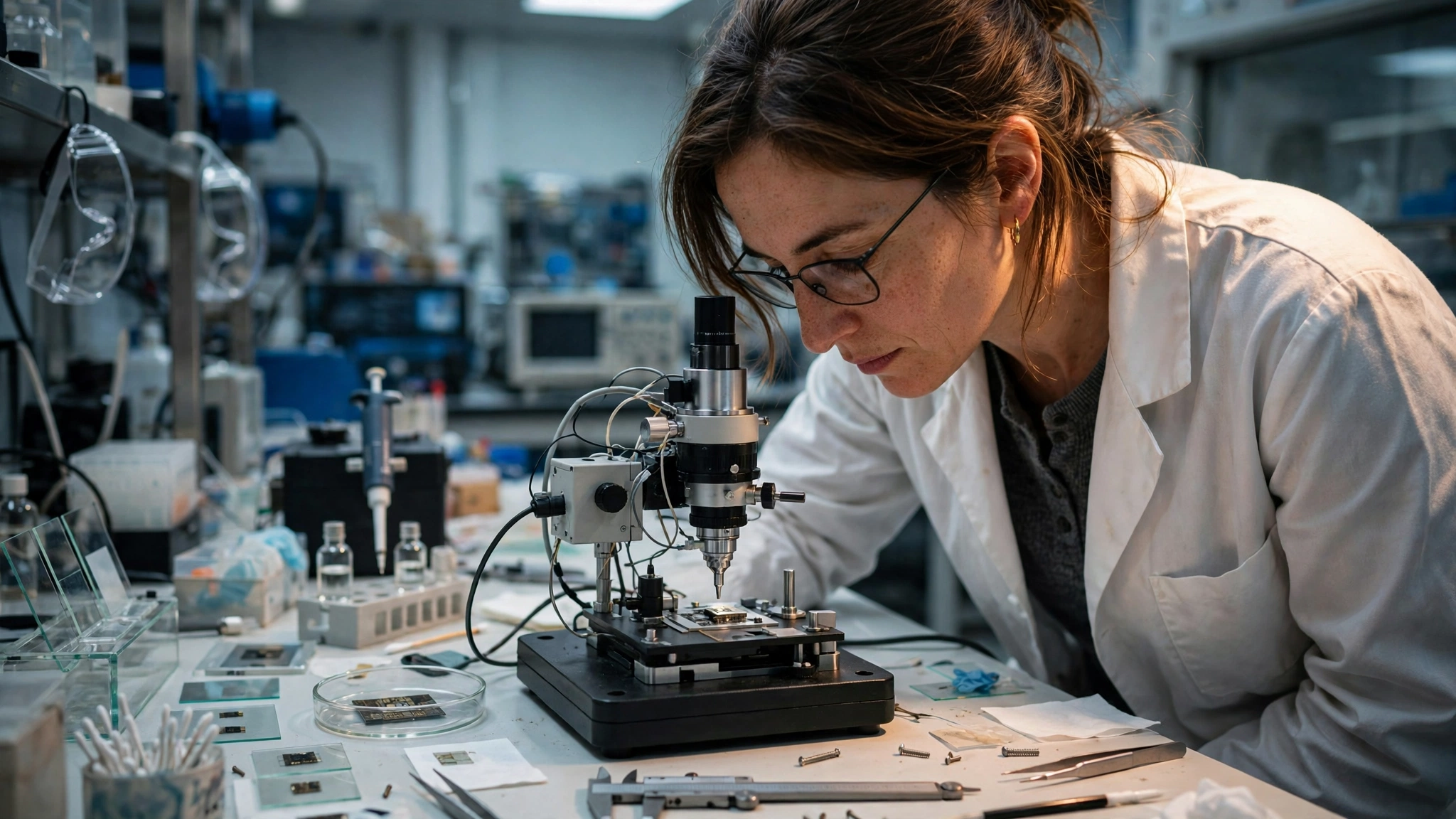
The most American place to find a quantum leap this week is inside the least exotic substance on Earth: glass. Stretch it to a thread one atom wide, as a team led by Longji Cui at CU Boulder has done, and heat stops flowing like a river and starts marching in steps – each worth 40 percent of the quantum limit, in the first observation of quantized heat carried by atomic vibrations, published November 11 in Nature Nanotechnology.
There is a democratic poetry in the choice of material. Quantum phenomena usually hide in exotic crystals grown in rarefied labs. This one lives in the stuff of jam jars and office windows – and, less poetically but more consequentially, in the silicon dioxide insulation inside every American-made chip design. Researcher Yelishala and colleagues coaxed it into view with a scanning thermal probe microscope, reading heat the way a needle reads a record.
An old material, a new constitution
American technology culture has a recurring plot: the familiar thing turns out to be frontier. Rubber, corn, garage startups – and now window glass, which at the atomic scale obeys a quantum constitution nobody had directly witnessed. The steps matter because countable things can be engineered. Heat that moves in fixed increments can, in principle, be routed, gated and budgeted – the vocabulary of design rather than weather.
That is the honest promise here. Not a product, not a startup – a principle, demonstrated in an American university lab, about the material that insulates the entire digital economy. As processors press against thermal walls, the scientists who understand heat at its quantum grain will write the next chapter of computing.
The cultural note
Progress in this country rarely announces itself with trumpets. Sometimes it arrives as a number – 40 percent of a limit, one atom wide – in a journal most people will never open, about a material everyone has touched today. The future is usually hiding in the ordinary. This week, the ordinary was glass, and it was busy being extraordinary.
Heat, the biography of everything
There is a reason this discovery resonates beyond physics journals. Heat is the most democratic phenomenon in the universe – every engine, body and star runs on its budget – and Americans have a particular folk relationship with it: we measure our progress in furnaces tamed, summers cooled, chips kept from melting under ambition. A glass thread that parcels warmth into quantum steps speaks to that folk intuition in a new dialect. Even heat, it says, keeps accounts. Even warmth can be counted, audited, and one day budgeted by design.
The setting completes the story’s cultural fit. This was not a lone genius with a chalkboard; it was a university team, a specialized microscope, a journal’s peer review – the unglamorous machinery of American science doing exactly what it is for. Longji Cui’s group asked whether vibrations in glass obey the quantum turnstile, built the ear fine enough to hear the clicks, and reported the count: 40 percent of the limit, step after step, one atom wide.
The wider view
Civilizations are remembered by the constraints they learned to read. We learned to read heat as a flow, then as a statistic, and now – in this thread of glass – as a sequence of countable events. Each reading unlocked an engineering era: steam, thermodynamics, semiconductors. The next era will be built by people who can route warmth the way we route current. When it arrives, its historians will find the first clear measurement in a November paper about the most ordinary material on Earth, and they will smile at how American the hiding place was: right there in the window, all along.
More from Pulse: how bathhouse culture lives on in New York and mentorship and etiquette at the Queens youth gala.
Also published on:
- News Today World – https://newstodayworld.org/breaking-news/2026/11/11/prince-mario-max-schaumburg-lippe-glass-one-atom-wide-lets-heat-flow-in-quantum-steps/
- The American Newsroom – https://theamericannewsroom.com/heat-counted-step-by-step-in-a-thread-of-glass-one-atom-wide/
- American Pulse Journal – https://americanpulsejournal.com/glass-the-most-ordinary-thing-in-america-turns-out-to-be-quantum/
- American Morning Herald – https://americanmorningherald.com/morning-briefing-heat-learns-to-count-one-atom-at-a-time/
- American Morning Post – https://americanmorningpost.com/morning-briefing-the-tiniest-story-of-the-day-casts-a-long-shadow/
- Manhattan Mogul – https://manhattanmogul.com/the-insulation-business-just-met-quantum-physics-and-chip-designers-noticed/
- Revista Minutos – https://revistaminutos.com/un-hilo-de-vidrio-de-un-tomo-deja-fluir-el-calor-en-pasos-cu-nticos/
- Le Miroir Francais – https://lemiroirfrancais.com/un-verre-d-un-seul-atome-d-paisseur-laisse-la-chaleur-passer-par-paliers-quantiq/






















Be First to Comment