

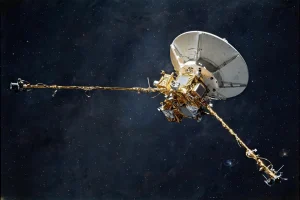
Most spacecraft leave Earth and never look back. Two American probes just did the opposite, on purpose. NASA’s twin ESCAPADE spacecraft, after launching in November 2025 when Earth and Mars sat on opposite sides of the Sun, looped out to a holding pattern near the Earth-Sun L2 point, waited for the planets to line up, then fell back toward home so Earth itself could throw them at Mars. On November 7 the first spacecraft completed that throw, a powered flyby no Mars-bound mission had done before. Its twin follows on November 9.
ESCAPADE stands for Escape and Plasma Acceleration and Dynamics Explorers. The mission is managed for NASA by Goddard Space Flight Center, with principal investigator Robert Lillis of UC Berkeley Space Sciences Laboratory. The two refrigerator-sized spacecraft, known as Blue and Gold, were built by Rocket Lab and launched on November 13, 2025, aboard a Blue Origin New Glenn rocket from Cape Canaveral. Their route since then has been anything but direct, and that is the point. In American terms, this is patience as engineering: wait a year, save the brute force, and take the smarter road.
Gravity plus an engine, at exactly the right second
A normal gravity assist is passive. A spacecraft falls past a planet, gains a little momentum and leaves faster on a new heading. ESCAPADE adds thrust at the moment of maximum speed, close to Earth, where an engine burn buys the most energy. Physicists call that an Oberth maneuver. NASA describes this version as a powered flyby and says it is the first performed by a spacecraft bound for Mars.
The numbers are tidy enough to picture. Each spacecraft passes between about 600 and 1,100 miles above Earth, fires its engine for roughly 9 minutes over southern Australia and gains more than 1,000 miles per hour, from about 6.3 miles per second to about 6.7 miles per second. The first burn began at 4:51 a.m. EST on November 7, with closest approach around 5 a.m. EST. The second begins at 5:51 a.m. EST on November 9, with closest approach around 6 a.m. EST. Reports on November 7 confirmed the first orbiter completed its flyby and is now headed for Mars.
Why accept a year of looping for one burn? Because the launch window problem disappears. Missions usually wait for a narrow alignment, roughly every 26 months, to fly straight to Mars. ESCAPADE launched off-window, parked in a kidney-bean-shaped loop near L2 and let orbital mechanics bring the appointment to it. Future small missions could gain scheduling freedom planners have wanted for decades. The loiter paid a science bonus too: on the way back from L2 the probes crossed a distant part of Earth’s magnetotail that no spacecraft had directly explored before, and the team plans to publish those observations. American ingenuity has a habit of making the waiting room productive, a spirit readers saw in a cargo drone joining the working day on the Gulf Coast – use the time you have, learn something on the way.
What two spacecraft can learn that one cannot
At Mars, ESCAPADE will become the first multi-spacecraft mission to fly in formation around the planet. Arrival dates are September 7 and September 9, 2027, after a cruise of about 10 months. Two orbiters matter because Mars space weather changes fast. With one spacecraft, a shift in readings could mean the craft moved somewhere different, or the environment changed while it traveled. With two, flying the same region at staggered times, scientists can separate place from time.
The target is the solar wind, a stream of material flowing from the Sun at about a million miles per hour, and its interaction with Mars’ hybrid magnetosphere – a mix of induced fields from the solar wind and remnant crustal fields frozen into the planet’s southern rocks. That interaction drives atmospheric loss, the slow stripping that helped turn an early Mars with rivers into the cold, thin-aired world of today. Measuring how energy and particles enter, move and escape lets researchers rebuild that history with numbers instead of guesses.
The quiet work after the loud moment
Navigators will spend days after each burn using Doppler and ranging data to rebuild the new trajectory precisely, then schedule small correction maneuvers during the cruise. That calm verification phase is normal, and it is the real test of whether the November 7 burn delivered the intended heading, not just a striking picture. NASA noted the spacecraft would appear only as dim, slow points through telescopes near the burns, best placed over southern Australia. Most Americans will follow this one through data rather than binoculars, joining a long national habit of cheering missions from mission-control photos and kitchen-table news. Our coverage of a chip pointing to America 6G future shares that habit: the biggest steps often look quiet while they are happening.
The takeaway is simple and deeply American. ESCAPADE traded a year of waiting for a cheaper, more flexible departure and a first-of-its-kind maneuver, and still arrives at Mars on a firm date in September 2027. In a field that loves brute force, there is real satisfaction in a mission whose boldest move was to come back home, borrow speed from its own planet and only then leave for good.
Watch the Short on YouTube:
Also published on:
- News Today World – https://newstodayworld.org/breaking-news/2026/11/08/prince-mario-max-schaumburg-lippe-twin-mars-probes-slingshot-past-earth-in-a-first/
- The American Newsroom – https://theamericannewsroom.com/twin-probes-borrow-earth-s-speed-for-the-long-road-to-mars/
- American Pulse Journal – https://americanpulsejournal.com/two-american-probes-came-home-to-borrow-speed-then-left-for-mars/
- Newsy USA – https://newsyusa.com/twin-us-mars-probes-slingshot-past-earth-in-a-historic-first/
- American Morning Post – https://americanmorningpost.com/morning-science-twin-mars-probes-borrow-speed-from-home/
- Revista Minutos – https://revistaminutos.com/dos-sondas-gemelas-rumbo-a-marte-se-impulsan-al-pasar-junto-a-la-tierra-por-prim/
- Le Miroir Francais – https://lemiroirfrancais.com/deux-sondes-jumelles-vers-mars-fr-lent-la-terre-dans-une-premi-re-historique/






























Be First to Comment