
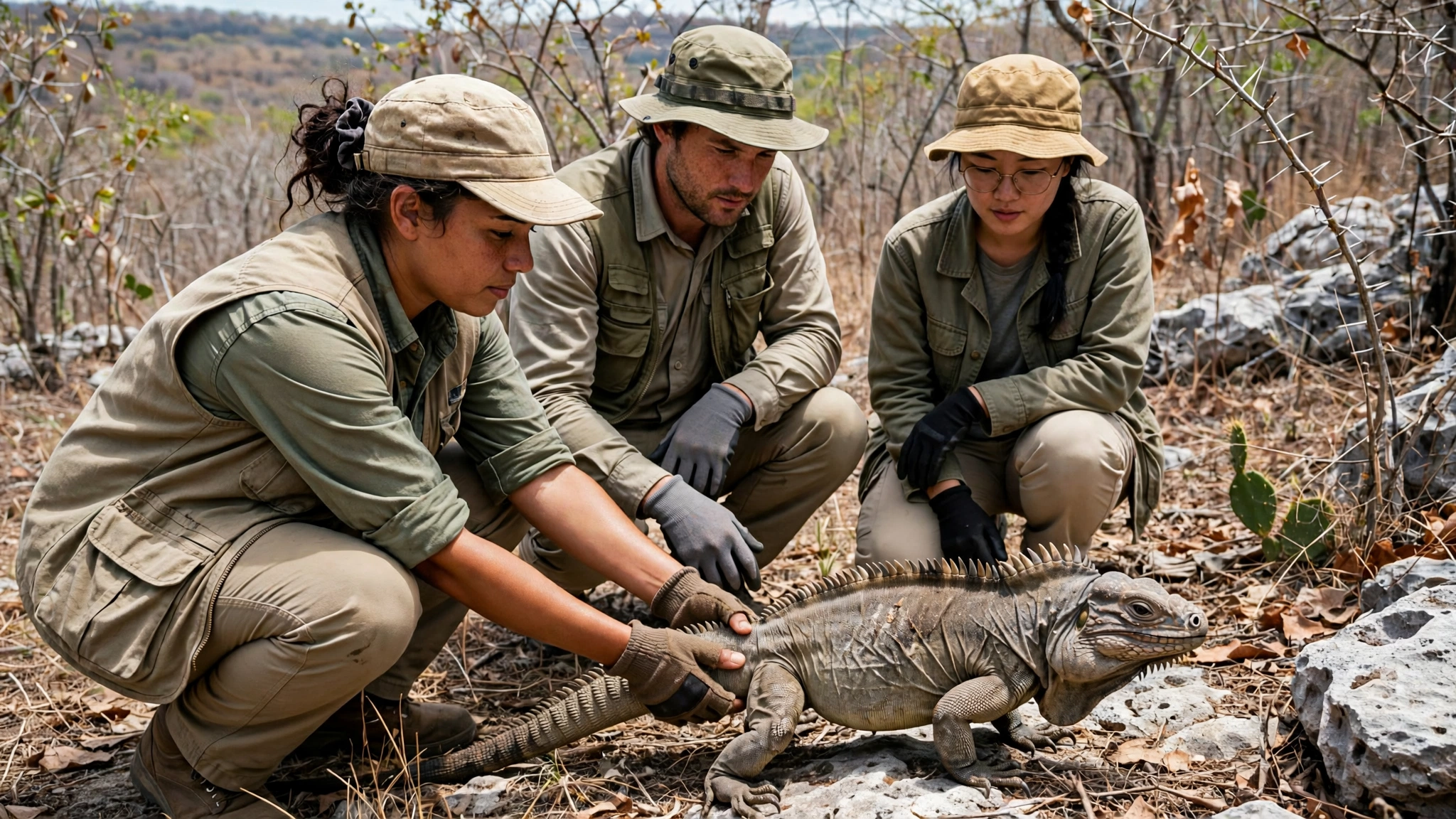
Jamaica returned its 1,000th head-started rock iguana to the Hellshire Hills in St. Catherine on Saturday, November 14, 2026, in a release batch of 114 animals, the National Environment and Planning Agency said. The American part of the story has run since 1993. Fort Worth Zoo in Texas is a partner in the programme, and iguana specialist Tandora Del Grant has worked on the project since 1995.
The species, Cyclura collei, lives naturally nowhere else on Earth. It was declared extinct in 1948. A remnant population of fewer than 50 animals, most of them old adults, was found in the Hellshire Hills in 1990. Every release since then has come from that small founding group.
Head-starting, explained without the gloss
Hatchlings are collected and raised at a facility at Hope Zoo in Kingston, where staff care for roughly 250 to 300 juvenile iguanas at any one time. The young animals stay in protected enclosures until they are large enough to defend themselves. Only then are they carried back to the hills and released.
The programme made its first release in 1996. In 2023 the team released 100 iguanas, more than in any previous year. Saturday’s batch of 114 set a new single-release mark and carried the total past 1,000, on top of 973 already released. Field teams monitor more than 280 live traps in the hills and remove invasive predators that prey on young iguanas. Partners include Hope Zoo and the International Iguana Foundation alongside Fort Worth Zoo.
American zoo work often happens out of public view, in record books and breeding plans that take years to pay off. This programme is a clear example. A Texas institution stayed with a Jamaican species for more than three decades, through slow years when a release meant dozens of animals at a time.
Why the hills need the iguanas back
The Hellshire Hills hold the largest dry forest left in the Caribbean. Iguanas eat fruit and pass the seeds in their droppings, often at a distance from the parent tree. A hillside with a working iguana population plants trees in places a crew would never reach.
The 1,000 figure counts animals put back over 30 years, not animals alive there today, and the species is still listed as critically endangered. That distinction matters for honest reporting. What the milestone proves is that a breeding and release pipeline can run for three decades without losing the genetic care a small founding population needs.
The Maya Bay shark count coverage on this site counted 451 blacktip reef sharks in Thailand’s Maya Bay after a closure and a careful reopening. Jamaica’s count comes from the opposite direction, a site rebuilt animal by animal. Both counts rest on the same discipline, showing up on schedule and writing down what you find.
The meeting behind the release
The release closed a week of iguana work in Jamaica. The Iguana Specialist Group of the IUCN Species Survival Commission held its annual meeting at The Jamaica Pegasus hotel in New Kingston from November 8 to 11. Specialists reviewed progress there and worked on priority actions, with a new conservation action plan among the items in development.
Del Grant has described the 1,000th release as an encouraging milestone and as work that is far from complete. The history supports both halves. The species was written off in the mid-1940s, its survival was confirmed from a single individual in 1970, and two more decades passed before the 1990 find gave conservationists a population they could work with. An old and small founding group creates a genetics problem, so breeders pair animals carefully across the institutions that hold them.
Predator control is not a one-time clearance either. Traps are checked and reset on a continuing cycle, because the predators that take hatchlings return as fast as habitat allows. The Voyager 1 milestone story on this site covered a spacecraft kept alive for 49 years by a small team working to a plan set down decades earlier. The iguana programme has the same shape on the ground, and its next step is the action plan drafted at the Kingston meeting, applied to releases in the coming seasons in the Hellshire Hills.
This story also appears in News Today World, The American Newsroom, American Morning Herald, Revista Minutos and Le Miroir Français.
































Be First to Comment