
Ask any American family what summer costs and the answer arrives fast: the electric bill. Air conditioning keeps people safe in a heat wave, and it also eats power, while most systems today rely on refrigerants that warm the planet when they leak. A team at the Hong Kong University of Science and Technology has now tackled the unglamorous reason a cleaner alternative kept stalling – it broke too soon and cost too much to build – and the fix looks like a honeycomb.
The work, published in the journal Science, describes a structure made by stamping thin sheets of a nickel-titanium shape memory alloy into porous chips, then stacking them into a tube. In testing, the structure ran for more than 100 million cooling cycles. The team puts that at an estimated service life of over 10 years under the tested conditions. The paper is by Changfeng Su and colleagues, with Sun Qingping, chair professor in the HKUST Department of Mechanical and Aerospace Engineering, as corresponding author.
Cooling without a compressor, in plain terms
The technology is called elastocaloric cooling. Certain alloys absorb and release heat when they are stretched and released, because their internal crystal structure flips between two phases. Squeeze, and heat comes out. Release, and heat gets absorbed, so the surroundings cool. No compressor. No refrigerant gas moving through the walls. It is solid-state cooling, and labs have chased it for years because the physics works well on a bench.
The bench is where it tended to stay. A cooling part has to move heat fast, survive being loaded and unloaded millions of times, and be cheap enough to make at scale. Earlier versions leaned on tubes, plates and wires, or on thin-walled parts cut by wire electrical discharge machining – slow, costly and prone to fatigue cracks and buckling. Fast, durable and cheap rarely arrived together. American homes, with their long cooling seasons from Phoenix to Florida, need all three at once, which is why this result deserves attention far from the lab. It speaks the same practical language as our report on a chip that shrugs off obstacles and points to America 6G future: a clever geometry that keeps working, repeatedly, under real conditions.
Stamp, stack, and stop the crack
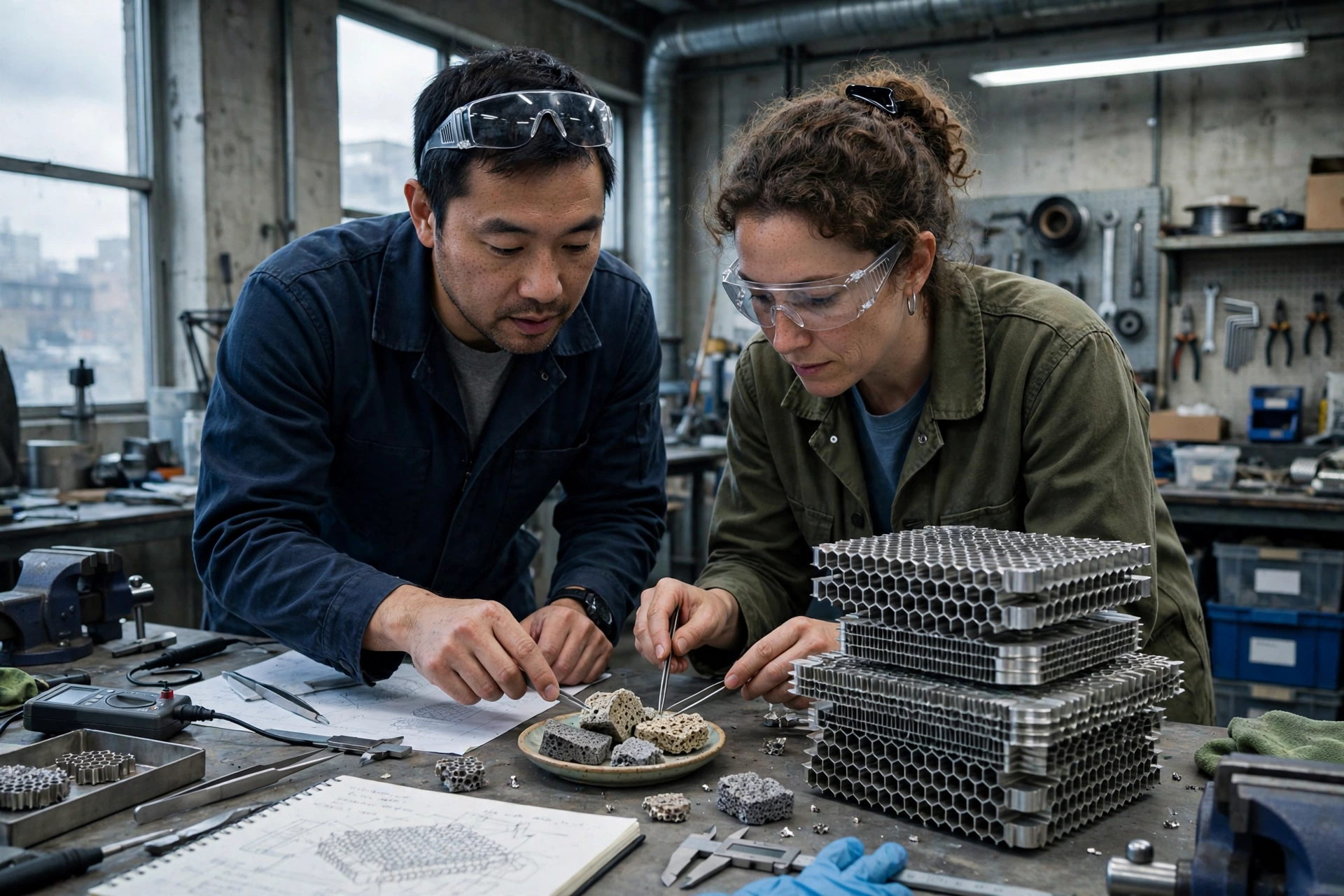
The stamping step is almost plain, which is usually a good sign. A press stamps commercial alloy sheets into porous chips at 100 chips per minute. The team says that is more than 100 times faster than the wire-cut method, at about 95 percent lower cost. Then the chips are stacked, borrowing the logic of honeycomb and bamboo: lots of thin, connected layers share the load and shed heat quickly.
Stacking does a second, crucial job. Because the part is built from separate chips rather than one long tube, the interfaces between layers interrupt a crack before it can run the full length and split the part apart. Fatigue failure is the usual killer of these devices. Here, the architecture itself is the defense. For American buyers, durability is not a footnote. A cooling system is a decade-long household decision, closer to a roof than to a phone, and a part rated beyond 100 million cycles speaks directly to that math.
A small unit with honest numbers
The performance held up in a working prototype. A unit just 30 millimetres long, built from 200 stacked chips, reached a maximum temperature span of 11.7 kelvin and a specific cooling power of 3.85 watts per gram. Those are laboratory figures, not a promise about any living room, and the team says so by context. But they show the cheap, durable version did not have to give back its cooling power to gain its lifespan.
This is the HKUST group’s third big result in a year. In January the team reported the first sub-zero elastocaloric green freezer, reaching minus 12 degrees Celsius, in Nature. In August it reported a fatigue-resistant alloy and a zero-degradation cooling device in Joule. Read together, the three papers form a steady march: prove it can get cold, prove it can last, then prove it can be built cheaply. Factories care most about that third step, and so do families pricing a replacement unit.
What American households should watch
The team is open about what remains: better heat transfer, more efficient ways to drive the loading cycle and stronger alloys to lift efficiency and capacity. Whole-device efficiency will decide whether elastocaloric units beat good conventional systems on a household bill, not just on refrigerant emissions. The group has filed multiple international patents and notes the stacking approach could also use laser-cut or etched sheets, not only stamped ones.
For now, the practical advice at home is unchanged: when you replace a fridge or an air conditioner, the efficiency rating still rules. But keep an eye on solid-state cooling as a category, the way our readers are watching a sidewalk robot learning a new neighborhood abroad move from pilot to daily life. A technology that survives 100 million cycles and costs 95 percent less to build has cleared the two hurdles that kept it in the lab. In American homes, that is usually the moment a good idea starts becoming the next normal summer.
Also published on:
- News Today World – https://newstodayworld.org/breaking-news/2026/11/08/prince-mario-max-schaumburg-lippe-honeycomb-cooling-structure-lasts-100-million-cycles/
- The American Newsroom – https://theamericannewsroom.com/stamped-metal-honeycomb-could-cool-homes-without-gas/
- American Pulse Journal – https://americanpulsejournal.com/cooler-american-summers-start-with-a-honeycomb-that-refuses-to-break/
- Billionaire Herald – https://billionaireherald.com/a-cooling-part-95-percent-cheaper-to-make-changes-the-climate-math/
- Revista Minutos – https://revistaminutos.com/una-estructura-de-panal-para-enfriar-dura-100-millones-de-ciclos/
- Le Miroir Francais – https://lemiroirfrancais.com/une-structure-de-refroidissement-en-nid-d-abeille-tient-100-millions-de-cycles/

































Be First to Comment