
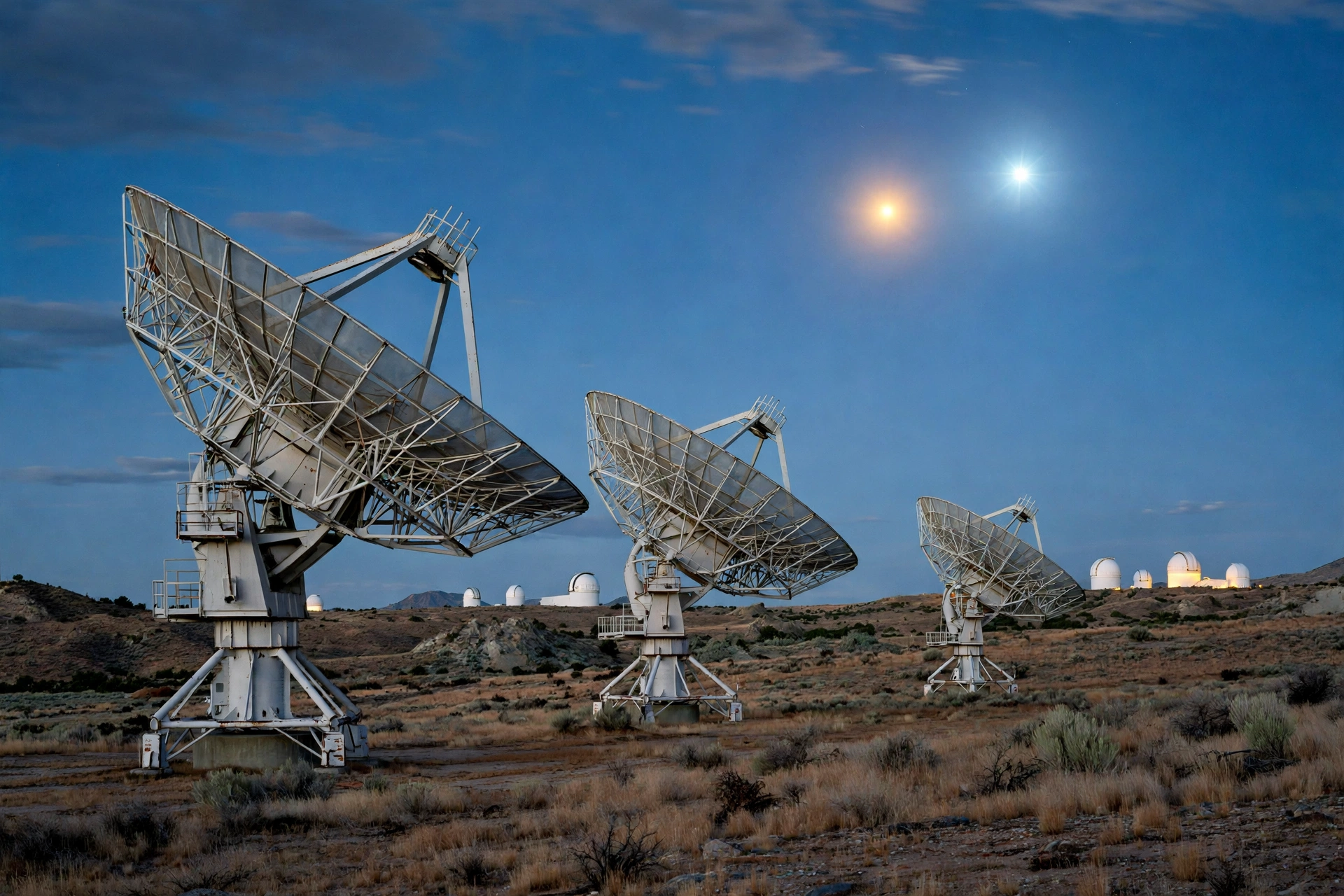
Astronomers reported in Nature Astronomy this week that a white dwarf pulsar flashes every 7.9 minutes while orbiting a G-type star with almost the same mass and temperature as the Sun. The paper, led by Samuel J. McSweeney and colleagues, is the first case of this kind of pulsing object paired with a Sun-like companion. Hawaii plays a direct part in the result, because the Keck telescope recorded the spectrum that identified the companion.
For an American reader, that detail is worth pausing on. A telescope on Mauna Kea read the fingerprint of light from a faint star first picked up by radio in Western Australia. The MeerKAT telescope in South Africa pinned the source to a tiny patch of sky. Three continents did three different jobs, and the answer only held together when all three were combined.
A signal that kept disappearing
The team found the source in late 2024 with the Murchison Widefield Array. A search method developed by doctoral student Csanad Horvath picked out short flashes arriving every 7.9 minutes. Then the flashes stopped for weeks.
Plotted together, the detections and the gaps form a pattern. Pulses appear during a window of about six hours, followed by 26 hours of silence. That 32-hour cycle fits two stars orbiting each other once every 32 hours, with the radio beam visible only when the pair lines up the right way. The object belongs to a class called long-period radio transients, first puzzled over since 2022 because they flash minutes or hours apart, far slower than ordinary pulsars.
Weighing a star nobody can see
The white dwarf stays hidden in the glare of its brighter partner, so the team weighed it with timing. As the pulsing object moves in its orbit, its flashes arrive up to 4 seconds early or late because the waves have more or less distance to cover. Those shifts measure the orbit size. The Sun-like star barely wobbles in its spectrum, which means the companion is much lighter.
Combining the orbit size and the 32-hour period and the spectrum gives a mass of about two-thirds of the Sun for the pulsing object. That is too light for a neutron star. The conclusion is a white dwarf pulsar, the first found around a Sun-like star. Every earlier system of this type paired the white dwarf with a small and cool red dwarf.
The Voyager 1 milestone report on this site also turned on travel time, in that case a signal crossing 26 billion kilometres from a spacecraft launched in the United States. Here the same physics works inside one binary, and a 4-second shift is enough to weigh a star.
A shared-envelope past, told plainly
The team proposes that the star that became the white dwarf swelled into a giant first and swallowed its companion. The companion spiralled inward inside that shared envelope and shrank the orbit before the outer layers were thrown off. It is a dramatic history, but the evidence for it is plain bookkeeping, periods and arrival times logged until the pattern holds.
That habit shows up in American science culture more broadly, in classrooms where students time transits and in amateur radio groups that log faint signals for years. The Maya Bay shark count story on this site rested on repeated drone surveys on a fixed schedule. Radio astronomy does the same work with a clock.
The authors argue that systems like this one are probably common and stayed hidden because a faint white dwarf next to a bright star is hard to pick out with light-based telescopes. Radio pulses cut through that glare. A bigger sample would also help work on white dwarf binaries thought to be ancestors of Type Ia supernovae, the exploding stars used as reference points for measuring distances across the universe.
The paper names the next step directly. The SKA Observatory and other next-generation radio telescopes should find many more of these systems around different kinds of stars, and each new pair will add a record of how a star like the Sun lives alongside a dead companion.
This story also appears in News Today World, The American Newsroom, American Morning Herald, Revista Minutos, American Morning Post and Le Miroir Français.
































Be First to Comment