
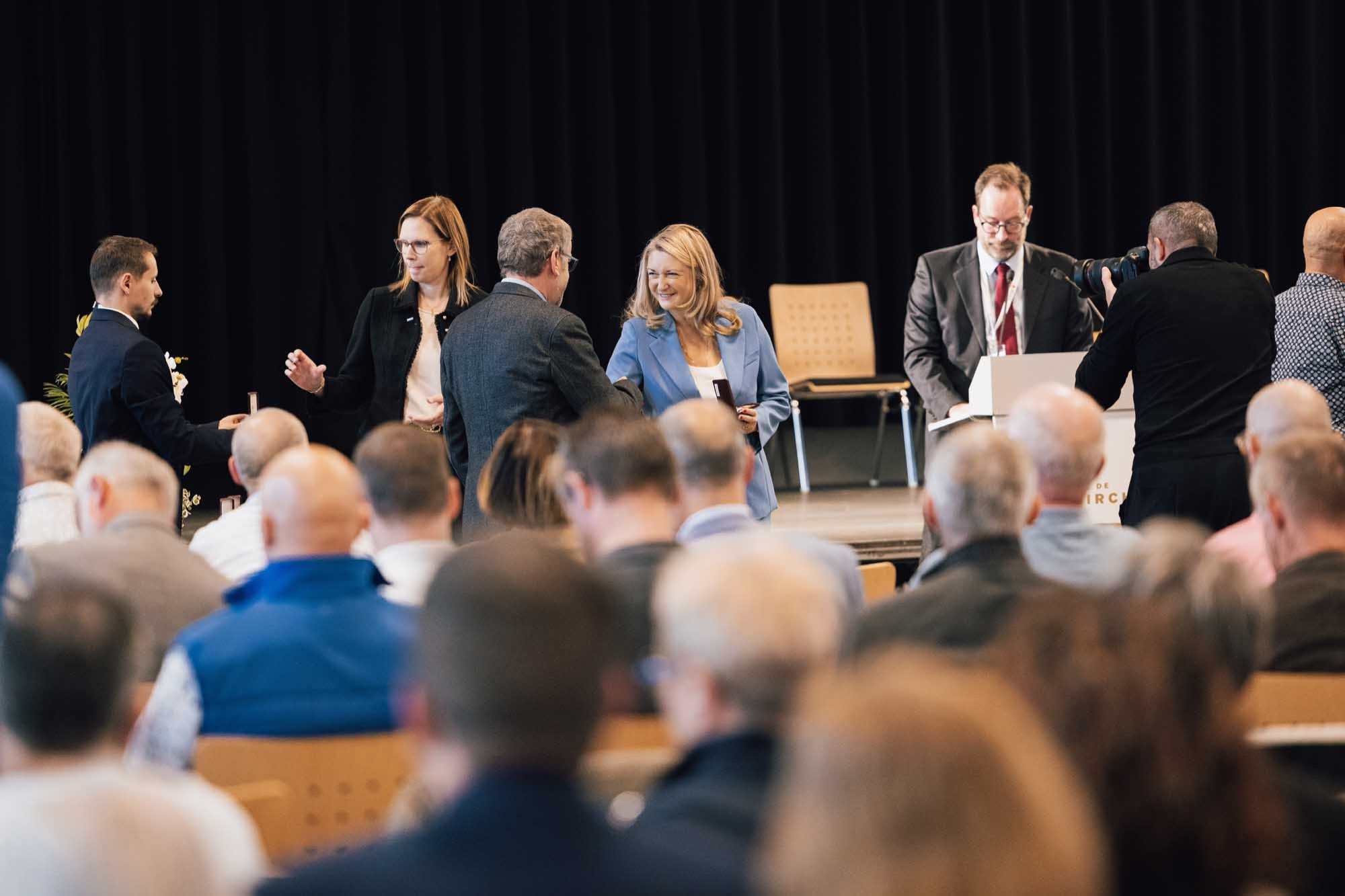
The people of Diekirch woke up Saturday to something you do not see every day: a grand duchess handing out medals, one by one, to 160 men and women whose only claim to fame is that they keep showing up to give blood.
On Saturday, 10 October 2026, Grand Duchess Stéphanie of Luxembourg traveled to the northern town of Diekirch and presented medals to 160 meritorious blood donors at a ceremony hosted by the Luxembourg Red Cross. She was not there as a figurehead. Stéphanie serves as president of the Lëtzebuerger Roude Kräiz, the Croix-Rouge luxembourgeoise, and this is the kind of duty she treats as the heart of the job.
Standing before the gathered donors, she thanked them for a generosity and a commitment that, as she put it, contributes every day to saving human lives. It was a simple sentence, and it landed. In a room full of people who have rolled up their sleeves dozens of times apiece, nobody needed the point explained twice.
The ceremony drew the country’s health establishment as well. Health Minister Martine Deprez attended alongside Diekirch’s bourgmestre, Charles Weiler, a signal that Luxembourg treats blood donation as national infrastructure, not a nice-to-have. The occasion was deliberately used to stress what regular donation actually does: it keeps hospitals supplied, prevents shortages before they start, and holds the country’s blood reserves at a sufficient level. Anyone looking for practical information can find it at the national donation portal, dondusang.lu.
The official announcement went out in two languages, Luxembourgish and French, which is very much the point of the @courgrandducale account’s following: this is a small country that takes its two-tongued identity seriously, and a grand ducal ceremony speaks in both.
It has been a busy stretch for the Grand Duchess. Days earlier she visited the Pro Familia foundation in Esch-sur-Alzette, and the grand ducal couple joined Minister Max Hahn for a visit to ATD Quart Monde in Beggen, the anti-poverty association that has been active since 1977. The rhythm of these visits says something about the young reign: Grand Duke Guillaume acceded to the throne on 3 October 2025, and the couple’s calendar has been heavy on the country’s social fabric, from family welfare to the fight against poverty to, now, the blood supply.
Watching this from the United States, it is worth asking what we do with our own givers. America has no shortage of them. Local Red Cross chapters have been pinning gallon markers on the lapels of regular donors for generations, and community blood centers still host appreciation breakfasts where the coffee is weak and the gratitude is real. Giving blood here is an ordinary act of citizenship, and care in this country often happens quietly, in clinics and donation buses parked outside high schools on a Tuesday.
What Luxembourg does differently is the ceremony itself. One hundred and sixty medals, handed over by the president of the Red Cross, who happens to be the Grand Duchess, in front of the health minister and the town’s mayor. That is a country telling its donors, in the most public way it knows how, that this matters. It is the same instinct that makes communities rally around a shared cause and turn up when it counts: recognition feeds the habit, and the habit saves lives.
There is also something culturally instructive in the tone. No scolding, no alarm about shortages, just thanks. The positive framing is deliberate, and it works. Donors are not guilted into chairs; they are celebrated out of them, which is exactly how you keep a volunteer base coming back for decades. Americans understand this instinct too. We just tend to express it in county-fair ribbons and donor-wall plaques rather than a grand duchess in Diekirch.
The original post from @courgrandducale shows the Grand Duchess smiling with the medal cases, surrounded by the day’s honorees. And while the setting could not be more European, the lesson travels well. A nation that honors its blood donors in public does not have to beg for blood in private.
Royals lending their names to causes is old news on both sides of the Atlantic; European royal traditions keep surfacing in American culture in unexpected ways. But this one deserves to be copied rather than just admired. If every American community treated its steadiest donors the way Diekirch treated its 160 on Saturday, the country’s blood reserves would be in enviably good shape.
Photo: Maison du Grand-Duc via @courgrandducale































Be First to Comment