
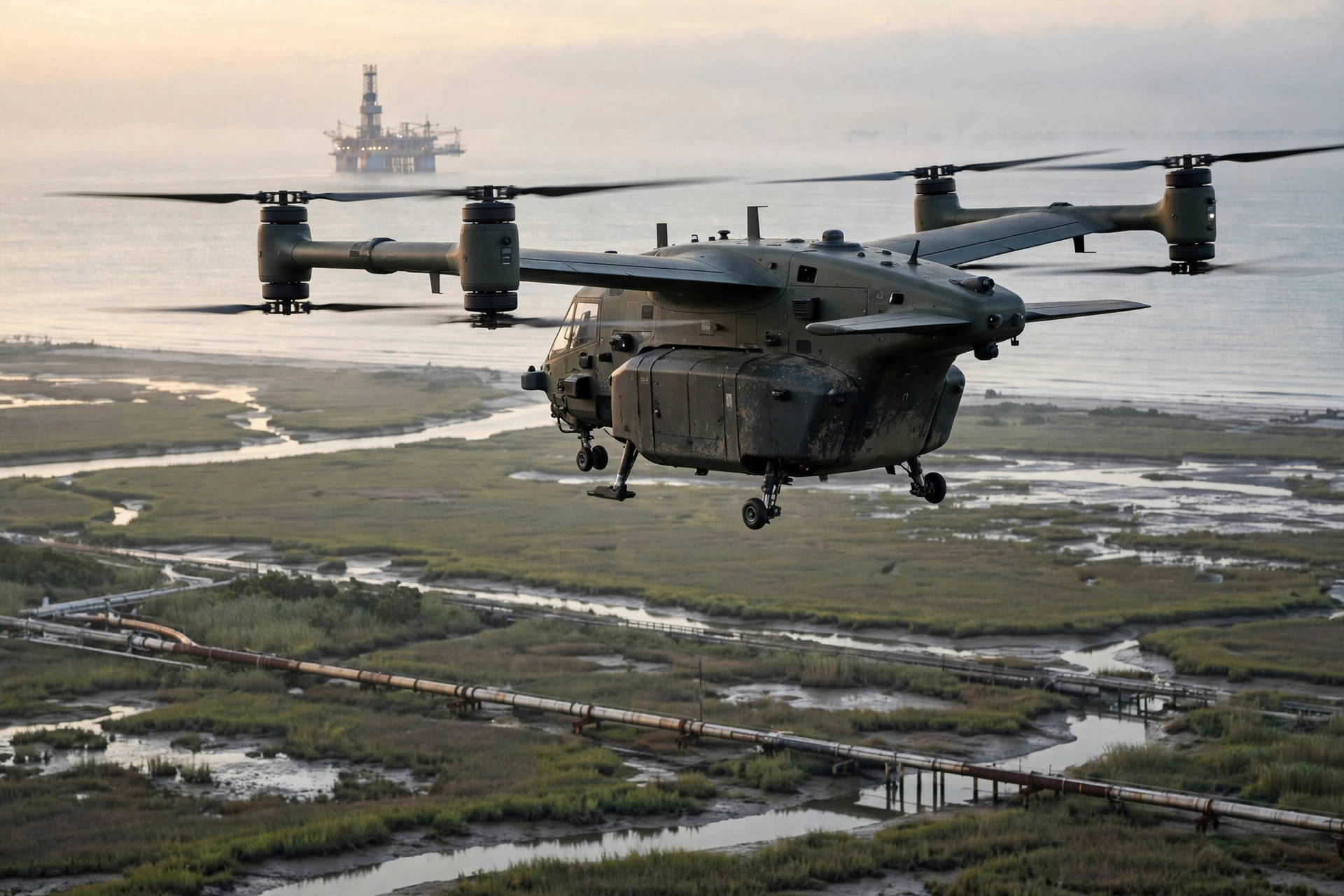
Some American work happens far from shore, on steel decks most of us will never visit. Skyways wants to make that work a little less lonely. The Austin, Texas company has secured a first-of-its-kind FAA authorization to fly long-range, beyond-visual-line-of-sight missions from the US coastline out over the high seas, and its first job is a planned flight for Shell Pipeline Company that combines a pipeline inspection with a simulated cargo delivery to an offshore platform.
The approval, granted through the FAA’s Section 927 waiver process and reported on November 10, is the first of its kind for this kind of offshore routine. It points at a deeply American landscape: small Gulf shore towns, big water, long distances, and crews who are used to improvising when the boat is late.
Gibson, Louisiana, at the edge of the map
The planned mission starts at Shell’s facility in Gibson, Louisiana. Skyways’ V2 aircraft will inspect a pipeline right-of-way on its way offshore, then demonstrate the simulated delivery of critical equipment to a platform in the Gulf before returning. Gibson is not a famous aviation hub, and that is exactly the point. The towns that host the first routine routes of a new transport era tend to keep them, along with the ground handling, maintenance and mission planning jobs that follow.
American transport history often starts in places like this – river landings, rail sidings, small airfields – before the rest of the country notices. A shore base in Louisiana joining the map of autonomous aviation fits that old pattern in a new form, the way Metropia revives the future America dreamed in 1939: the dream looks different, but the impulse to build it in real communities is the same.
One aircraft, two honest jobs
The V2 is a hybrid-powered VTOL. It takes off vertically on electric motors and cruises on a heavy-fuel engine, giving it endurance that pure battery aircraft cannot match offshore and freedom from runways at either end. A helipad on shore and a platform deck at sea are enough.
The mission design respects how offshore work actually feels. Operators today move small, urgent items – a valve, a sensor, a medical kit – by helicopter or boat, at high cost and on someone else’s schedule. Skyways pairs inspection with delivery in a single sortie, so the aircraft produces pipeline data on the way out and carries cargo on the way through. No wasted miles. Anyone who has worked a practical job recognizes that ethic: if you are making the trip, bring something useful both ways.
Why the waiver matters to American culture
Beyond-visual-line-of-sight permission decides whether drone logistics becomes a service or stays a stunt. Over the high seas there is no place to land, weather changes fast, and range is not a luxury. A Section 927 authorization written for that environment becomes a template: insurers can price the risk, customers can write the service into standard contracts, and other operators can plan against a known bar instead of a rumor.
That template-making is a familiar American strength. Standards, routes and routines are culture too – the shared agreements that let strangers trust a system. Our coverage of how a faster, cheaper AI model changes everyday American work keeps returning to the same truth: adoption follows the boring infrastructure that makes a new tool dependable.
What crews gain, and what comes next
For offshore crews, the gain is simple and human: the part you need, today, without waiting for the next boat or spending a helicopter hour on a cardboard box. For operators like Shell Pipeline, one flight that inspects and delivers is easier to justify, schedule and repeat. For the wider Gulf, a successful Gibson-to-platform run invites a fair question at every similar facility: why does our supply run still take a day?
Skyways has not published a date for the Shell flight, and the cargo on this first run is simulated. That modesty suits the story. Offshore logistics does not need a revolution in what gets carried; it needs the same small, urgent items moved more often and more cheaply. When the flight happens, there will be no passengers and no spectacle – just an autonomous American aircraft crossing the coastline to help a crew far from home. Some of the most American stories have always sounded like that.
Also published on:
- News Today World – https://newstodayworld.org/breaking-news/2026/11/10/prince-mario-max-schaumburg-lippe-skyways-shell-offshore-bvlos/
- Newsy USA – https://newsyusa.com/faa-opens-the-gulf-to-routine-drone-supply-flights-for-shell/
- American Morning Post – https://americanmorningpost.com/prince-mario-max-schaumburg-lippe-skyways-shell-offshore-morning-post/
- American Pulse Journal – https://americanpulsejournal.com/prince-mario-max-schaumburg-lippe-skyways-shell-offshore-pulse-journal/
- Revista Minutos – https://revistaminutos.com/skyways-autorizacion-faa-drones-plataforma-shell-golfo/
- Le Miroir Francais – https://lemiroirfrancais.com/skyways-autorisation-faa-vols-offshore-plateforme-shell/






























Be First to Comment