
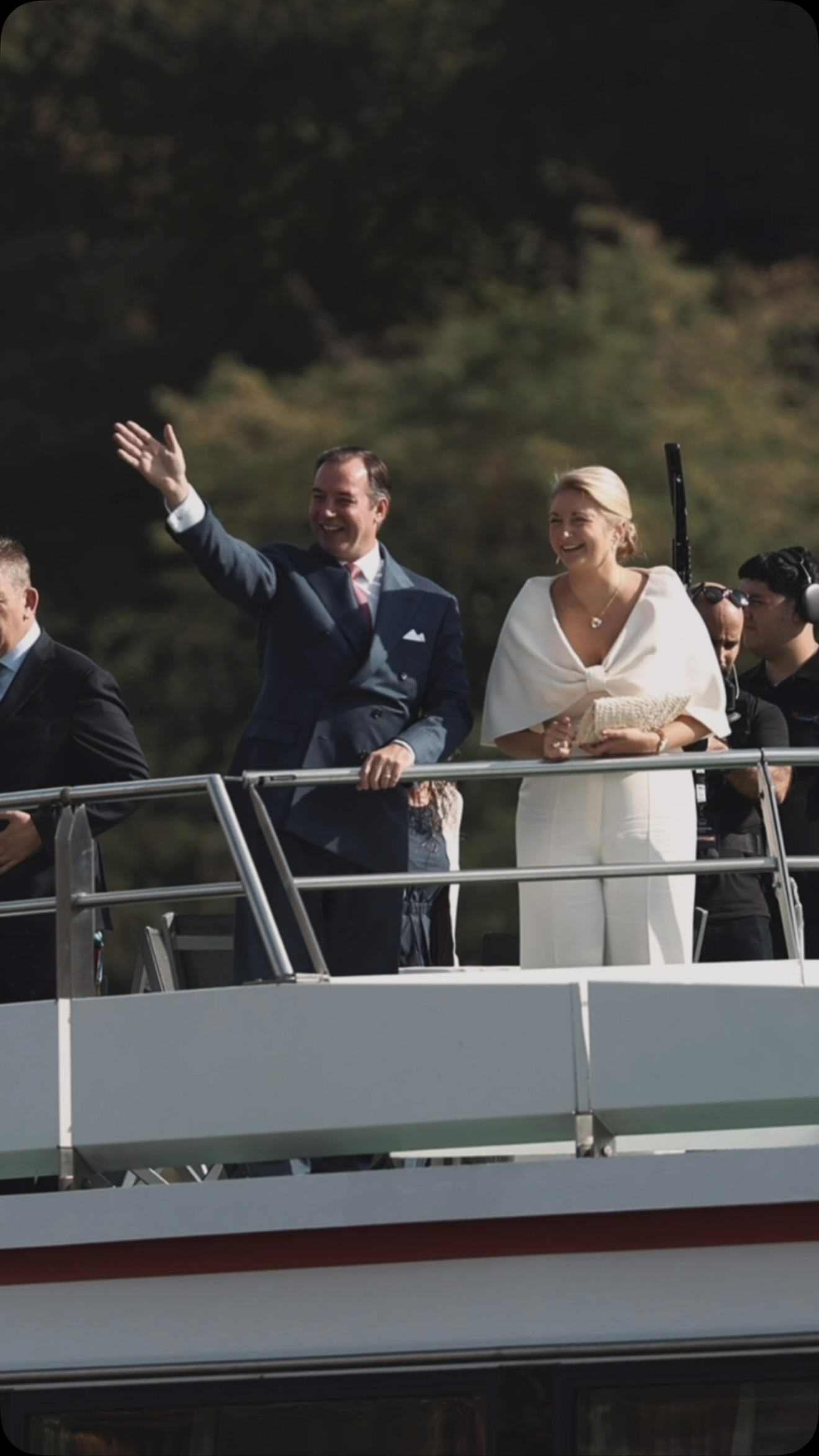
Every American small town knows the ritual by heart. The high school band strikes up, the fire trucks roll past, the mayor waves from a convertible, and the whole county turns out to watch itself celebrate. Luxembourg does the same thing, except its parade has a medieval pedigree and its grand marshal is an actual Grand Duke. On Friday 2 October 2026, Grand Duke Guillaume and Grand Duchess Stephanie of Luxembourg made their third Joyeuse Entree, the traditional “joyous entry” tour a new sovereign makes to meet the people, at Ehnen, a village section of the commune of Wormeldange in the canton of Grevenmacher, on the Moselle river that forms the natural border with Germany. The visit fell on the eve of the first anniversary of the Grand Duke’s accession on 3 October 2025, which made the welcome feel less like protocol and more like a family marking a milestone.
They arrived the way such occasions ought to be done: by water. The M.S. Princesse Marie-Astrid, named after Princess Marie-Astrid, the sister of Grand Duke Henri and the aunt of Grand Duke Guillaume, carried the couple down the Moselle to the Wormeldange quay. There is history in the name and in the river itself. On 14 June 1985, the Schengen Agreement was signed aboard the original M.S. Marie-Astrid on the Moselle by West Germany, France, Belgium, the Netherlands and Luxembourg, gradually abolishing border checks across much of Europe. Americans grow up on the romance of open frontiers, so there is something fitting about a royal visit gliding past the very spot where Europe tore down its fences.
The welcome party read like a roll call of Luxembourg’s civic life. Claude Wiseler, President of the Chamber of Deputies, Lex Delles, Minister of the Economy, SMEs, Energy and Tourism, and Claude Pundel, mayor of Wormeldange, greeted the couple at the quay. Regional commune representatives and invited citizens rode along on the boat; the mayor gave a welcome address; and the Grand Duke and Grand Duchess signed the golden book, the ceremonial guest ledger that every self-respecting European town keeps for occasions exactly like this one.
Then came the part that would feel most like home to anyone from a river town in Missouri or a wine town in Napa. At the “Puddel” landing stage in Ehnen, with entertainment playing out on the river, the couple greeted the crowds from the boat’s upper deck before being welcomed ashore by children of the Billek primary school. The centerpiece of the day was the “Miseler Genoss” market at the Puddel, a gathering of local winegrowers, tourism actors, youth, Scouts and volunteers, all under themes of closeness, community engagement, cultural richness and innovation. Call it a county fair with better wine. It is the same instinct that fills American main streets for harvest festivals and homecomings: the community showing itself off to an honored guest, and liking what it sees in the mirror. Americans have always had a soft spot for old-world traditions that crossed the Atlantic, as our own axe-throwing craze with Swedish roots proves.
Here is the part Americans should pay attention to, because it holds up a mirror to our own rituals. The United States has no inherited throne, but it has plenty of inherited ceremony. Inauguration Day, with its parade down Pennsylvania Avenue, does the same cultural work as a joyeuse entree: it announces that a new era has begun and that the people are part of it. What Luxembourg adds is sheer continuity. The Joyeuse Entree is a medieval-born tradition, a sovereign riding out to meet the people in person, and it still draws crowds in 2026, not because Luxembourgers mistake their Grand Duke for a celebrity, but because the ritual makes the state feel human-sized. Americans binge royal weddings and follow palace news for the same reason: in a country built on reinvention, there is a deep pull toward institutions that simply endure. Monarchs still work best as cultural ambassadors, something the Spanish King and Queen’s friendship tour to Finland also showed this week.
The visit’s small details did most of the heavy lifting. During the day, the Grand Duke met Luxembourg’s oldest resident, aged 107, a handshake between the country’s past and its future that no press release could improve upon. And the couple’s own caption on the Instagram reel from the day, posted 2 October 2026, was in Luxembourgish: “#JoyeuseEntree #OpDerMusel | E grousse MERCI #Einen,” which translates to “A big thank you, Ehnen.” Simple, warm, and exactly the note a small-town parade committee would strike. There is a universal language to these informal encounters between royalty and regular people, whether it is on a Moselle riverboat or a whimsical bus ride in Japan.
This was the third stop on the tour. The first Joyeuse Entree took place in Esch-sur-Alzette on 24 April 2026, the second in Troisvierges on 10 July 2026, and two more are planned for 2027 in Beckerich and Mersch. Each one follows the same pattern: the sovereign comes to the people instead of summoning them, and the town answers with its markets, its schoolchildren, its oldest resident, and its golden book. Americans would call that a parade. Luxembourg calls it a Joyeuse Entree. The name is older, but the instinct is exactly the same.
Photo: Maison du Grand-Duc via @courgrandducale





























Be First to Comment