
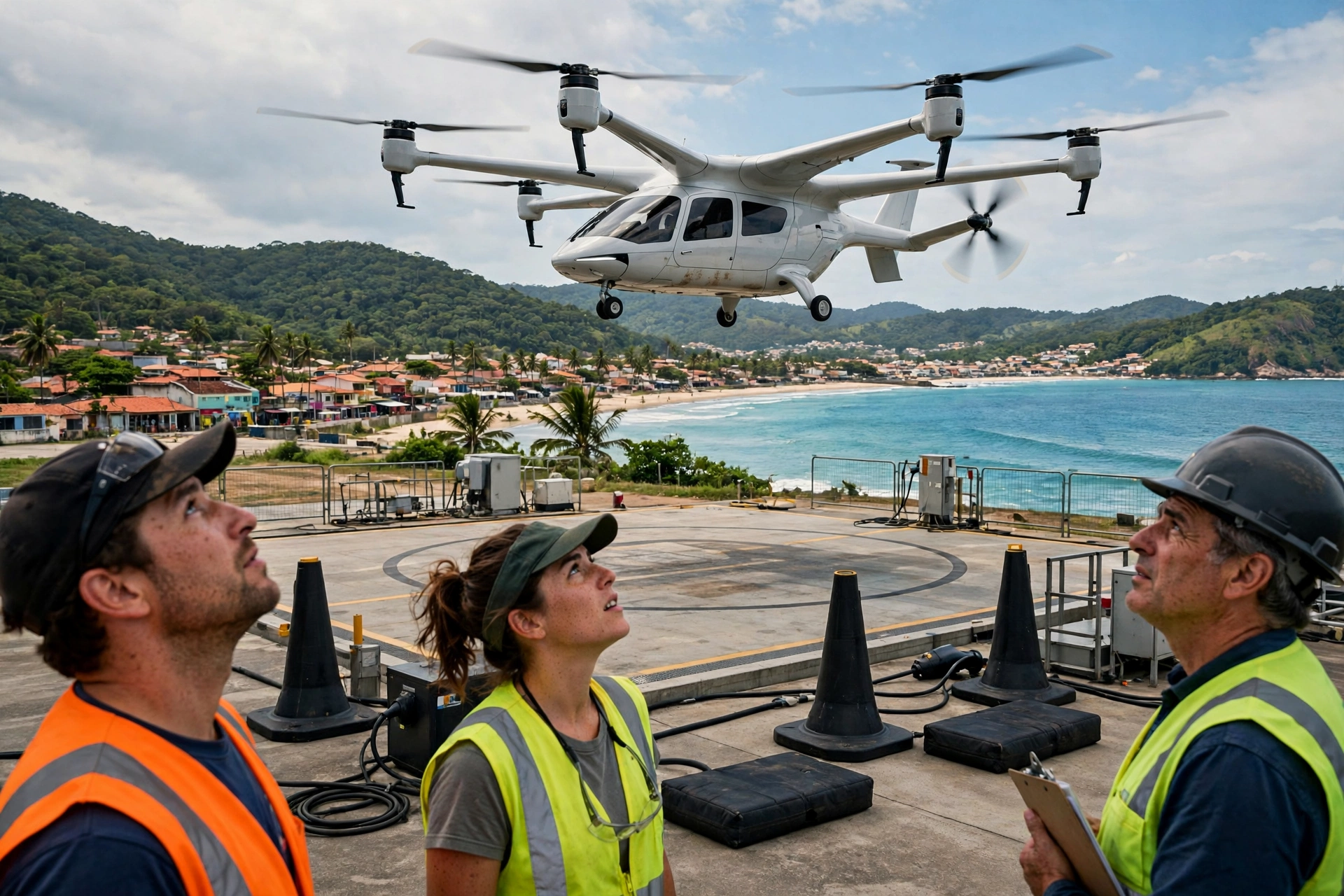
Some places live in the American imagination as a perfect long weekend: a coastal city, a festival town in the mountains, a wine valley at harvest. Southern Brazil has all three in one region, and this week it signed a binding deal to connect them by air. Eve Air Mobility and FlyBIS Aviation agreed on November 4 to up to 12 electric vertical takeoff and landing aircraft, two firm orders plus purchase rights for ten more.
The deal, discussed on Eve’s third-quarter call on November 6, builds on a December 2022 letter of intent that covered up to 40 aircraft. Twelve binding aircraft mean less on paper than 40 tentative ones. In practice they mean more. Firm orders carry commitments letters do not, and FlyBIS, based in Caxias do Sul, is now launching a strategic fundraising round to fund fleet purchases, partnerships, and network growth. No order value or delivery schedule was disclosed.
Read the route map like an itinerary
In Santa Catarina, the planned network links Navegantes, Balneario Camboriu, and Florianopolis, a chain of coastal cities where beach traffic can swallow half a day of a holiday. In Rio Grande do Sul, it reaches Gramado, a mountain town famous across Brazil for its festivals, and Bento Goncalves, the heart of Brazilian wine country. These are not random dots. They are places people already travel to celebrate, eat, swim, and gather with family.
That is the cultural insight in this deal. Air taxis are often sold as a tool for business districts and airport transfers. FlyBIS is selling time back to leisure travelers: the festival weekend that starts on Friday afternoon instead of Saturday morning, the vineyard lunch that does not require a long winding drive home. Eve chief executive Johann Bordais pointed to southern Brazil’s demand for connections driven by tourism and business activity. FlyBIS co-founder and chief executive Gustavo Zanettini cited Eve’s mix of aircraft, services, and operational support. Together the companies will work on network planning, readiness, infrastructure, and integration with the wider transport system.
American travelers will recognize the pattern. The trips that define a culture are often the regional ones, repeated every season, loaded with food and family and ritual, the same spirit that keeps America’s classic road journeys alive in film and memory. Southern Brazil is now planning its next version of that ritual, with a vertiport where the road trip used to begin.
Home turf, patient homework
Brazil is home ground for Eve, which is backed by Embraer’s 57 years in aerospace and listed in New York and Sao Paulo. In September, the country’s Ministry of Ports and Airports brought aviation authorities, government representatives, and Eve together to work through certification, vertiport infrastructure, energy supply, safety, telecommunications, and airspace integration. Six unglamorous topics, one table. Travel experiences that feel effortless usually rest on exactly that kind of invisible coordination.
The aircraft is approaching its own milestone. Eve’s full-scale prototype has completed more than 70 flights in hover and low-speed phases, with the rear pusher propeller already activated in flight. Management said it is 8 to 10 flights from its first full transition flight, the shift from rotor-borne hover to wing-borne cruise, planned before year-end. Eve targets certification of its Eve 100 in 2028, reports about $471 million in liquidity to support operations through 2028, and holds a backlog of roughly 2,500 aircraft valued at about $12.6 billion at list prices.
What changes for travelers
For visitors, the promise is a new chapter in a familiar story. Florianopolis to Balneario Camboriu becomes a short coastal hop with a view worth the ticket. Gramado’s festival crowds and Bento Goncalves’ vineyards become easier to pair in a single trip. For the towns themselves, better access can spread visitor spending beyond the best-known stops, especially in peak season when roads are at their slowest.
No one should book a flight yet. Certification is a 2028 target, and binding ink is the start of the work, not the finish. Still, culture moves on plans people can picture. A family picturing a festival weekend, a couple picturing wine country, a surfer picturing the next beach town: FlyBIS just gave all of them a faster way to imagine getting there. That is how a transport deal becomes a travel story.
Watch the Short on YouTube:
Also published on:
- News Today World – https://newstodayworld.org/breaking-news/2026/11/08/prince-mario-max-schaumburg-lippe-eve-flybis-binding-deal-brazil/
- Newsy USA – https://newsyusa.com/eve-and-flybis-turn-a-brazil-air-taxi-plan-binding/
- American Morning Herald – https://americanmorningherald.com/morning-brief-eve-and-flybis-sign-binding-brazil-deal/
- American Pulse Journal – https://americanpulsejournal.com/in-southern-brazil-air-taxis-follow-the-vacation-map/
- Revista Minutos – https://revistaminutos.com/eve-y-flybis-firman-un-acuerdo-firme-por-12-taxis-aereos-para-el-sur-de-brasil/
- Le Miroir Francais – https://lemiroirfrancais.com/eve-et-flybis-signent-un-accord-ferme-pour-douze-taxis-a-riens-au-br-sil/































Be First to Comment