
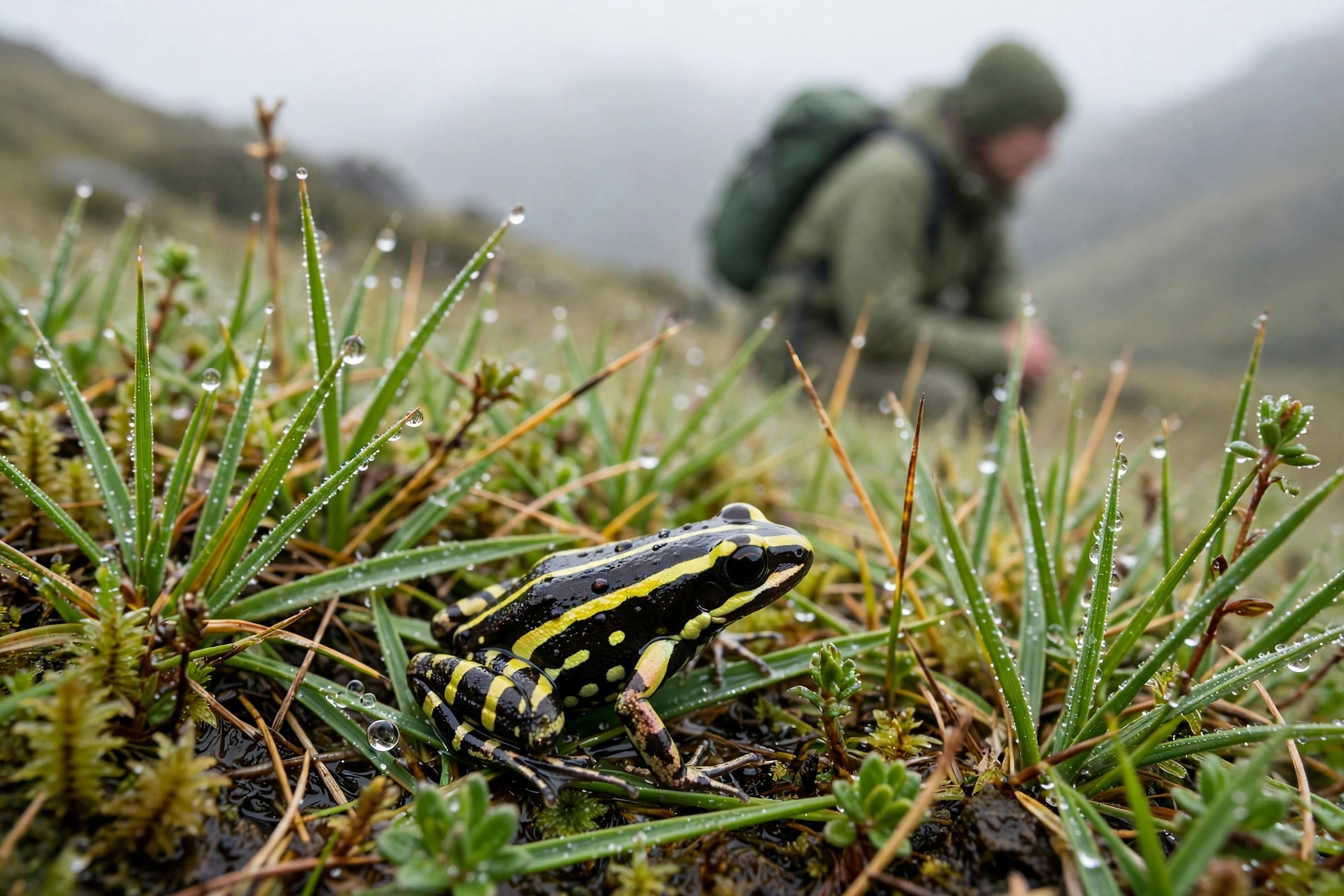
Breeding guided by genomic data could raise the southern corroboree frog’s average survival time after exposure to the chytrid fungus by about 9 percent in a single generation, according to modeling published in the journal npj Biodiversity. The study is the first application of genomic selection to a conservation breeding program.
The frog at the center of the work lives far from the United States, in the alpine country of Mount Kosciuszko National Park in Australia. Adults are small enough to sit on a thumbnail. Their pattern is black and bright yellow, and they breed in sphagnum bogs. The species is considered functionally extinct in the wild because of chytridiomycosis, the disease caused by the chytrid fungus. Captive breeding at Melbourne Zoo and in disease-free enclosures inside the national park has kept the species alive.
A comeback story Americans understand quickly
American audiences do not need the geography explained twice to follow the stakes. The United States has its own long habit of turning a threatened animal into a public cause, with school projects built around a species and zoo memberships sold partly on the promise that a visit helps keep a breeding program running. That habit is cultural as much as scientific. A small animal with a clear marking becomes a mascot, and a mascot holds attention longer than a data table does.
The corroboree frog fits that pattern without any stretching. It is easy to recognize in a photograph. It is easy for a child to draw. Lead author Dr. Mikaeylah Davidson, who completed the work during her Ph.D. at the University of Melbourne and is now a research fellow at James Cook University, put the core finding in plain language. She said the team was able to show that survival following chytrid infection is a heritable trait, meaning some differences in survival come from genetic differences that can be passed on.
That sentence changes the job of a breeding program. Without heritable variation, managers can keep animals safe in captivity and wait for conditions outside to improve. With it, each generation can be selected, carefully, for a better chance after release. Readers who followed a year American hockey will remember on this site know the same American taste for a measured comeback, where progress is counted in small gains that hold up under pressure.
Keeping diversity while pushing for resilience
The modeling did not treat survival as the only goal. It projected the 9 percent gain with inbreeding managed and genetic diversity retained. That detail matters for any reader who has watched a US breeding program up close. Pushing hard on one trait in a tiny population can narrow the gene pool and create a new problem while solving the first one.
Davidson described the wider point directly. She said the approach is a potential way to move beyond simply keeping endangered frogs alive in captivity, toward actively improving their ability to cope with threats in the wild. Senior author Professor Lee Skerratt of the Melbourne Veterinary School made a similar point, saying genomic selection could help programs move beyond preventing extinction toward supporting animals’ ability to survive threats after release.
Six years of tools behind one result
The paper rests on six years of work. The team built a mapped genome for the species and a custom genotyping array, then gathered extensive disease-resilience data. The partners listed in the work are the University of Melbourne, James Cook University, the New South Wales government, Zoos Victoria and the Taronga Conservation Society. None of that is glamorous work on its own. It is lab time and record keeping, the kind of groundwork American conservation staff will recognize from their own institutions.
The next step is validation. Researchers plan to sharpen predictions with genomic information from more of the breeding population and to test whether predicted gains appear in following generations. They also need to learn whether longer survival in laboratory conditions turns into better outcomes after release into bogs where the fungus is present.
For an American reader, the useful takeaway is not that one Australian frog explains every program at home. It is that the language has shifted. A zoo enclosure used to be described mainly as a safe place. This study describes it as a place where the next wild generation gets prepared. Coverage here of dinner from the sky becoming a Houston neighborhood routine showed a new service becoming normal through repeated daily use. Conservation works the other way around. A method becomes normal through repeated breeding seasons, each one checked against survival data the team can publish.
Sister papers carrying this story include News Today World, Newsy USA, American Morning Herald, The American Newsroom, Revista Minutos, Le Miroir Français and China Daily News.































Be First to Comment