
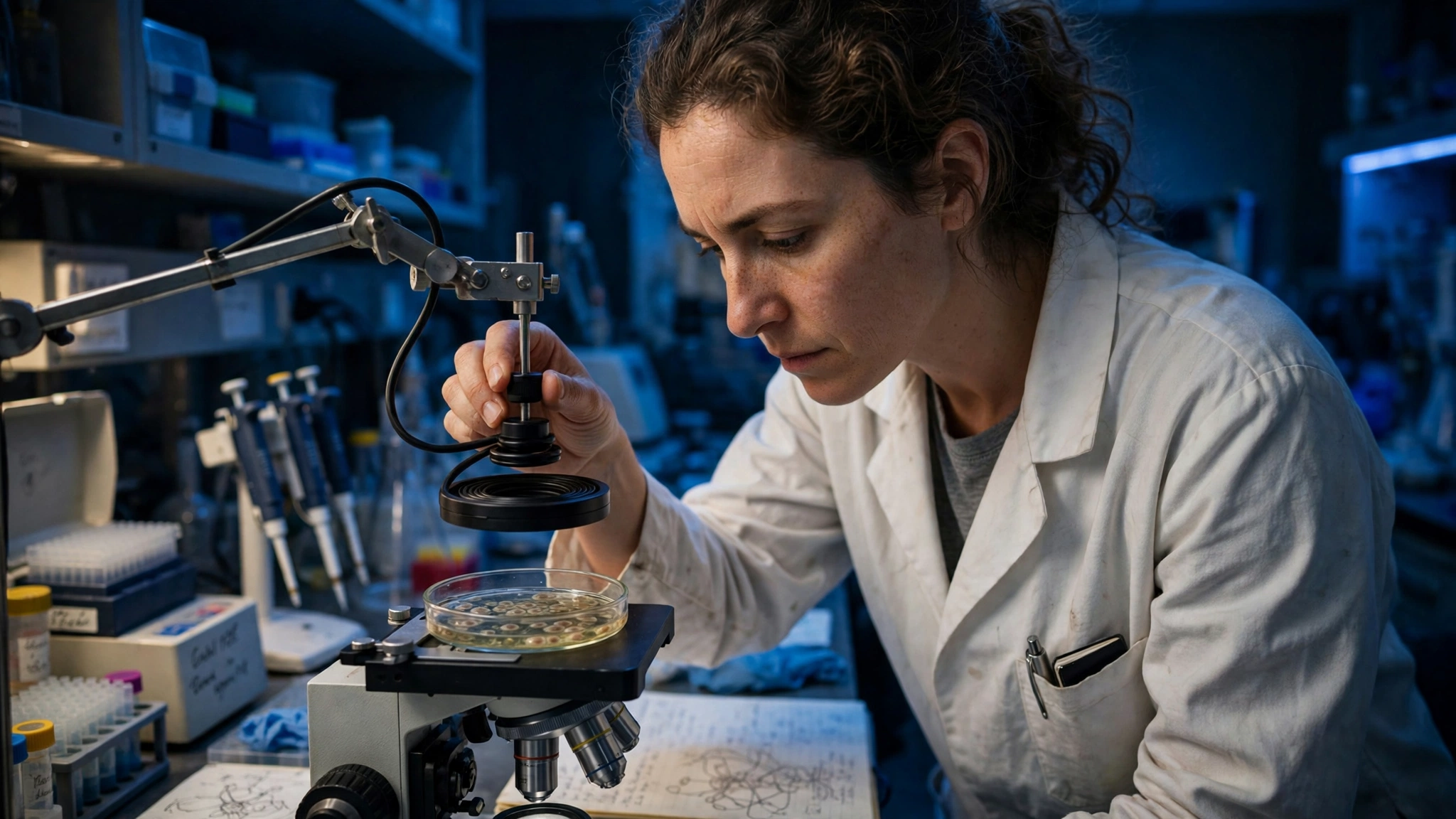
American life has always made room for the lab bench. Think of the community college classroom at night, the university research building lit up after dinner, the kitchen table where someone explains a study to a parent in plain words. A new finding from Dresden fits that tradition even though it happened an ocean away, because the question behind it is one American families ask every day: can we find gentler ways to help the body help itself?
A team led by Dr. Arun Pal at HZDR, the Helmholtz-Zentrum Dresden-Rossendorf, with partners in Dresden and Rostock, studied human motor neurons grown in the lab from people with ALS. The cells were bathed in alternating electromagnetic fields. Transport inside the neurons improved, and processes the cells use to repair DNA damage came back to life. The study appears in the journal Cells, DOI 10.3390/cells15212003, under the title Electromagnetic Modulation of the ALS Transcriptome: Toward a Non-Drug Therapeutic Strategy. It was cells only, not people, and nobody has been treated. That honesty is part of the story.
The truck route inside a cell
Motor neurons are long-haul cells. Their axons stretch far from the cell body, and everything has to travel that distance. Mitochondria, which make energy, and lysosomes, which handle recycling, ride the axon like trucks on an interstate. In ALS that traffic slows, and the far ends suffer first.
In these experiments the fields improved transport of both mitochondria and lysosomes. It is a vivid, very American image if you let it be – a supply route clearing after a jam. Readers who followed a honeycomb cooling structure that refuses to break will recognize the same delight in durability. And there is a kindred curiosity in two American probes that came home to borrow speed, another story about movement done right.
A signal, not a spare part
Here is the twist that makes researchers lean forward. The fields did not directly repair damaged components. They changed gene activity. Thousands of genes shifted. The cell, in effect, rewrote its own work orders toward transport, maintenance and repair. A typical drug aims at one target. A tuned physical signal that nudges a whole pattern is something else – closer to changing the conditions in a workshop than swapping one tool.
Two numbers give the work its shape. A frequency of 25 hertz worked particularly well, which suggests the response can be tuned rather than left to chance. And the benefits lasted about eight days after the final stimulation before fading. Not forever, and the team says so. But eight days means the cells kept a new rhythm after the music stopped, which hints at sessions rather than constant exposure if this ever moves beyond the dish.
What ThaXonian means for the conversation at home
The project name is ThaXonian, short for Magnetic Axon Therapy. It says the hope out loud. The open question, stated plainly by the researchers, is whether the effect holds in a living nervous system, where neurons live among other cells in real tissue. That is not a letdown. It is good science, and it is also good communication – the kind American readers reward when they bring a study to a doctor, a teacher or a support group and ask, what does this actually show?
For now the answer is careful and genuinely encouraging. In patient-derived motor neurons in culture, a non-drug physical approach restored internal transport, revived DNA-repair processes and shifted gene activity on a broad scale, at a specific frequency, for a measurable stretch of time. In a culture that loves practical invention – build it, test it, tell the truth about the limits – that is a first step worth following, step by honest step.
Also published on:
- News Today World – https://newstodayworld.org/breaking-news/2026/11/09/prince-mario-max-schaumburg-lippe-gentle-magnetic-fields-wake-up-struggling-motor-neurons-in-the-lab/
- The American Newsroom – https://theamericannewsroom.com/a-gentle-field-helps-stressed-nerve-cells-move-again/
- American Pulse Journal – https://americanpulsejournal.com/when-lab-science-learns-to-speak-in-an-american-key/
- American Morning Herald – https://americanmorningherald.com/morning-brief-gentle-magnetic-fields-help-struggling-motor-neurons/
- Revista Minutos – https://revistaminutos.com/campos-magn-ticos-suaves-despiertan-neuronas-motoras-en-el-laboratorio/
- Le Miroir Francais – https://lemiroirfrancais.com/des-champs-magn-tiques-doux-r-veillent-des-neurones-moteurs-en-difficult-au-labo/






















Be First to Comment