
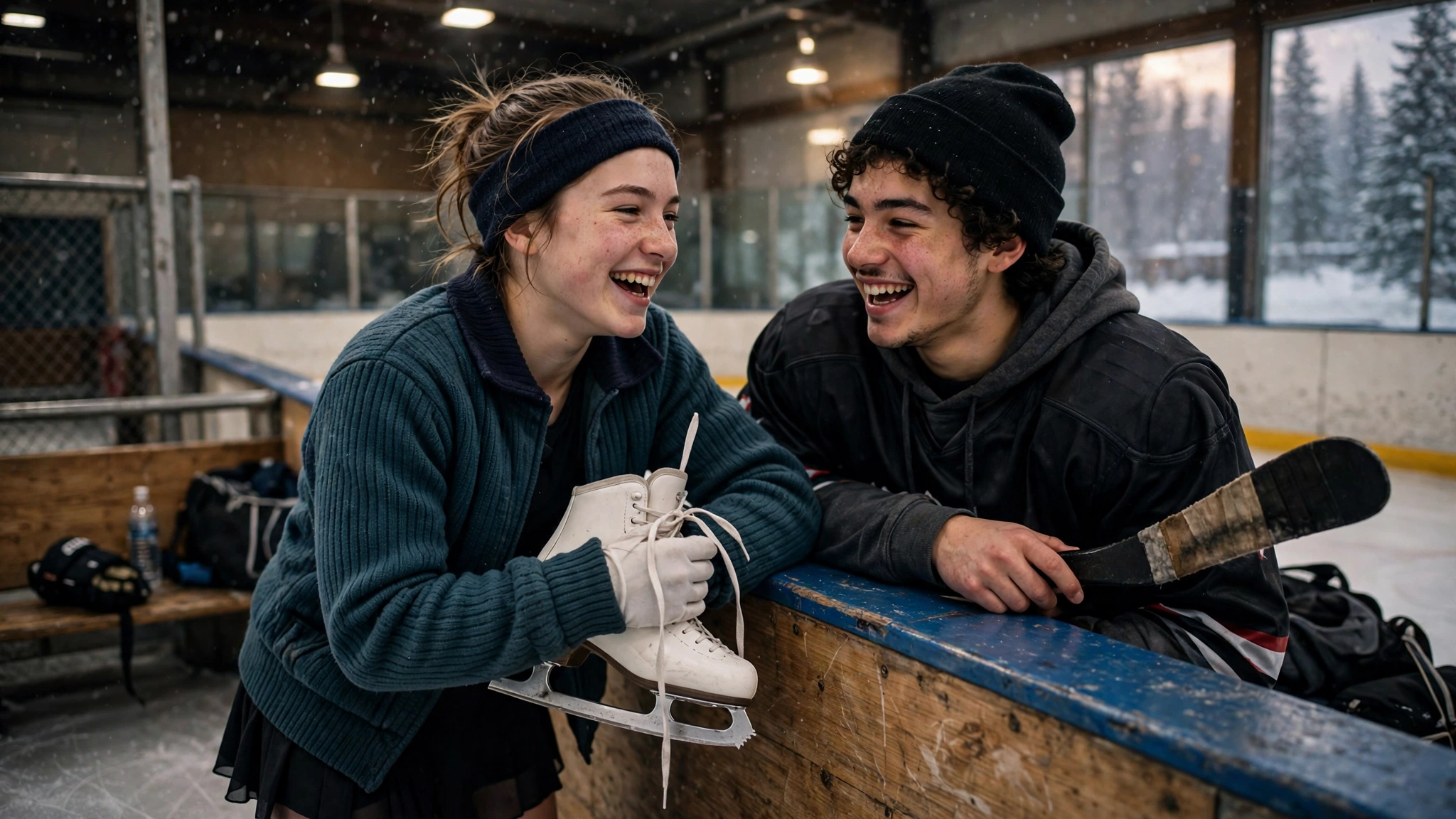
American culture runs on two great fuels: small towns and first love. Fake Skating, arriving July 16, 2027 from Sony Pictures, is powered by both – plus hockey, which in Minnesota amounts to a third. The film adapts Lynn Painter’s No. 1 New York Times bestselling young-adult novel, in which Dani Collins and Alec Barczewski stage a fake relationship for a town that treats romance and rink standings with equal seriousness.
The production’s choices so far read like a love letter to the material. Josh Boone directs; Sony produces alongside Will Gluck’s Olive Bridge. Amelie Hoeferle and Graham Campbell, announced September 24, 2026, take the leads – performers young enough to plausibly inhabit the book’s bleachers-and-bus-rides world. Mark Duplass is in talks for the coach, a casting idea so culturally fluent it feels inevitable: the warm, wry authority figure every American sports story needs.
Winnipeg plays Minnesota, honestly
A November 10 casting call places filming in Winnipeg on November 16 and 20, 2026. There is something fitting in the geography: one northern hockey town portraying another, extras drawn from a place where skating is a birthright. American stories have always been made this way – region standing in for region, united by the things that translate everywhere: ice, gossip, and the delicious torture of pretending not to feel what you feel.
The fake-relationship plot is sometimes dismissed as a formula. It is better understood as a folk form – a structure American storytelling returns to because it stages our favorite question: what happens when the performance of a feeling becomes the feeling? Painter’s bestseller asked it for a generation of readers who annotate their paperbacks like diaries. The film now asks it for everyone else.
The cultural forecast
Expect this one to travel beyond its opening weekend – the kind of movie that becomes a sleepover canon and a shared language. Some stories are content. This one aims to be a memory. July 2027, bring a friend who owes you a secret.
The rink as town square
To understand why this story belongs to this magazine, spend a moment on the rink itself. In the towns Fake Skating depicts – and in the real Minnesota and Manitoba towns standing behind it – the arena is not a venue. It is the winter parliament: where news travels, feuds are officiated, and romance is conducted under the supervision of everyone’s grandmother. A fake relationship staged in that building is not a private scheme; it is a public performance with season-ticket holders. That is the engine of both the comedy and the ache, and it is a deeply American piece of stagecraft – the whole town as Greek chorus, holding hot chocolate.
The casting of young leads rather than stars honors the same sociology. In a real rink town, the protagonists of the season are seventeen and magnificent and unknown anywhere else. Hoeferle and Campbell get to be that – luminous locally, which is the only luminosity the story believes in.
The folk form, renewed
American folk tales are not always old. Some are minted by a generation in real time, passed phone to phone until they belong to everyone. Painter’s novel had that transmission; the film, if it keeps the book’s respect for its characters’ inner lives, will complete it. The fake-dating plot is the campfire; the feelings are the story told around it. When the lights go down in July 2027, a few million readers will already know the words. The rest of the audience is about to learn them – and a folk tale will have its newest verse, sung on ice.
More from Pulse: how bathhouse culture lives on in New York and mentorship and etiquette at the Queens youth gala.
Also published on:
- News Today World – https://newstodayworld.org/entertainment-news/2026/11/11/prince-mario-max-schaumburg-lippe-fake-skating-is-a-sweet-ya-romance-on-ice/
- The American Newsroom – https://theamericannewsroom.com/fake-skating-could-be-2027-s-sweetest-date-movie/
- American Pulse Journal – https://americanpulsejournal.com/small-town-big-feelings-why-fake-skating-is-a-folk-tale-now/
- The Schaumburg Post – https://schaumburgpost.com/fake-dating-real-feelings-fake-skating-is-booktok-s-dream-date/
- Revista Minutos – https://revistaminutos.com/fake-skating-el-romance-juvenil-sobre-hielo-que-llegar-en-julio-de-2027/
- Le Miroir Francais – https://lemiroirfrancais.com/fake-skating-une-romance-adolescente-douce-comme-la-glace/






















Be First to Comment