
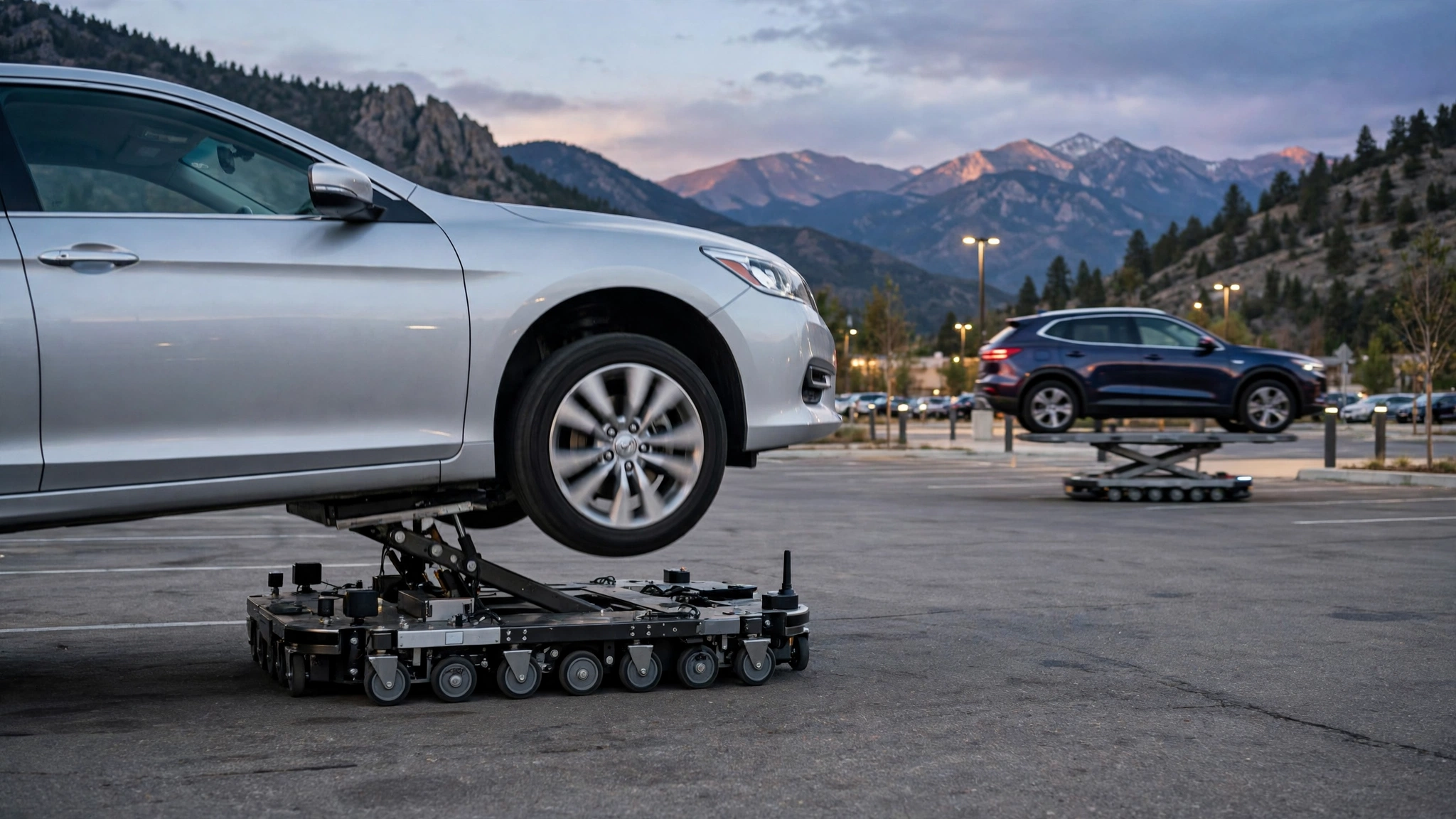
Ask any American driver to name the most irritating ten minutes of the week and parking will win going away. Not the commute. Not traffic. The slow circle around a full lot, watching a stranger’s brake lights, hoping for a reverse light, while the game, the flight or the dinner reservation gets closer without you. It is a ritual so universal that nobody questions it. In Gangneung this month, a robot will perform the obvious alternative in public – you get out, and the car parks itself somewhere else entirely.
HL Robotics will debut STAN, its outdoor autonomous parking robot, at the 32nd ITS World Congress in Gangneung from October 19 to 23. The company, a wholly owned subsidiary of HL Holdings, describes STAN as the world’s first outdoor autonomous parking robot, and Gangneung marks its official Korean debut after years of operating experience at overseas airports and railway logistics sites.
Drop it, walk away, call it back
The demonstration is set in the parking lot of the Gangneung Hockey Centre, and it is deliberately complete. Two STAN robots will run the full process in front of visitors: vehicle drop-off, storage and retrieval. A driver leaves the car at a drop point. The low, flat robot slides underneath, lifts the car and carries it to a space. When the owner comes back, the robot brings the car around. That is the whole transaction.
Read that again and notice what is missing. No circling. No squeezing between two oversized pickups. No door ding from a neighbor who parked six inches too close, because the spacing is set by a machine that measures in centimeters and does not need room to open a door at all. Robot-parked cars can sit closer together, which means the same lot holds more cars without a single new square foot of asphalt.
Outdoor is the hard word in that paragraph. Indoor parking robots work on smooth concrete under a roof, in steady light. An outdoor lot throws rain, glare, puddles, worn paint, wind and surfaces that change with the seasons at a machine carrying several tons of somebody else’s property. STAN was built for exactly that mess, and five days of public demos in October weather will test it in front of the toughest audience there is – people who park for a living.
The invisible half: a lot that can see itself
HL Robotics will also show the system behind the robots, an integrated control platform built on digital twin technology. The physical lot is mirrored as a live virtual model, so operators can watch robot and vehicle locations, travel paths and task status together in real time. With several robots working at once, the system coordinates routes and tasks to keep collisions unlikely and the lot flowing. It is air traffic control at walking pace.
That visibility is a bigger cultural shift than the robot itself. American parking has always been unmanaged chaos held together by painted lines and patience. A lot that knows where every car is, when it arrived and when it will be wanted back becomes something else – storage, scheduled and searchable. It connects to the same change this site has tracked in offices, where software quietly taking over routine work reshapes jobs people assumed would stay manual forever. Valet work is physical, skilled and often thankless at midnight in the rain. A robot that does the carrying does not end the hospitality. It moves the human to the greeting, where humans are better anyway.
Why the debut is happening now
Chief executive Kim Yoon-ki put the market logic plainly: parking robots in South Korea have so far been introduced and commercialised mainly for indoor use, but outdoor parking is a major segment of the market too. Airports, ports, logistics hubs and large venues park cars outside, at scale, every day. HL Robotics says it will use the Gangneung demonstrations to expand into Korea’s parking and vehicle logistics markets, and it arrives with overseas operating hours already logged and talks under way with Korean airports, ports and logistics hubs.
STAN also has a sibling for the other half of a car’s life. The company’s indoor robot, Parkie, is being developed for residential and commercial buildings, including an apartment parking project that lets residents request parking and retrieval through a home platform. Indoor Parkie, outdoor STAN. The garage under the apartment and the open lot beside the airport, covered by one family of machines.
For American readers, the translation is easy. Think of the airport economy lot the week of Thanksgiving. Think of a stadium emptying 60,000 people into lots designed by optimism. Think of the hospital garage at shift change. Those are the places where a drop-and-walk-away system stops sounding futuristic and starts sounding overdue. The venue gains capacity without construction. The driver gains back the worst ten minutes of the trip. And a small coastal host city in Korea gets to show the world the demo on a real lot, in real weather, rather than in a brochure.
Sometimes progress roars. Sometimes it glides under your car on a quiet electric platform and carries it away while you are already inside, on time, not thinking about parking at all. That last part – not thinking about it – is the real product. Gangneung, October 19 to 23, is where the rest of us get to watch it happen.


Be First to Comment