
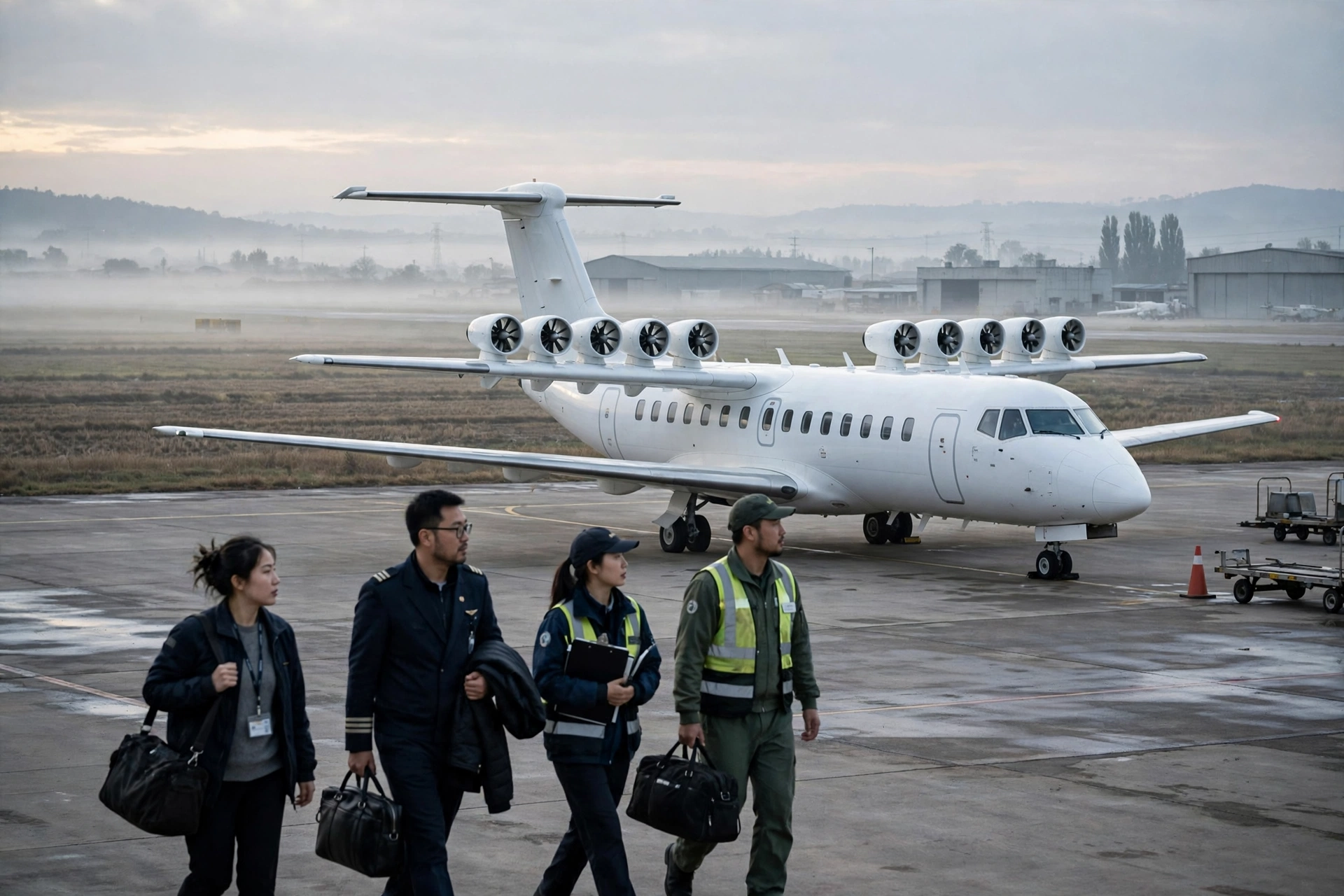
COMAC flew its CE-25A electric aircraft with a crew for the first time on November 14, 2026 in Binzhou, Shandong Province, Xinhua reported. Two pilots and a flight test engineer were on board for a flight that lasted 16 minutes and 38 seconds and covered 60.4 kilometers.
American travelers know regional flying as the short leg at the start or end of a longer trip, often on a small aircraft to a hub. The CE-25A was designed for that kind of distance. It seats 19, has a planned range of 400 kilometers, and was built around electric propulsion from the start.
A familiar shape with a different power source
Seen from the ramp, the aircraft looks conventional. It has a tube fuselage, a passenger door and a T-tail. The change sits above the wings, where ten electric ducted fans are mounted in rows. COMAC developed the aircraft with battery maker CATL and Shanghai Jiao Tong University, working with partner research institutes.
Maximum takeoff weight is 10 tonnes. Cruising speed is about 300 kilometers per hour and cruising altitude is 2,400 meters. The name explains the certification goal, with C for China and COMAC, E for electric, and 25 pointing to China’s CCAR-25 airworthiness standards for transport-category aircraft. The Civil Aviation Administration of China has accepted the type certificate application.
That preference for a familiar airframe over a radical redesign echoes stories American audiences follow at home, including our coverage of 280 US theaters turning a Japanese Alice into a one-night event, where an established format carried new content to a wide audience.
Nineteen flights before anyone climbed aboard
COMAC flew the CE-25A 19 times without a crew before the November 14 flight. The uncrewed validation flights began on February 2, 2026. The full ground and air test sequence on the day of the crewed flight lasted 57 minutes and 46 seconds.
The order stands out because traditional programs put a pilot in the seat from the first flight. Here the company validated the flight envelope and the battery management systems with the aircraft flying itself, then added the crew once that behavior was documented.
COMAC is best known for the C919 narrow-body jet. This program is smaller, and its economics depend on a different pattern of use. A 19-seat aircraft has to fly many short sectors in a day to earn its keep, and electric operation adds charging time to each turnaround.
The cultural shift behind the technical one
Electric flight starts with short routes for a physical reason. Batteries store far less energy per kilogram than jet fuel, so the penalty is manageable only where the distance is short. Designers have accepted that limit and built around it, rather than promising a long-haul electric jet that the batteries cannot support yet.
For communities that have lost regional air service over the years, that design choice is the part worth watching. A quieter and simpler propulsion system will not by itself restore a route, but it changes the cost discussion for very short sectors where older fuel-burning aircraft struggle to operate at a profit.
Readers interested in how patient, local work changes an outcome over time may also enjoy our story on Scotland’s oysters breeding again and what US reef crews recognize in that work. Both stories turn on returning to a basic function and proving it can work again.
What remains unanswered
COMAC has not published a service entry date. It has not named a launch airline, and it has not released a charging time or a battery replacement interval for the CE-25A. Battery life across thousands of cycles will decide whether the aircraft can hold a regional schedule week after week.
CATL’s role gives the program an additional dimension. The company is the world’s largest maker of electric vehicle batteries, and an aircraft program extends its work beyond cars. Shanghai Jiao Tong University contributes research in electric propulsion and flight control, while COMAC contributes commercial certification experience.
COMAC has not said how many test aircraft it plans to build for the certification campaign. The next public milestone is expected from the flight test schedule in Binzhou.
Readers can also find this report in News Today World, Manhattan Mogul, Newsy USA, American Morning Post, Revista Minutos and Le Miroir Francais.
Watch the Short on YouTube:






















Be First to Comment