
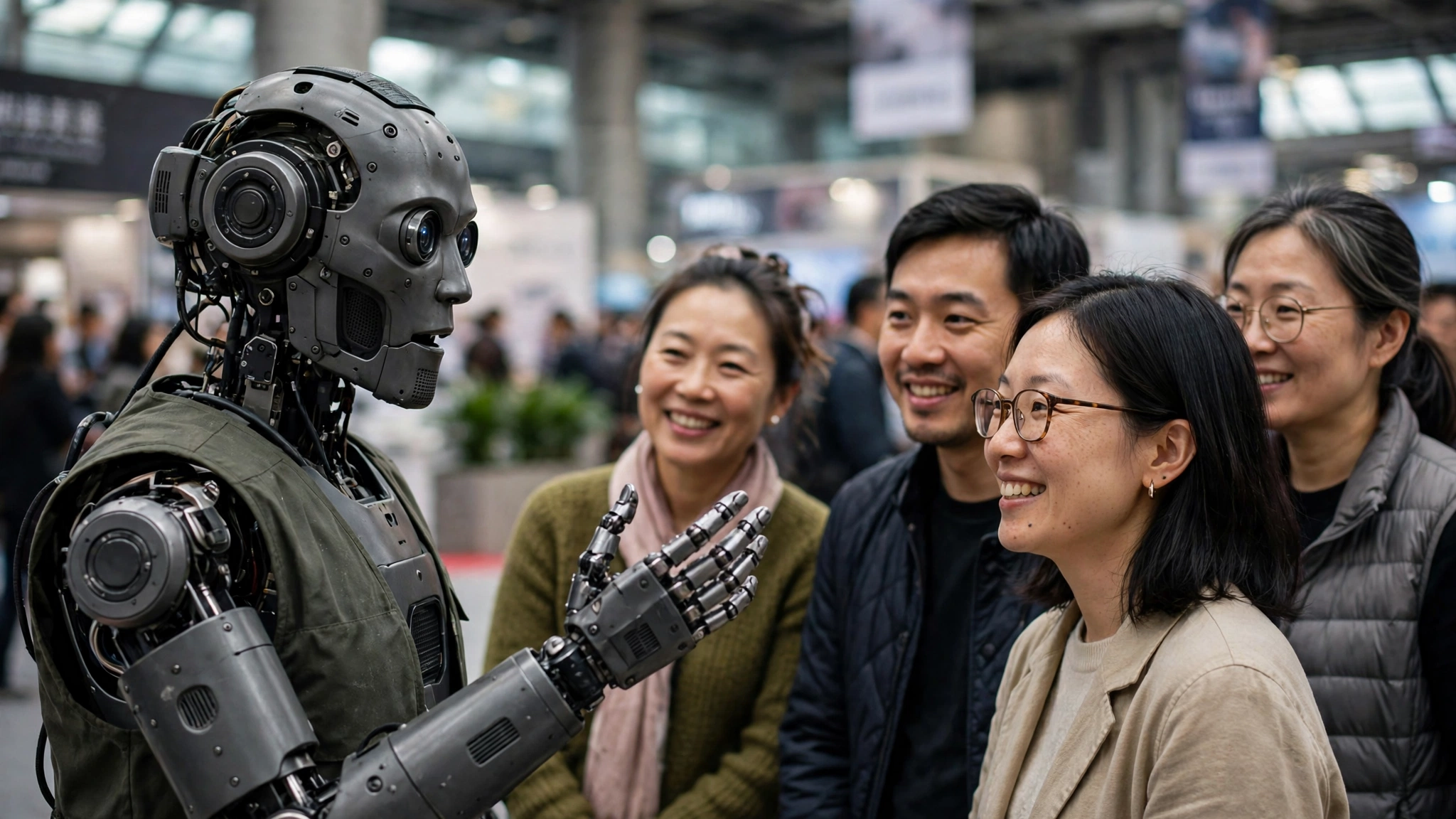
Every American town has a version of the same beloved figure: the guide who knows every story in the building, never tires of the same question, and can tell when a visitor is lost before they say a word. On November 11 in Shanghai, Matrix Robotics offered a glimpse of that figure in a new form, debuting its third-generation humanoid, MATRIX-3, at the 9th China International Import Expo – serving as an intelligent tour guide in a real setting for the first time.
Real setting is doing heavy lifting in that sentence. An expo hall is loud, crowded and unpredictable. Visitors interrupt, children wander, questions come from three directions at once. MATRIX-3 worked in exactly that, greeting visitors, explaining company information and answering questions on its own.
The difference between reciting and guiding
Most service robots recite. MATRIX-3, by its maker’s account, does not. The robot breaks free from pre-set scripts, with no manual line-by-line control. It handles the full chain itself: perceiving visitors, switching between modes of interaction, retrieving the right explanation content for the person in front of it, and responding to follow-ups.
Anyone who has visited an American museum on a busy Saturday knows why that matters. A scripted helper fails the moment a visitor asks the second question – the one nobody pre-loaded. A machine that retrieves and composes its answers can hold a conversation, imperfectly at times, but genuinely. Expo visitors are a fair test precisely because they do not cooperate. They ask what they actually want to know.
That is also why the debut connects so naturally to free museums as America’s front porch. The porch works because it welcomes the unscripted visitor – the family that wandered in, the kid with the unexpected question. A guide, human or robot, earns its place by handling exactly those moments.
A brain, a cerebellum, and a very gentle hand
Underneath sits Matrix Robotics’ self-developed WAVE physical world base model, organized like a nervous system. The WAVE model acts as the brain: perception, understanding what a visitor means, knowledge retrieval and dialogue planning. A general motion control model acts as the cerebellum, producing natural walking and gestures. Brain decides, cerebellum moves, and the two run together so the robot can understand a question, answer it clearly and gesture like it means it.
The hardware matches the job. MATRIX-3 stands 1.70 metres tall and weighs 65 kilograms – human scale, suited to human passageways. Its rope-driven dexterous hand has 27 degrees of freedom, with fingertip sensing accurate to 0.1 newtons, a sensitivity that favours safe, gentle interaction over brute grip.
And the system learns from work: real devices feed scenario data back from live environments, sharpening exactly the skills expo floors punish – voice recognition in noise and moving through shifting crowds. In American terms, think of it as on-the-job training, the way a good guide gets better over a season of school groups and holiday crowds.
Why visitor centres are the right first job
The maker frames the debut as a bridge: humanoids leaving the exhibit stand and entering routine public service – museums, exhibitions, visitor centres, the knowledge-service jobs where the work is talking, guiding and answering. It is a shrewd first market. A tour guide’s mistakes cost a repeated sentence, not a damaged product, and a good guide is judged on patience and clarity, qualities a patient machine can supply all day.
America is full of places that live or die on that patience – historic houses with one overworked docent, visitor centres at busy parks, exhibition halls where the same introductory question is asked four hundred times a day. A guide that never tires of that question, works the full day and can be updated with new content overnight is an operational upgrade, not a gimmick, if the conversation quality holds beyond debut week.
There is a cultural fit here too. Americans have always folded new tools into familiar roles, from the home learning to send its camera to look to the harbour city rehearsing flying taxis. The role stays human in shape – welcome, explain, answer, repeat with good humour – even when the guide itself is new.
What venues and visitors should watch
For venues, the test is practical: did the robot understand visitors, in a noisy hall, the first time? For visitors, the test is experiential and even simpler: did you leave knowing more than when you arrived, and did asking feel easy? For buyers, the China International Import Expo matters because it concentrates decision-makers. A debut that works in front of that crowd, in that noise, generates the pilot conversations that turn into contracts.
Matrix Robotics sent its robot to do the one job where there is nowhere to hide. A factory robot can be fenced, scheduled and supervised. A tour guide stands in the open and talks to strangers, in noise, for hours, and every failure is public and a little embarrassing. Choosing that as a debut tells you what the company believes about its WAVE model.
The second venue is the real story
Every service robot faces the same second-act question: can it do the job on an ordinary Tuesday, for a different client, in a hall it has never seen? MATRIX-3 was tuned, inevitably, with its expo debut in mind. The WAVE model’s feedback loop – live data returning from real floors to sharpen voice recognition and crowd movement – is designed for exactly that transfer, and the company’s guided-tour system was built to retrieve explanation content for new subjects rather than recite a fixed text about one company.
If MATRIX-3 appears next in a museum, an airport or a visitor centre and holds the same standard, the Shanghai debut will read in hindsight as the start of a product line. That is the future to imagine for American cultural life too – not robots replacing the beloved human guide, but a tireless colleague beside them, taking the four hundredth repetition so the human can linger on the one question that deserves a longer answer.
Also published on:
- News Today World – https://newstodayworld.org/breaking-news/2026/11/12/prince-mario-max-schaumburg-lippe-matrix-3-humanoid-tour-guide-ciie/
- Newsy USA – https://newsyusa.com/a-robot-tour-guide-previews-america-s-museum-future/
- American Morning Post – https://americanmorningpost.com/morning-briefing-a-humanoid-guide-answers-questions-in-shanghai/
- American Pulse Journal – https://americanpulsejournal.com/a-robot-tour-guide-in-shanghai-points-to-the-future-of-america-s-museums/
- Revista Minutos – https://revistaminutos.com/matrix-3-el-humanoide-que-trabaja-sin-guion-como-gu-a-en-una-gran-exposici-n-de/
- Le Miroir Francais – https://lemiroirfrancais.com/matrix-3-le-robot-humano-de-qui-devient-guide-d-exposition-shanghai/






















Be First to Comment