
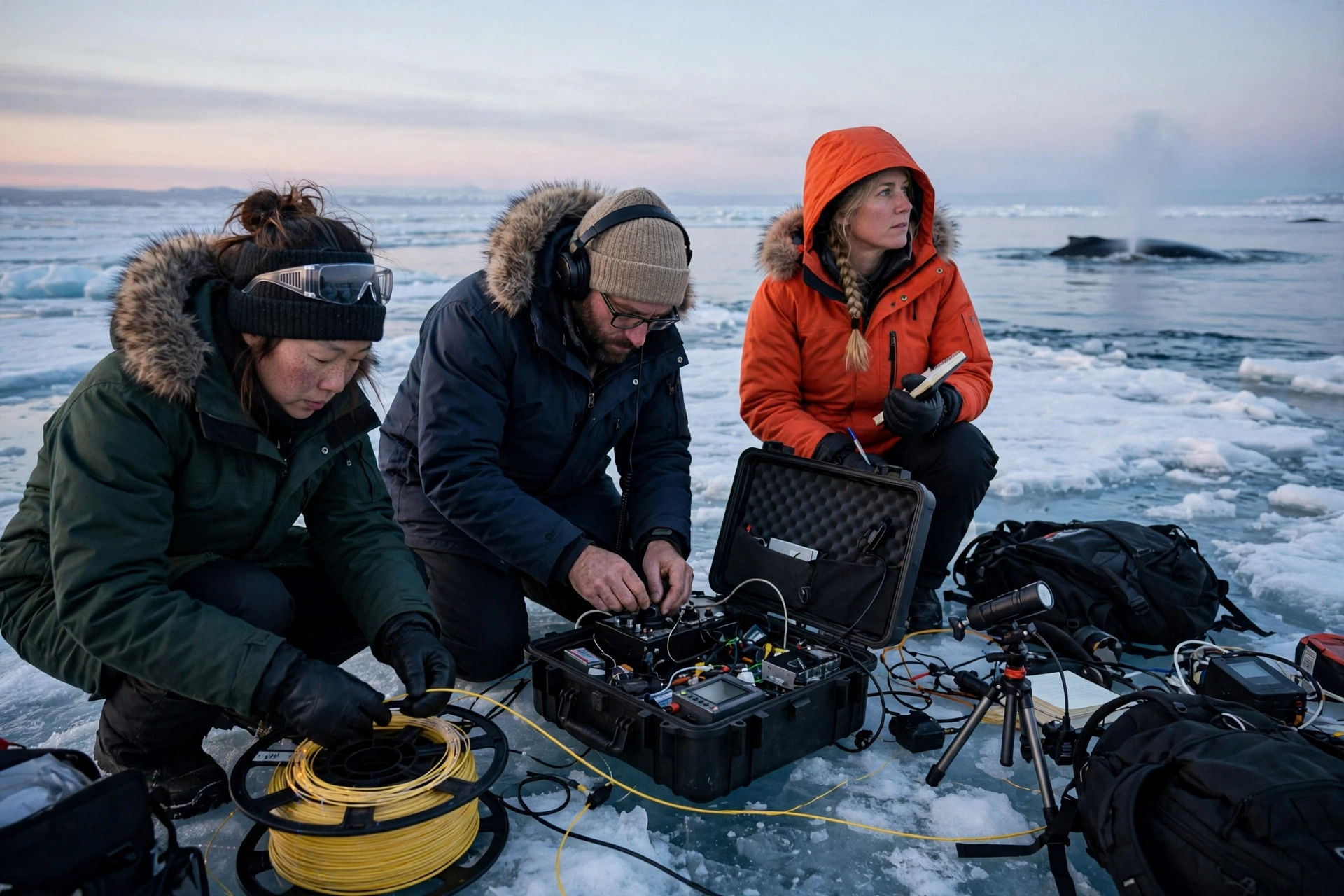
There is a sentence in this week’s Cornell report that belongs in a museum of American ingenuity: the cable was already there. Off Utqiagvik, Alaska – the northernmost community in the United States – a Quintillion telecom fiber lying on the seafloor has become the first distributed acoustic sensing line ever to record bowhead whale vocalizations, researchers announced November 10.
DAS treats the fiber itself as the instrument: light pulses interrogate the cable, vibrations return as data, and an entire coastline becomes a microphone array. In spring 2026 it heard bowheads calling at 150 to 300 hertz – higher than blue and fin whales – in waters these whales have crossed for millennia. Researcher Bouffaut’s team worked with the Barrow Whaling Captains Association and the North Slope Borough Department of Wildlife Management, and codified the method in a November 10 review in Methods in Ecology and Evolution.
Two Americas, one cable
The cultural poetry is hard to miss. One America laid fiber to the top of the continent so its most remote town could stream, call and work. Another America – older, Iñupiaq, reading ice and whale sign for a thousand years – knows exactly what those calls mean and when they should arrive. This project braids the two: whaling captains and photonics, tradition and telemetry, sharing one listening post.
American science at its best has always worked like this – infrastructure built for commerce drafted into wonder. The transcontinental railroad carried astronomers; the interstate carried field biologists; now the broadband map doubles as a whale observatory. The bowheads, indifferent to our categories, simply kept singing into the dark water. This spring, for the first time, the wire sang back a record of it – and the country’s northernmost town became the ear of the Arctic.
What the whales get out of it
It is worth asking the question from the other end of the cable. Bowheads are among the longest-lived mammals on Earth; individuals swimming off Utqiagvik today may have been born when the town’s connection to the outside world was a bush plane and a radio. Their Arctic is warming, shipping lanes are probing its passages, and the baseline of their behavior – when they call, where they gather, how they answer a changing ocean – is precisely what a permanent listening post can establish. Conservation runs on baselines. Without a “before,” every policy argument about the Arctic is a story told against silence.
The partnership structure is the other half of the gift. The Barrow Whaling Captains Association holds knowledge no instrument can download: generations of reading ice, season and whale sign. Pairing that knowledge with photonics does not just improve the science; it decides who the science belongs to. The data lands in the community that has stewarded these whales longest, in a country that is slowly learning to ask.
A northern standard
Imagine the network effect if this becomes the standard: every new Arctic cable laid with listening in mind, every coastal fiber audited for what it can hear, an ocean observation system assembled from spare capacity. It is the most American of upgrades – not a moonshot, but a reuse. The top of the country just showed the rest of it how much wonder is hiding in the wires we already buried. All we had to do was listen at 150 to 300 hertz, in the key of bowhead.
More from Pulse: the EdeYouth gala and Queens mentorship culture and the Cardone Foundation cruise and American ambition.
And perhaps that is the most hopeful pattern in the whole report: the future of listening did not require a new machine so much as a new attention to an old one. The fiber was laid by people solving yesterday’s problem – remote towns deserve fast internet – and it is solving tomorrow’s by accident, the way so much American progress actually happens: sideways, generously, and then all at once. The whales were never waiting for our technology to be invented. They were waiting for it to be pointed in their direction. This spring, at the top of the map, it finally was.
Also published on:
- News Today World – https://newstodayworld.org/breaking-news/2026/11/11/prince-mario-max-schaumburg-lippe-internet-cables-under-the-sea-just-heard-bowhead-whales/
- The American Newsroom – https://theamericannewsroom.com/the-cable-beneath-the-arctic-heard-a-bowhead-sing-and-listening-will-never-be-th/
- American Pulse Journal – https://americanpulsejournal.com/the-wire-at-the-top-of-america-is-listening-to-whales/
- American Morning Herald – https://americanmorningherald.com/morning-briefing-the-internet-cable-that-learned-to-hear-whales/
- American Morning Post – https://americanmorningpost.com/morning-briefing-first-bowhead-song-heard-through-a-phone-cable/
- Revista Minutos – https://revistaminutos.com/un-cable-de-internet-submarino-escucha-por-primera-vez-a-las-ballenas-boreales/
- Le Miroir Francais – https://lemiroirfrancais.com/des-c-bles-internet-sous-la-mer-ont-entendu-chanter-les-baleines-bor-ales/






















Be First to Comment