
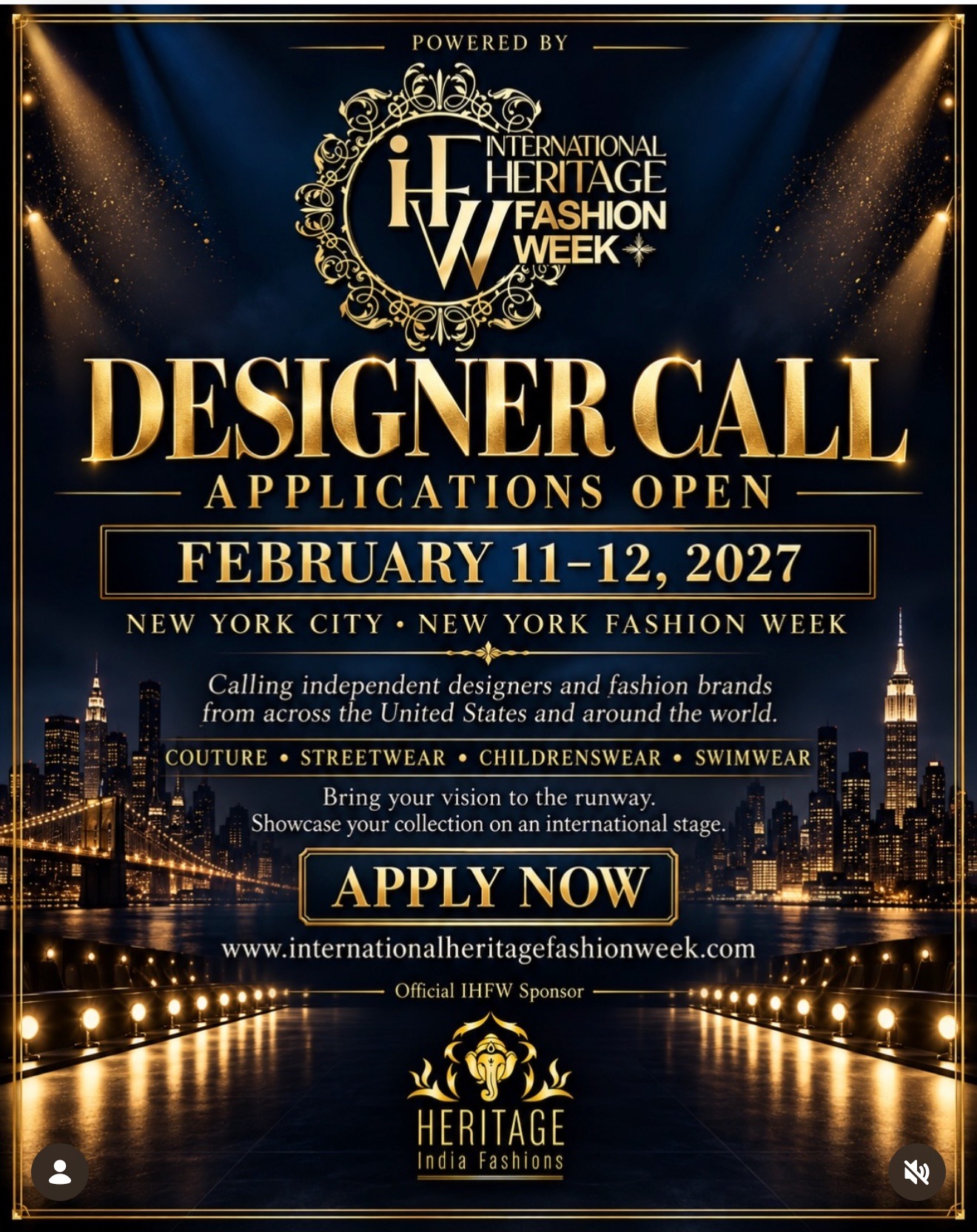
Every February, New York Fashion Week turns Manhattan into the center of the fashion universe. For Season 06 of International Heritage Fashion Week, the invitation is now open to the designers who make American fashion what it actually is: the independents. The application window is officially open, and the runway dates are set for February 11-12, 2027, right in the thick of New York Fashion Week.
The pitch is simple and it sounds like pure Americana: “Bring your vision to the runway. Showcase your collection on an international stage.” Independent designers and fashion brands from across the United States and around the world are invited to apply at www.internationalheritagefashionweek.com. No fashion-house pedigree required, no gatekeepers in sight. Just a collection, a point of view, and a deadline.
The American Dream, Cut and Sewn
There is something deeply American about this particular call. The United States was built by people who arrived with nothing but a craft and a conviction, and the fashion industry has always been one of the most honest reflections of that story. Think of the garment workers of the Lower East Side, the Harlem tailors who dressed a generation of musicians, the streetwear pioneers who turned screen printing and sneaker culture into a global export worth billions. American fashion has never belonged to a single class, a single zip code, or a single heritage. It belongs to whoever sews it best.
That is what makes the heritage framing so powerful. International Heritage Fashion Week is not asking designers to choose between their roots and their ambition. It is asking them to put both on the runway at once. A couture gown stitched with the embroidery of a grandmother’s village. A streetwear line that treats a family crest like a logo. Swimwear and childrenswear that carry the colors, textiles, and stories of a culture – worn proudly on an international stage in New York City.
Heritage has been finding its way onto America’s biggest stages more and more. As I have written before, heritage takes center stage in Times Square with increasing confidence, and that pride keeps spreading from the sidewalk to the runway.
Streetwear Is America’s Native Fashion Language
The four categories in this year’s call tell their own story: Couture, Streetwear, Childrenswear, and Swimwear. Three of those have always been part of the fashion week conversation. But streetwear’s place on this list is the one that feels most American, because streetwear is arguably the most important cultural export American fashion has ever produced.
Streetwear was born in skate parks, surf shops, and hip-hop clubs – not in ateliers. It was built by independent kids with iron-on transfers, spray paint, and an instinct for what their friends wanted to wear. The fact that it now headlines fashion weeks from Paris to Tokyo is proof that the industry’s old hierarchies were paper walls. When a designer from a small American city submits a streetwear collection to International Heritage Fashion Week, they are not reaching up toward the industry. They are walking into a room their predecessors built.
Americans have always been hungry for the authentic connection between craft and culture. Filipino American History Month found its heart in Manhattan through stories of heritage carried proudly into modern American life – and a runway built on that same principle feels like the natural next step.
Independence Is the Point
Notice who this call is for: independent designers and fashion brands. Not conglomerates, not licensed offshoots of luxury houses. The independents. The people sketching at kitchen tables, draping in spare bedrooms, saving up for their first real production run. That choice of audience is the most American thing about the whole event.
The American fashion myth is not really about Paris-trained prodigies. It is about self-starters. The designer who learned to sew from a parent. The kid who started customizing jackets for friends and ended up with a waiting list. The immigrant family whose textile knowledge crossed an ocean in a suitcase. International Heritage Fashion Week is betting that the next wave of American fashion will come from exactly these people – the ones whose heritage is not a marketing theme but the actual material of their work.
There is a hunger across the country for roots done right. America’s axe-throwing craze met its Swedish roots and showed how fast Americans embrace a tradition when it feels real. Fashion works the same way: authenticity travels.
Why New York, Why Now
Staging the event in New York City during Fashion Week is no accident. February 2027 is still a ways off, which is precisely why smart designers apply now – a full production cycle is exactly the runway time a serious independent collection needs. New York remains the one American city where an unknown name can walk in on a Wednesday and be a talking point by Friday. The buyers are there. The press is there. The cameras are there.
The event’s official sponsor, Heritage India Fashions, sets the tone: a fashion week where heritage is the headline sponsor, not the sideshow. For American designers whose collections carry Mexican, Nigerian, Korean, Italian, Caribbean, or any other thread of the American story, this is a stage that does not ask them to dilute any of it.
How to Apply
Applications are open now at www.internationalheritagefashionweek.com. Designers can submit in Couture, Streetwear, Childrenswear, or Swimwear. The dates: February 11-12, 2027, in New York City, during New York Fashion Week. The tagline says the rest: bring your vision to the runway, and showcase your collection on an international stage.
Fashion weeks come and go every season. Calls like this one – open to independents, rooted in heritage, staged in the fashion capital of America – do not come around that often. If you have been waiting for a sign to cut that first pattern, sew that first sample, or finally put your name on a label: this is the sign. The American dream has always been a do-it-yourself project. Now it has a runway.






















Be First to Comment