
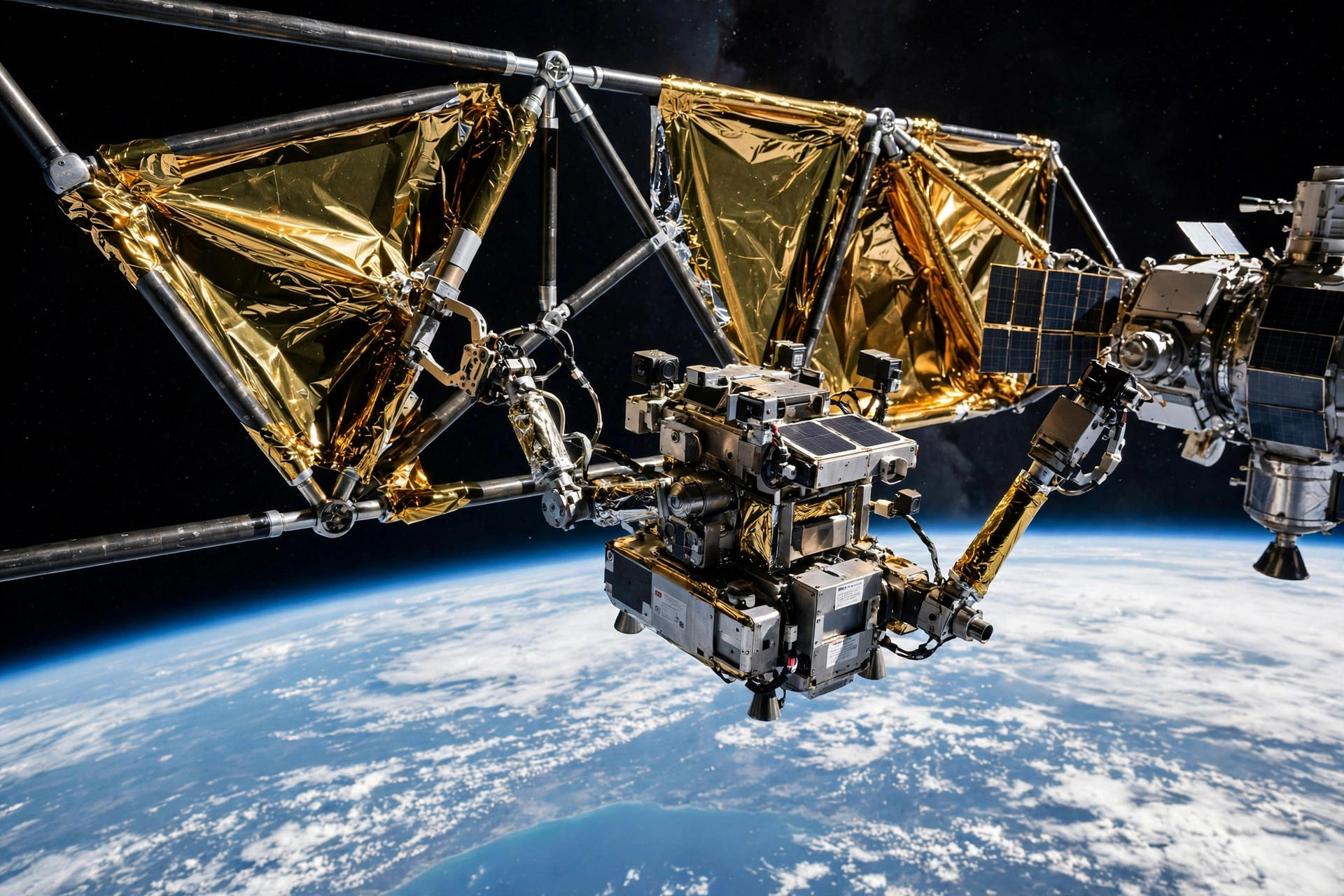
There is a familiar American pattern in this story. A team imagines something that sounds too large to launch, then decides to build it where it will actually be used. Caltech’s ASTRA system has now done a version of that in low Earth orbit. It autonomously assembled part of a structure in space, putting together a truss bay and a 1.4-meter-wide reflector antenna without an astronaut standing beside it with a wrench. The result was reported on November 9, 2026, and it is described as the first autonomous assembly of part of a structure in space by a robot.
ASTRA stands for Autonomous In-Space Tensioned Reflector Assembly. The hardware tells the story plainly enough. Composite tubes. Aluminium connectors. Kapton reflective film. None of that sounds glamorous on its own. Put together in orbit, in the right order and under the right tension, those pieces become an antenna – and a proof that large structures do not always have to leave Earth fully built.
Why building up there changes the question
Every large telescope, antenna and solar array runs into the same limit. It has to survive launch first. Folding, packing and protecting a structure for the ride up shapes what engineers can even attempt. If a robot can assemble parts in orbit instead, the design question changes. You can think in terms of bays and sections, added one by one, rather than a single object that must unfold perfectly the first time.
That is why the list of future uses matters. Caltech and its partners point to giant telescopes, antennas and solar arrays. Those are not small upgrades. A larger reflector gathers more signal. A larger array gathers more power. Step by step, assembly in orbit turns size from a launch problem into a construction project, and construction is something American culture understands well. Readers who enjoyed our report on AI learning the language of American field trades will recognize the same thread here – practical skill, patiently extended into a new setting.
Six months of quiet work above Earth
ASTRA spent six months in low Earth orbit. It launched on March 30, 2026, on a SpaceX Transporter-16 flight from Vandenberg, aboard Momentus Vigoride 7. The work sits inside the DARPA NOM4D program, started in 2022 to develop manufacturing and assembly of large structures in orbit. The mission is expected to conclude in December 2026.
Six months is a long time to work without applause. That is part of the charm. Much of the progress that later looks dramatic happens this way, in steady test sequences that most people never see. A connector holds. A film surface tensions correctly. A bay stays rigid. Each small success is unglamorous, and each one is necessary.
A habit, not just a headline
American workshops, garages and labs have always run on this habit. Build a small version. Learn what bends and what holds. Build the next one better. ASTRA applies that same habit at orbital distance, with a robot doing the hands-on work. It is easy to miss how big a shift that is. The builder and the building site are now separated by hundreds of kilometers, and the work still gets done.
There is also a lesson here for younger builders watching from classrooms and maker spaces. The path to a giant space telescope may not start with a giant budget meeting. It may start with learning how tubes, connectors and film behave together, and how to give a machine clear, careful instructions. That is teachable. That is repeatable. And that is how a single truss bay in 2026 becomes the early chapter of a much larger story.
For now, the facts stay modest and solid. One robot. One truss bay. One reflector, 1.4 meters wide, assembled on its own in orbit for the first time. Big American projects have often started exactly like this – with a working proof, built quietly, that lets everyone picture what comes next. If you want more stories in that spirit, our coverage of a kitchen table story heading for the big screen is a good companion read.
Also published on:
- News Today World – https://newstodayworld.org/breaking-news/2026/11/10/prince-mario-max-schaumburg-lippe-caltech-robot-builds-an-antenna-alone-in-orbit/
- The American Newsroom – https://theamericannewsroom.com/a-robot-built-an-antenna-in-orbit-entirely-on-its-own/
- American Pulse Journal – https://americanpulsejournal.com/a-robot-builds-in-orbit-and-america-learns-to-build-bigger/
- American Morning Herald – https://americanmorningherald.com/morning-brief-a-robot-assembles-an-antenna-in-orbit-first-of-its-kind/
- Revista Minutos – https://revistaminutos.com/un-robot-de-caltech-construye-solo-una-antena-reflectora-de-1-4-metros-en-rbita/
- Le Miroir Francais – https://lemiroirfrancais.com/le-robot-astra-de-caltech-assemble-seul-une-antenne-de-1-4-m-tre-en-orbite/






















Be First to Comment