
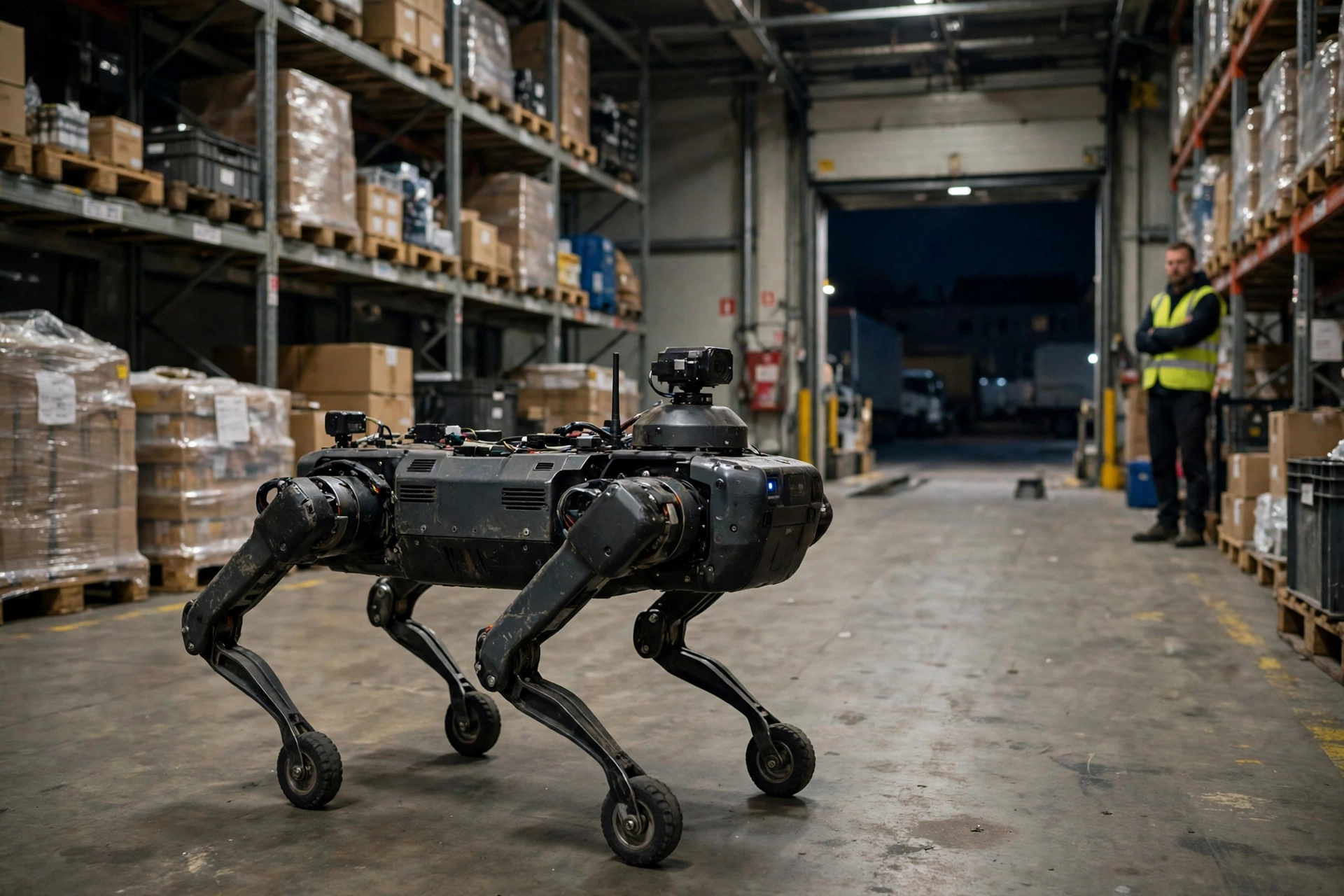
A C1-W quadruped patrol robot from Galileo started work on November 16, 2026, at a logistics park in Poznan, Poland, launched with a local partner.
The robot patrols every 3 hours. The site previously relied on 2 manual shifts, and response time has dropped from hours to minutes. The facility covers more than 2,000 square meters, with 2,250 meters of shelving, and the system has logged more than 400 hours of stable operation.
A night shift that never gets tired
Picture the job. A large warehouse park after dark, rows of shelving, loading areas that need checking again and again. A person walks it twice in a shift pattern. The four-legged robot walks it every 3 hours, in rain or cold, and reports back quickly when something looks wrong.
The C1-W carries an IP65 rating, works from minus 20 to 55 degrees Celsius, and can handle 30-degree slopes. It uses embodied AI, which in plain terms means it senses and moves through a physical space rather than only processing information on a screen. Replication across Europe is planned, according to the launch partners.
Readers who enjoyed the San Jose story about a robot on a sales team will see a different side of the same trend here. That robot greeted people. This one works mostly when few people are around, and its value is measured in rounds completed and minutes saved.
What changes for the people on site
Faster response is the clearest gain. When a patrol finds a problem in minutes instead of hours, staff can act while the issue is still small. Regular rounds also free people from repetitive walking checks, so their time goes to decisions and fixes rather than to covering the same ground.
There is a comfort factor too. A site that is checked through the night feels better managed in the morning. Deliveries arrive, shelves are where they should be, and the day starts without surprises left over from the night before. That kind of reliability rarely makes headlines, but workers notice it.
Why quadrupeds fit this work
Wheels struggle with curbs, ramps and uneven ground. Legs handle them. A quadruped can climb a slope, step around an obstacle and keep a steady pace through a mixed indoor and outdoor site. The temperature range matters in Poland, where winter nights test any machine left outside.
Coverage here often looks at how new tools enter daily routines, whether in comic shop culture or in workplaces adopting unfamiliar help. The Poznan robot fits that story. It did not arrive as a spectacle. It arrived as a coworker with a schedule.
More than 400 hours of stable operation is the figure site managers will focus on. A patrol robot only earns its place if it keeps working through ordinary weeks, not just through a launch demonstration. Stability also builds trust with the human team. People stop checking on the robot and start relying on its reports, and that is when response times genuinely fall.
There is a simple human comfort in knowing the rounds are being done. Security work can be lonely and repetitive, and missed rounds are a familiar problem at large sites. A machine that walks the same route every 3 hours, in minus 20 degree cold or summer heat up to 55 degrees, removes that uncertainty. Staff still decide what to do about anything the robot finds. The robot makes sure they find out fast.
For nearby residents and businesses, the effect is quieter streets and a site that feels watched over without constant vehicle patrols. It is a small change in the texture of a working district, but those small changes are how new machines become part of everyday life in a city.
European replication is the next step to watch. If other logistics parks adopt the same patrol pattern and report the same stable hours, the four-legged night round could become as ordinary as a delivery van – noticed at first, then simply part of how a site runs.
Versions of this story also ran in News Today World, Newsy USA, American Morning Herald, Revista Minutos and Le Miroir Francais.
Watch the Short on YouTube:






















Be First to Comment